Small Bedroom Desk Ideas: Corner Desk Sizes & Layout
Small bedroom desk ideas that fit: a corner desk needs 36 in (91 cm) of clear wall per leg and 30 in (76 cm) of chair pushback. Sizes and layouts.
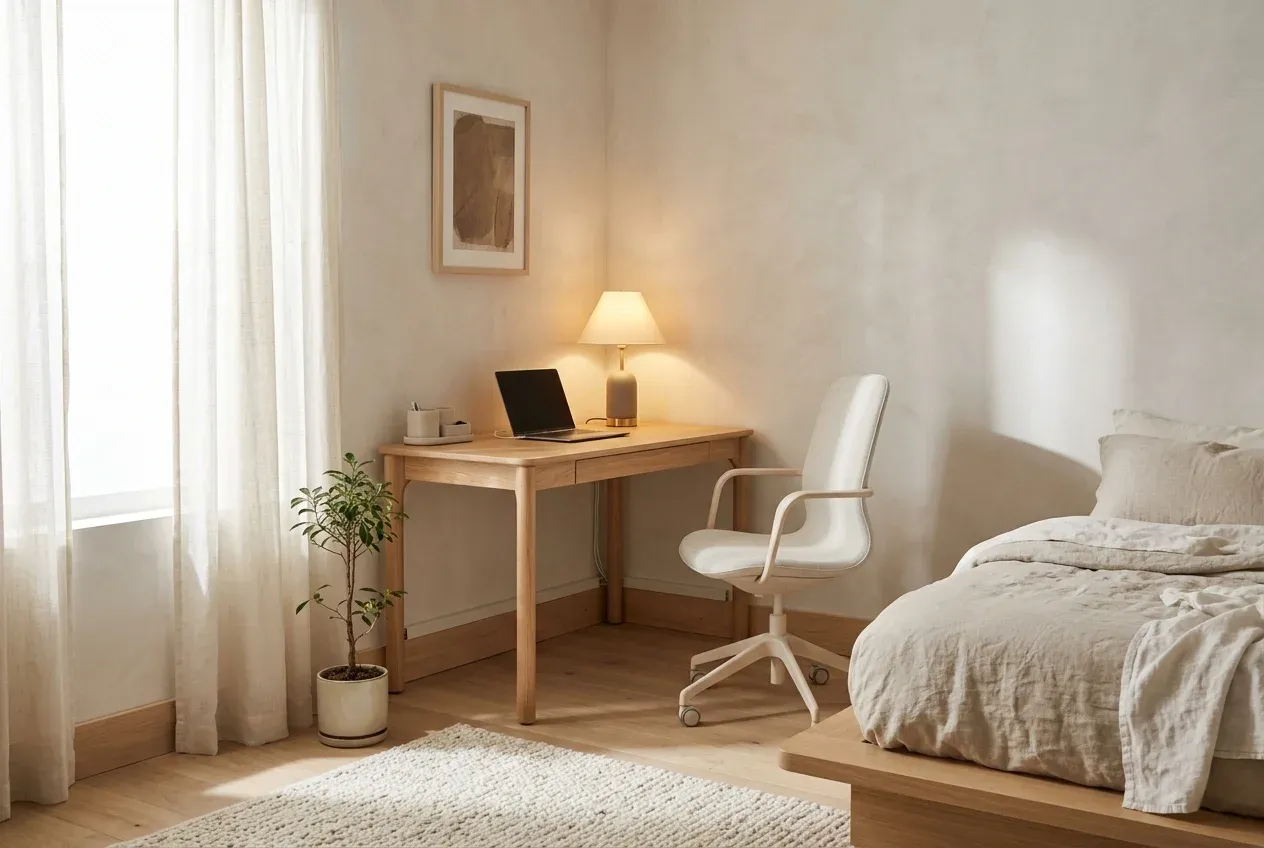
Room specifications
- Room ScaleSmall bedroom (about 10 x 10 ft)
- Design StyleWarm Minimalist / Japandi
- Budget TierBudget ($)
- Palette Swatches4 colors
The best small bedroom desk ideas start with the corner: a corner desk fits when the corner is genuinely unused: at least 36 in (91 cm) of clear wall on each leg, a desktop about 24 in (61 cm) deep at the apex, and 30 in (76 cm) of chair pushback before you hit the bed. If a closet door, radiator or bed frame already claims the corner, a straight desk on the longer wall is the better choice.
The rest of this guide shows how to test that in your room, which desk format to pick, and how to keep the setup from looking like an office next to your pillow.
Is your corner really free?
A corner desk works because it uses floor you were not using. Check three things before you shop:
- Measure both wall runs from the apex. A triangular unit needs about 36 in (91.4 cm) on each leg; an L-shaped desk needs closer to 40 in (102 cm) because the return run sits further from the apex.
- Open the closet door, the room door and the window to see whether anything swings into the corner.
- Look at where the bed frame sits. If the chair path crosses the mattress edge, the corner is already spoken for.
In a 10 x 10 ft (3.05 x 3.05 m) room with a queen bed, this usually means shifting the bed toward one wall and putting the desk in the opposite corner, with 30 in of chair clearance.
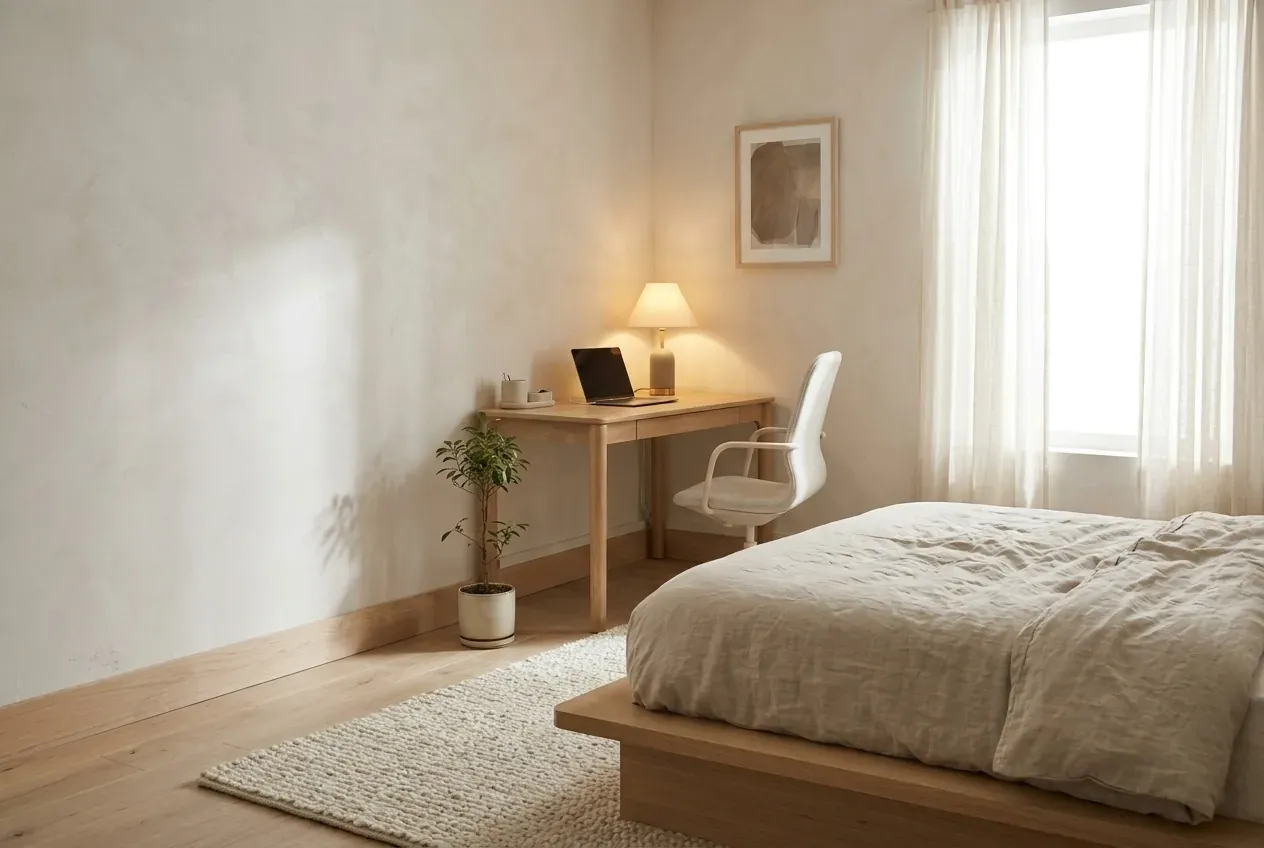 The same room seen from the opposite end, so you can judge the layout from the far side.
Clearances to hold
| Zone | Minimum | Aim for | Why |
|---|---|---|---|
| Chair pushback | 24 in (61 cm) | 30 in (76 cm) | You can stand up without hitting the bed or wall |
| Desk depth | 18 in (46 cm) | 20 to 24 in (51 to 61 cm) | Fits laptop, keyboard and mouse |
| Desktop width | 32 in (81 cm) | 36 to 42 in (91 to 107 cm) | Room for one 24 in monitor and a notebook |
| Monitor distance | 20 in (51 cm) | 24 in (61 cm) | Less eye and neck strain |
| Walkway beside the desk | 26 in (66 cm) | 30 in (76 cm) | Keeps the path to the door open |
| Knee height under the desk | 24 in (61 cm) | 27 to 29 in (69 to 74 cm) | Space for thighs, less slouching |
These are typical compact-workspace figures. Check the spec sheet for the outer diagonal width of any corner unit before ordering.
Watch the apex depth
A corner desk’s usable depth runs from the front edge to the rear apex, not to the wall. A triangular unit with a 36 in wall span can still have only 18 in (46 cm) of usable depth at the apex, which is too shallow for a monitor plus keyboard. You need about 24 in of front-to-rear depth to hold a 24 in monitor at a comfortable distance.
Choosing the desk format
Four formats cover most small bedrooms, and each suits a different corner.
| Format | Footprint | Best corner | Notes |
|---|---|---|---|
| Triangular corner unit | 36 x 36 in (91 x 91 cm) | Square room with an open 90 degree apex | Uses the dead corner; centre floor stays clear |
| L-shaped compact desk | 40 x 40 in (102 x 102 cm) | Alcove or nook | More surface, but both wall runs must be clear |
| Floating wall ledge | 20 x 36 in (51 x 91 cm) | Any wall | No legs; needs stud or heavy-duty anchoring |
| Folding wall desk | About 4 in (10 cm) deep closed | Narrow gap beside the bed | Disappears when not in use |
Floating desk: renters, read this first
A floating wall-mount desk lets the floor read as continuous and a chair tuck right under. But a 20 x 36 in oak top with a monitor and laptop can be heavy, and the load has to go into wall studs or a proper blocking plate. Drywall anchors alone can pull out. If your lease forbids drilling, choose a freestanding corner unit instead. Mount the top at about 28 to 30 in (71 to 76 cm) so the chair fits under and your elbows sit level with the keyboard.
Corner desk or straight desk?
| Situation | Choose |
|---|---|
| Dead 90 degree corner, two clear wall runs | Corner desk |
| Corner claimed by a closet or radiator | Straight desk on the longer wall |
| Under 36 in of wall on either leg | Folding or floating desk |
| You need storage as well as a surface | Straight desk plus a wall shelf above |
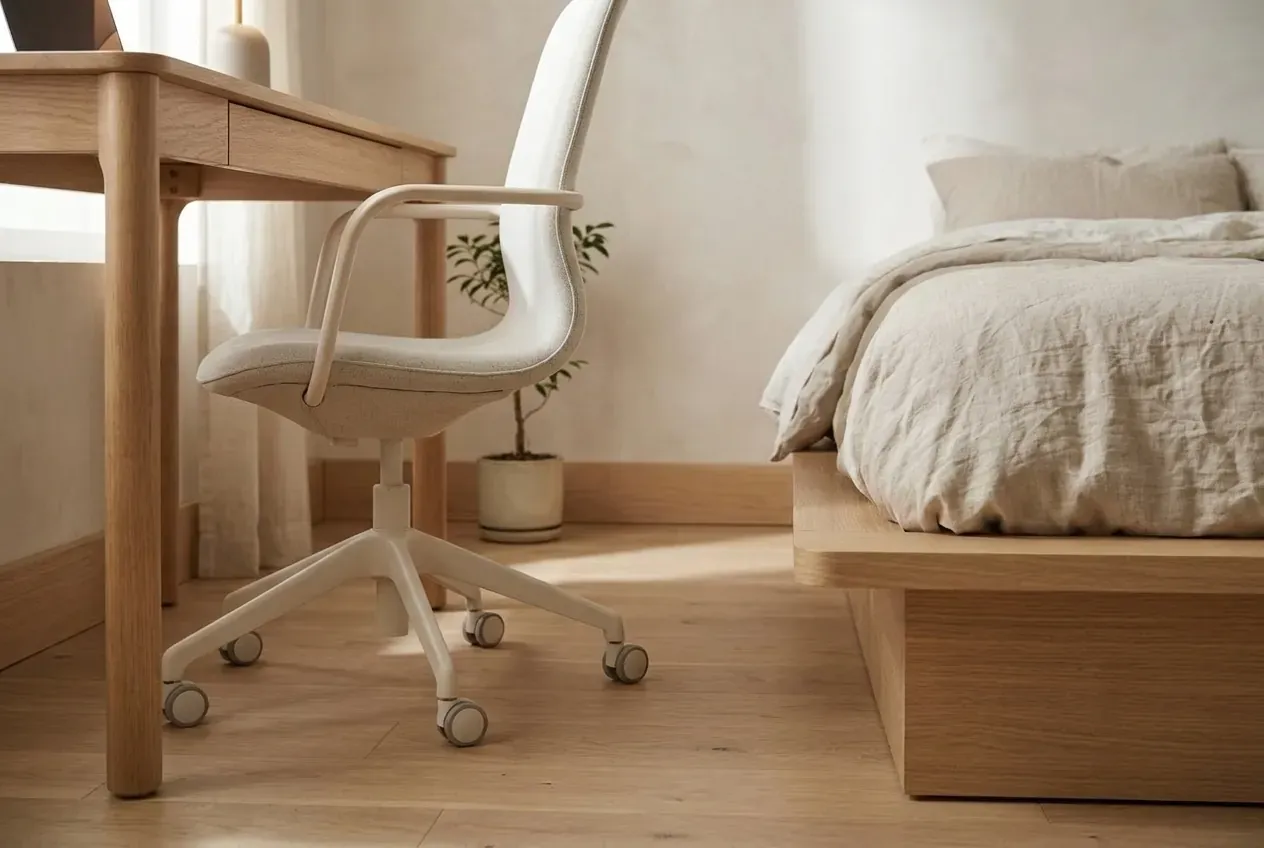 Close up: Maintain at least 30 in (76.2 cm) of chair pushback space between desk and bed.
Layouts that work in a small bedroom
Triangular unit in an open corner. Best for square rooms. The bulk sits in the apex and the centre floor stays open. Use an armless dining chair that slides fully into the knee well.
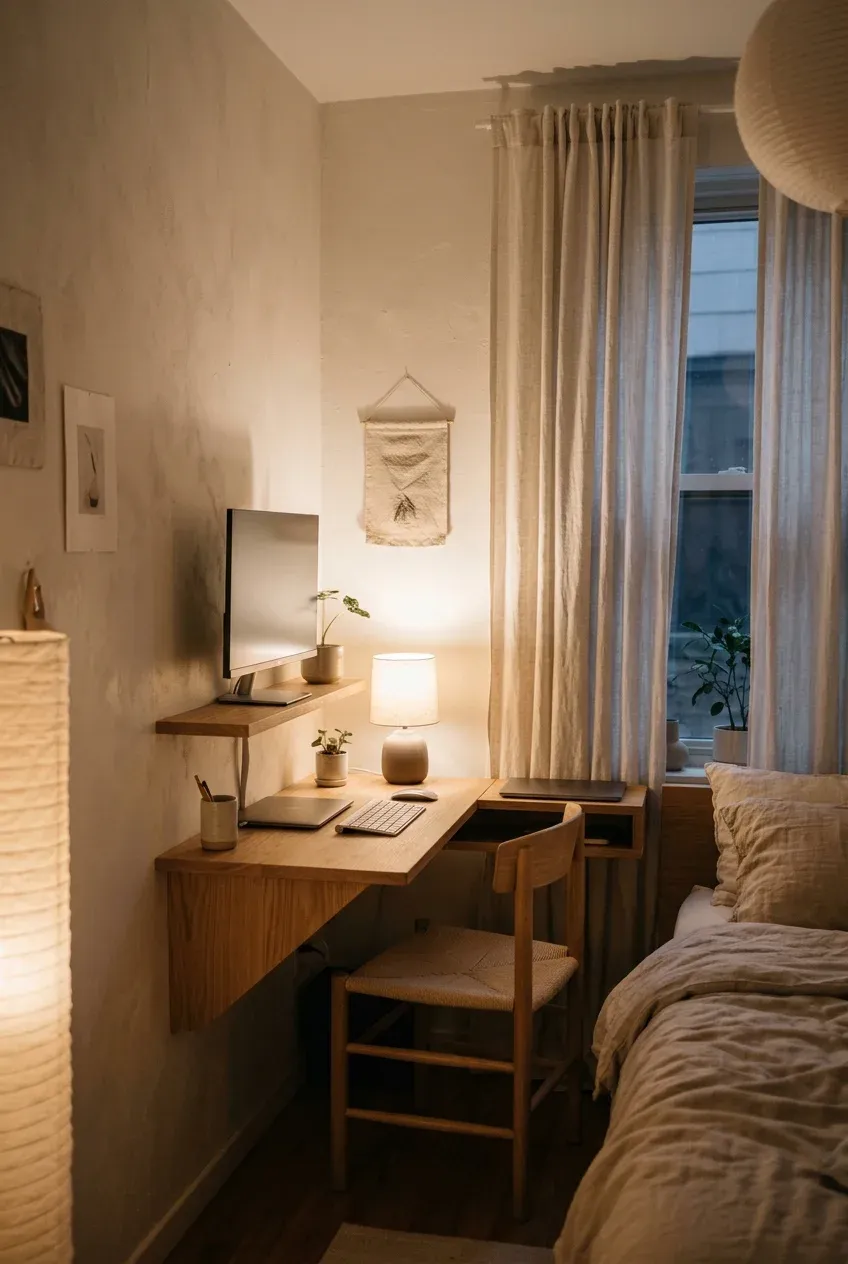
Floating corner ledge. Best when floor space matters most. A thick oak or similar shelf on heavy brackets keeps the floorboards visible all the way to the wall. See corner shelf height and spacing for mounting basics.
Beside the window. If the window throws glare onto the screen, turn a slim 32 x 18 in (81 x 46 cm) desk perpendicular to it. In a 10 x 10 ft (3.05 x 3.05 m) bedroom with one window that gives daylight without glare.
Desk as nightstand. Best for long, narrow rooms. Place a linear desk of about 20 x 38 in (51 x 97 cm) beside the bed so it holds a laptop by day and a lamp and water glass by night. More ideas in narrow nightstand ideas.
Studio divider corner. In an open studio, back the corner desk against a tall open bookcase so the screen is shielded from the front door and the bed zone. It then reads as a separate room without any wall.
Chair, cables and ergonomics
A swivel chair needs about 32 in (81 cm) measured diagonally from the front edge of the desk. An armless stool or dining chair that tucks under cuts that to roughly 24 in. A low-profile task chair without bulky wheels also works. Bulky gaming and executive chairs are the usual reason a desk ends up blocking the wardrobe door. Set the monitor so its top edge is near eye level.
Two monitors fit a 36 in corner desk on a single clamp-on monitor arm anchored at the rear corner, which frees desktop depth under the screens.
For cables:
- Run power through an in-desk grommet and mount a surge strip under the desktop so no cord crosses the surface.
- Put the router and power bricks in an adhesive tray or wire basket beneath the desk.
- Route cords along the baseboard with clear silicone clips so nothing stretches across the walkway.
- Stick felt pads under the desk legs to protect rental floors from chair shifts.
- Skip cheap rigid plastic chair mats, which can trap moisture and mark rental hardwood. A thin flat-woven runner with a rubber backing, or soft casters, is gentler.
- Put the lamp to one side of the screen, not behind it, and keep the bed out of the screen glare at night.
The acute void behind a corner desk is a good home for a wire basket of power strips and docks. A slim 12 in rolling drawer unit beside the desk holds paperwork without crowding knee space.
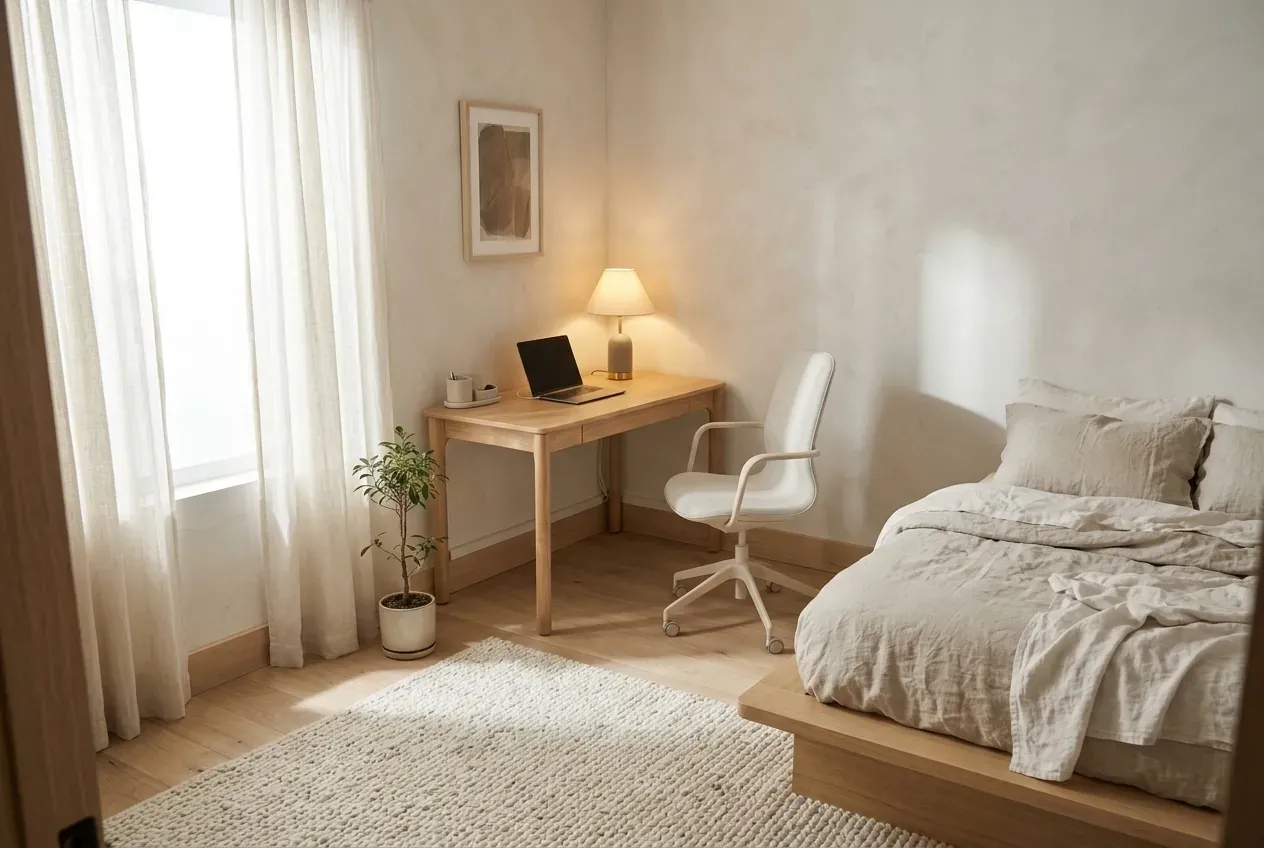 From above and to one side, the full footprint and the walkway read at a glance.
Make the desk read as bedroom furniture
In a bedroom, what you notice is usually the chair, the cables and the screen, not the desk itself.
- Pick a writing desk with tapered legs and shallow drawer fronts rather than a boxy office desk.
- Use an upholstered dining armchair with decent lumbar support in place of a commercial swivel chair.
- Match the desk wood to the nightstands so the corner looks like part of one set.
- Choose a warm lamp, around 2700K, so the corner shares the bed’s light. A desk lamp setup is also described in the living-room desk layout guide.
Pale walls, light wood and one dark accent keep a corner desk calm; the precise colors matter much less than keeping the surface clear. For drawer organization, see the desk drawer guide.
Close it up at night
If seeing the monitor from bed still bothers you, three small habits help more than a bigger desk:
- Choose a compact secretary desk with a fold-down front, or a drop-leaf top that shuts in seconds.
- On a flat desk, slide the laptop into a vertical sleeve, put the power brick in a drawer and leave only a lamp and one pen cup on top.
- Hang a light curtain or fold out a screen beside the desk. Run a slim adhesive cable raceway down one rear leg so no cord trails across the floor.
If the corner is not free: a straight desk under the window
When a closet door or radiator claims the corner, a straight desk on the free wall usually works better than forcing a corner unit. A 30 to 36 in (76 to 91 cm) wide, 18 to 20 in (46 to 51 cm) deep desk under a window gives even daylight from the front and lets the chair roll back into the open centre of the room. A desk top at 29 to 30 in (74 to 76 cm) sits just below a standard sill, so the glass stays clear. Keep 24 in (61 cm) of pull-back space before the bed frame; these are design guidelines for comfort, not building-code requirements.
Common mistakes
- Buying a desk by width alone and forgetting the 30 in (76 cm) of chair pushback.
- Choosing a desk with a drawer unit or footrest that cuts knee space below 24 in (61 cm).
- Standing a monitor on a shallow desk instead of clamping an arm to the back edge.
- Leaving cords across the floor where they trip you on the way to bed.
- Putting a rigid plastic chair mat on rental hardwood.
Tape it before you buy
- Measure both wall runs from the apex: at least 36 in each.
- Tape the desk outline on the floor, either a triangle or a 20 x 36 in rectangle.
- Tape a 30 in arc out from the desk front and check the chair clears the bed.
- Check the apex depth is about 24 in for a monitor.
- Find the nearest outlet and plan the cord path along the baseboard.
- Confirm the lease allows anchoring if you want a floating desk.
Curated Color Palette & Key Textures
- Alabaster Chalk #F5F2EB
- Oat Linen #D9CDB8
- Light Oak #C9A97C
- Charcoal Ink #2F3135
General references
Dimensions in these guides are typical planning ranges, not legal minimums, and they can differ by jurisdiction. Use the references below as starting points, then confirm local code and your lease before making changes.
FAQ
How small can a corner desk be and still fit a monitor?
A compact triangular corner desk needs a minimum depth of 24 inches (61.0 cm) from the front edge to the rear corner to maintain a safe 20-inch monitor viewing distance.
Can you fit a corner desk in a 10x10 bedroom with a queen bed?
Yes, by offsetting the bed toward one wall and tucking a 36-inch (91.4 cm) wide corner desk in the opposite corner with 30 inches (76.2 cm) of chair clearance.
What type of chair works best for a small bedroom desk?
Choose an armless upholstered dining chair or a low-profile task chair without bulky wheels that slides completely under the desk when not in use.
Is a corner desk or a straight desk better for a small bedroom?
A corner desk wins only when the 90-degree corner is genuinely dead space with at least 36 inches (91.4 cm) of clear wall on each leg. If a closet door or radiator claims the corner, a straight desk on the longer wall uses the room better.
How much wall space does a compact corner desk need?
A triangular corner unit needs 36 inches (91.4 cm) of clear wall on each leg. An L-shaped desk needs closer to 40 inches (102 cm) because the return run sits further from the apex.
Can you mount a floating desk in a rental?
Only if your lease permits drilling. A loaded 20 x 36 inch (51 x 91 cm) floating desk can weigh 60 lb (27 kg), which needs wall studs or a blocking plate. Drywall anchors alone will pull out, so renters who cannot drill should use a freestanding corner unit instead.
How do you hide office cords and a monitor on a bedroom desk that has to look like furniture?
Use an in-desk grommet and an under-desk surge strip so no power cord sits on the surface, put the router and bricks in an adhesive tray under the desktop, and choose a low-profile monitor arm or a 24 in screen. Match the desk stain to the nightstands so it reads as a vanity rather than an office.
How much floor clearance does a swivel chair need at a corner desk?
Plan about 32 inches (81 cm) of radius measured diagonally out from the front edge of the desk, or use an armless stool that tucks under to cut that to roughly 24 inches.
Can you fit two monitors on a 36-inch corner desk?
Yes, on a single clamp-on monitor arm anchored at the rear corner, which also frees about 15 inches of desktop depth under the screens.
Save this idea

Keep reading
Related rooms
Wicker and Rattan Furniture for a Small Balcony
What wicker furniture is, how it differs from rattan and which version survives a small balcony: weave materials, weather limits and a 4 x 8 ft layout.
Most Comfortable Office Chair in a Studio Corner
Compact office chair comfort, measured: 16-20 in (41-51 cm) seat height, 2 in (5 cm) of knee room, folding arms, and a fit for 24 in (61 cm) deep desks.
Small Balcony & Workspace Guide
A pillar guide to small balconies and home workspaces: furniture clearances, privacy screens, desk depths, and lighting for compact apartments.