Small Corner Shelf Ideas: Height & Spacing Guide
Maximize dead room corners with floating corner shelves. 12 in vertical spacing, radial clearances, stud-mounting math, and renter-safe anchor loads.
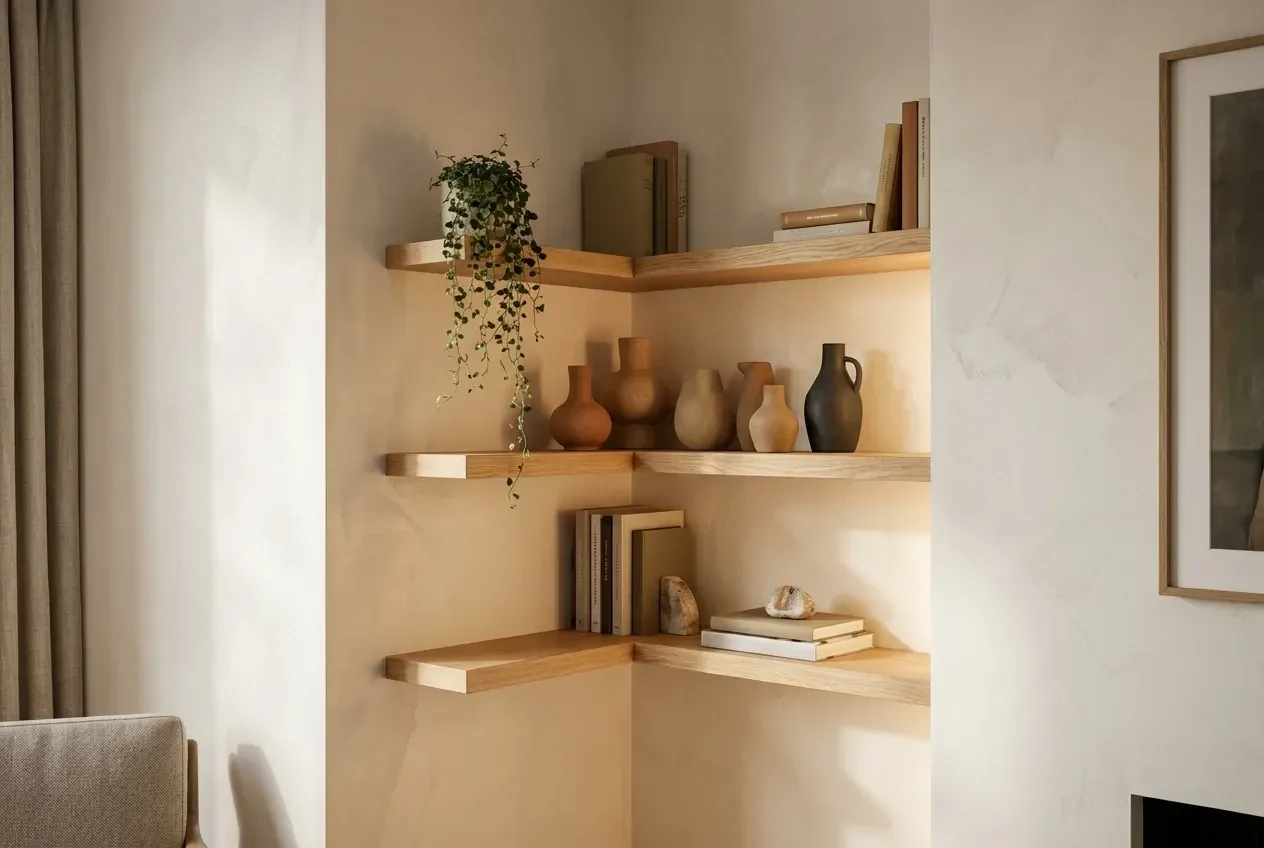
Room specifications
- Room ScaleSmall living room corner (about 90-degree alcove)
- Design StyleWarm Minimalist / Japandi
- Budget TierBudget ($)
- Palette Swatches4 colors
For small corner shelves, space the tiers 12 to 14 inches apart, keep each wing about 10 to 12 inches deep along the wall, and put the lowest shelf around 38 to 42 inches off the floor so you do not hit it as you walk past. Fix each shelf into framing or the right wall anchor, and check the shelf maker’s load rating.
Corners are often dead space. A rectangular bookcase wedged in leaves a triangle of unused floor behind it and sticks out into the room. Corner shelves use the vertical space instead and leave the floor open. They also sit well above an accent chair and in a studio, where you want storage without losing a 30 inch walking path. For wider storage ideas see best storage solutions for small apartments.
The measurements
These apply to normal 90 degree interior corners.
| Feature | Minimum | Better |
|---|---|---|
| Length along each wall | 8 in | 10 to 12 in |
| Space between shelves | 10 in | 12 to 14 in |
| Bottom shelf height | 30 in | 38 to 42 in |
| Projection from the corner point | 8 in | about 10 in |
The wall length keeps ceramics from sticking out into doorways. The 12 to 14 inch spacing fits hardcover books and a trailing plant. The bottom shelf is set to clear sofa arms and hips. Use a stud finder first, and look for outlets and switches, which hint at wiring in the wall.
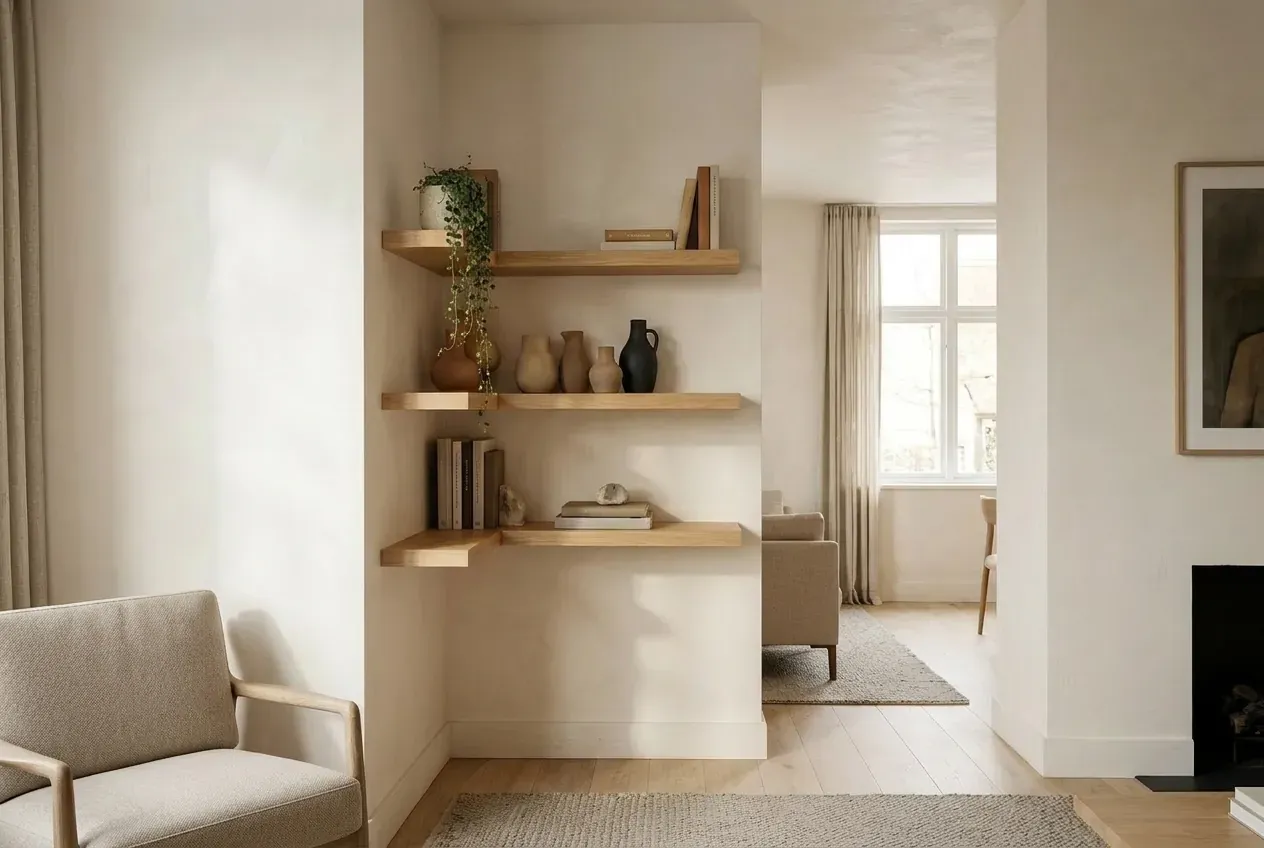 The same room seen from the opposite end, so you can judge the layout from the far side.
Layouts that work
A vertical stack of three
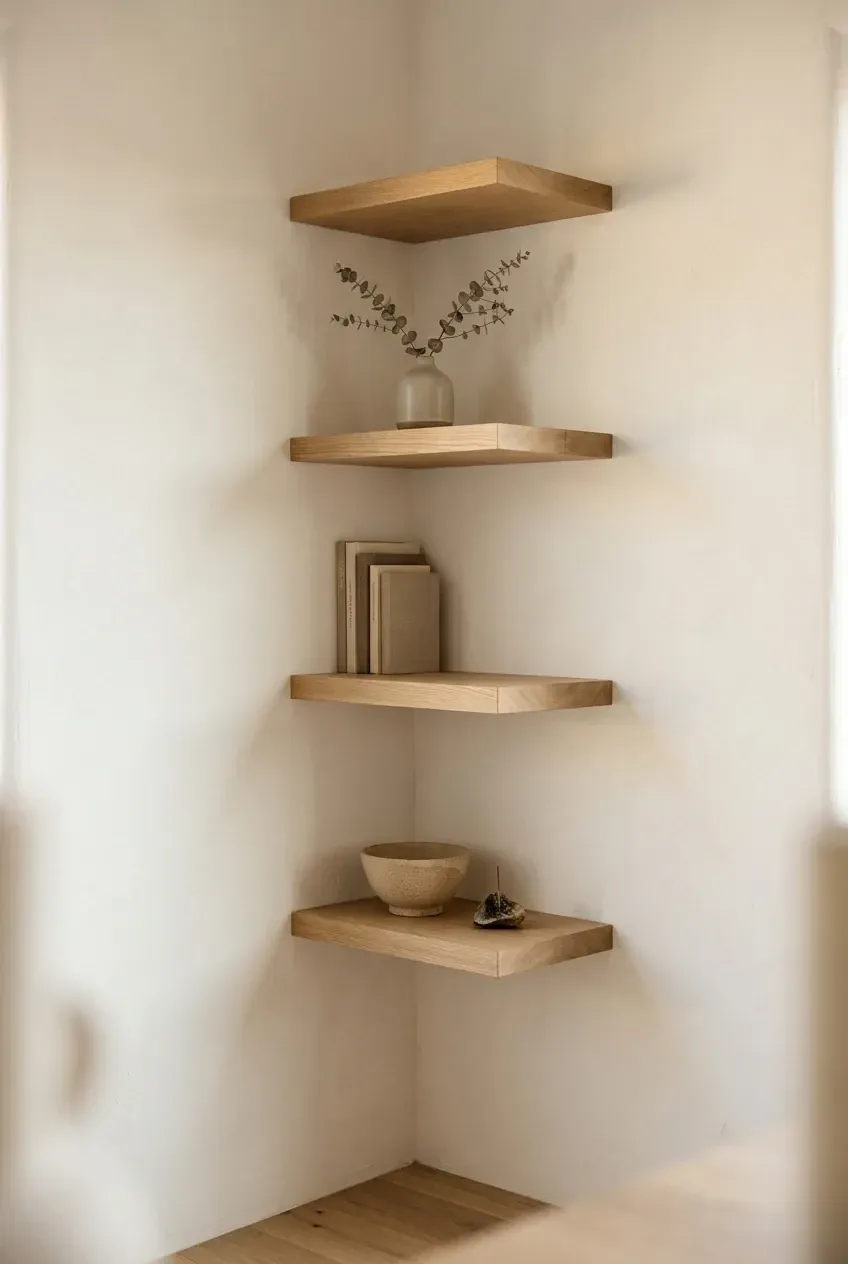
Next to a reading chair, three 12 inch curved shelves, about 13 inches apart, make a small display. Curved fronts soften the corner and reduce hip bumps. Add a pothos, a ceramic bowl and a few art books. See also the lounge chair guide and floating shelves for renters.
An offset pair
Two L-shaped shelves, mounted with a few inches of offset across the corner, create separate tiers and a more relaxed look that suits Japandi rooms.
A floor-to-ceiling mini library
In a small home office, five stacked corner shelves running from about 36 to 84 inches hold a good number of paperbacks in space that would otherwise be empty. The space-saving bookcase guide offers other options.
Fixing to the wall
- Framing in the corner. Corners often have several studs close together. Screws placed close to the corner may reach wood, but confirm with a stud finder.
- Hidden pins. Concealed steel pins in the shelf carry the load without visible braces. Capacity depends on the pin and the shelf material, so use the maker’s rating.
- Move-out. Fill screw holes with non-shrinking spackle, smooth them with a damp sponge, and touch up the paint.
Check the lease before you drill. If drilling is not allowed, a free-standing corner unit or a no-drill option is safer.
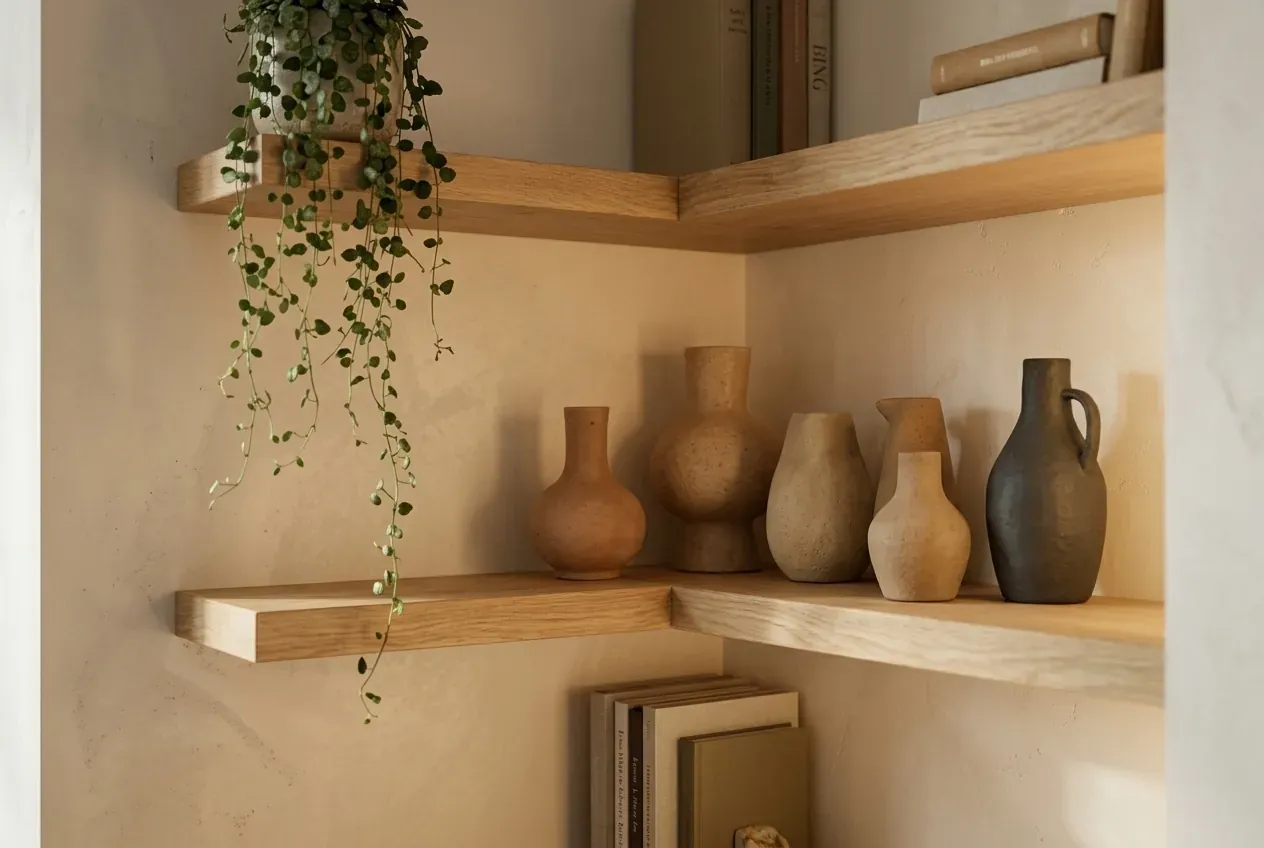 Close up: Maintain at least 12 to 14 in (30.5-35.5 cm) of vertical space between floating corner shelves.
Installing a corner shelf step by step
- Check the corner is square. Hold a level or a framing square against both walls. A corner that is off will leave a gap behind a rigid shelf, so consider a curved or flexible-edge shelf.
- Find the framing and services. Use a stud finder along both walls. Do not drill where you cannot rule out a cable.
- Mark level lines. Mark the bottom shelf height first, then step up by the spacing so all tiers line up.
- Dry-fit. Hold the shelf in place and check it clears door trim and sofa arms.
- Fix, then load. Drill pilot holes, use the right fasteners for the wall, and test with light items first.
Styling
- Put heavier, darker objects on the lowest tier and the lightest on top.
- Use an odd number of objects per tier and leave one tier mostly open.
- Keep trailing plants on the highest shelf you can still water safely.
- Light oak shelves against pale walls with a few dark metal accents keep the corner quiet.
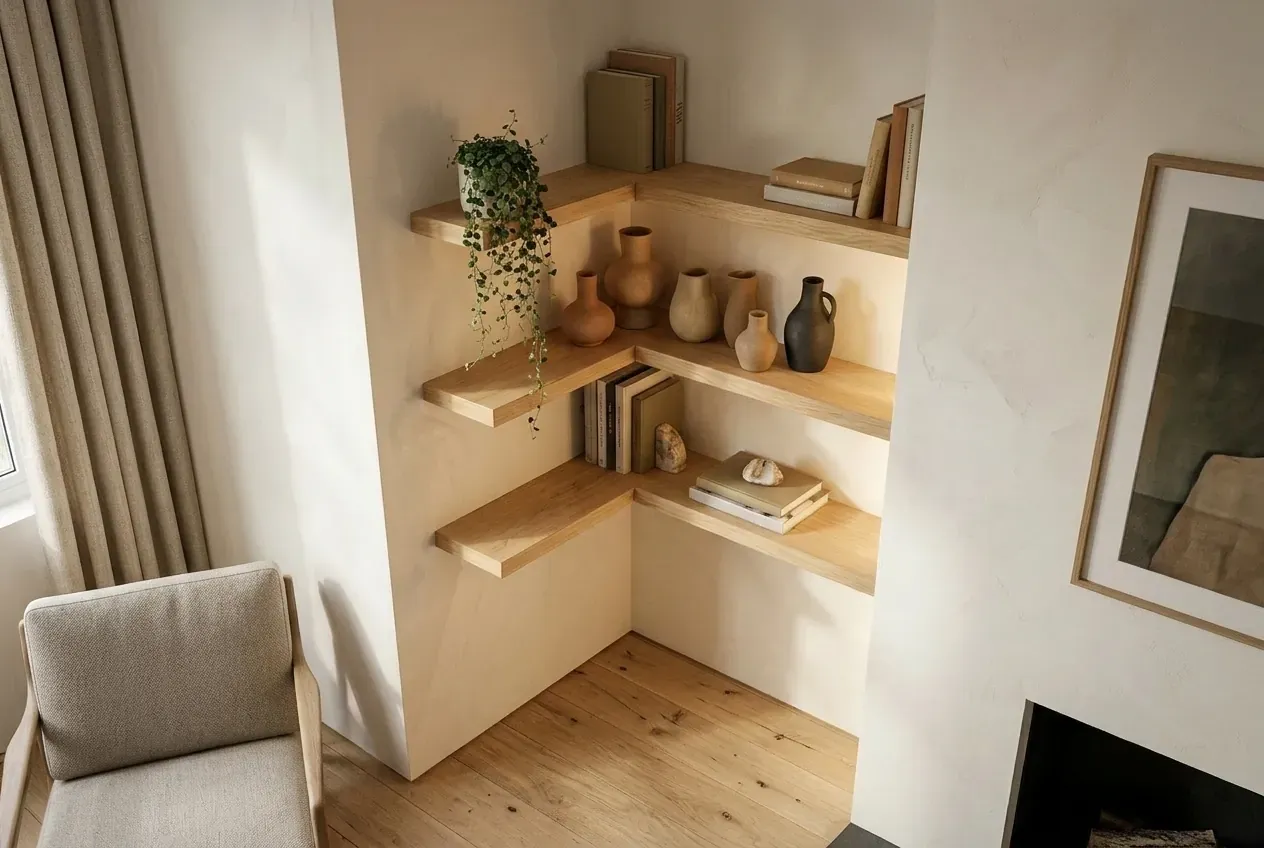 From above and to one side, the full footprint and the walkway read at a glance.
Mistakes to avoid
- A bottom shelf at hip height in a walkway.
- A deep shelf in a tight corner.
- Shelves near a door that slams, or in a stairwell.
- Overloading before checking the fixings.
Before you buy
- Test that the corner is square.
- Choose shelf depth for the space, about 10 to 12 inches.
- Decide the bottom shelf height, 38 to 42 inches in most rooms.
- Check the stud location and the fixings.
- Dry-fit and test with light items.
Curated Color Palette & Key Textures
- Alabaster Chalk #F5F2EB
- Light Oak #C9A97C
- Warm Greige #BDB3A3
- Charcoal Ink #2F3135
General references
Dimensions in these guides are typical planning ranges, not legal minimums, and they can differ by jurisdiction. Use the references below as starting points, then confirm local code and your lease before making changes.
FAQ
What is the best depth for a small corner shelf?
A corner shelf measuring 10 to 12 inches (25.4 to 30.5 cm) along each wall provides ample display depth for books and plants without projecting into primary walkways.
How do you hang a corner shelf securely in rental drywall?
Secure each shelf wing with at least one screw driven into a wall stud, backed by heavy-duty 50-lb hollow wall toggle bolts for unsupported holes.
How high off the floor should the lowest corner shelf be placed?
Mount the lowest corner shelf at least 36 to 42 inches (91.4 to 106.7 cm) above the floor to clear low furniture and avoid hip strikes.
Save this idea

Keep reading
Related rooms
Standard Window Sizes: 24 x 36 to 48 x 72 in Chart
Standard window sizes in inches and cm: most run 24 to 48 in wide by 30 to 72 in high, and a bedroom window needs a 5.7 sq ft clear opening for egress.
TV Dimensions by Screen Size: 65 in Is 56.7 x 31.9 in
TV dimensions by screen size in inches and cm: a 65 in TV is 56.7 x 31.9 in, a 55 in is 47.9 x 27.0 in, plus the viewing distance and stand width for each.
How High to Hang Pictures: 57 in (145 cm) Center
Hang pictures with the center 57 in (145 cm) up, the frame bottom 7 to 10 in (18 to 25 cm) above a sofa, and frames 2 to 3 in (5 to 8 cm) apart.