How to Style Bookshelves: Designer Rules for Small Rooms
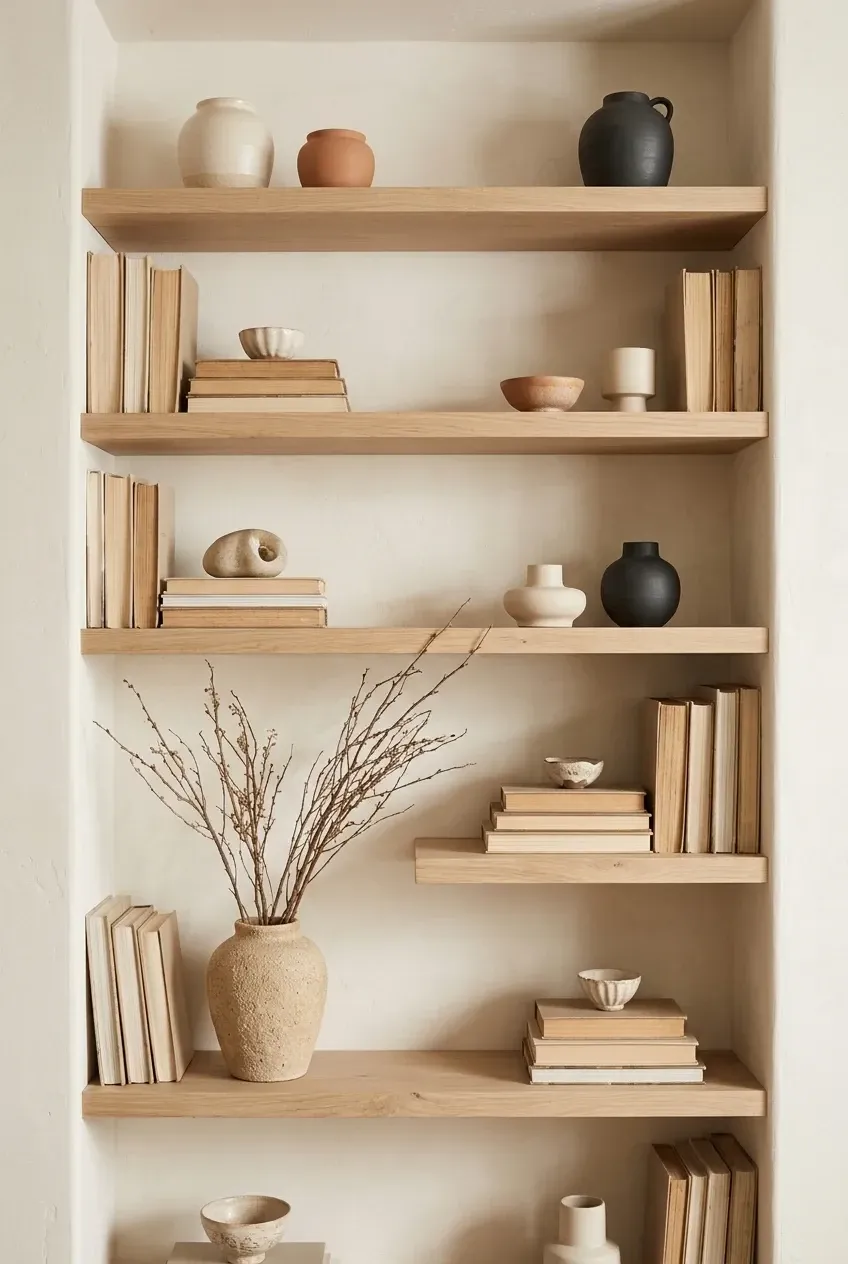
How to style bookshelves like a designer: leave one-third empty, group books in stacks of 4 to 6, and use odd-numbered objects on 12 in deep shelves.
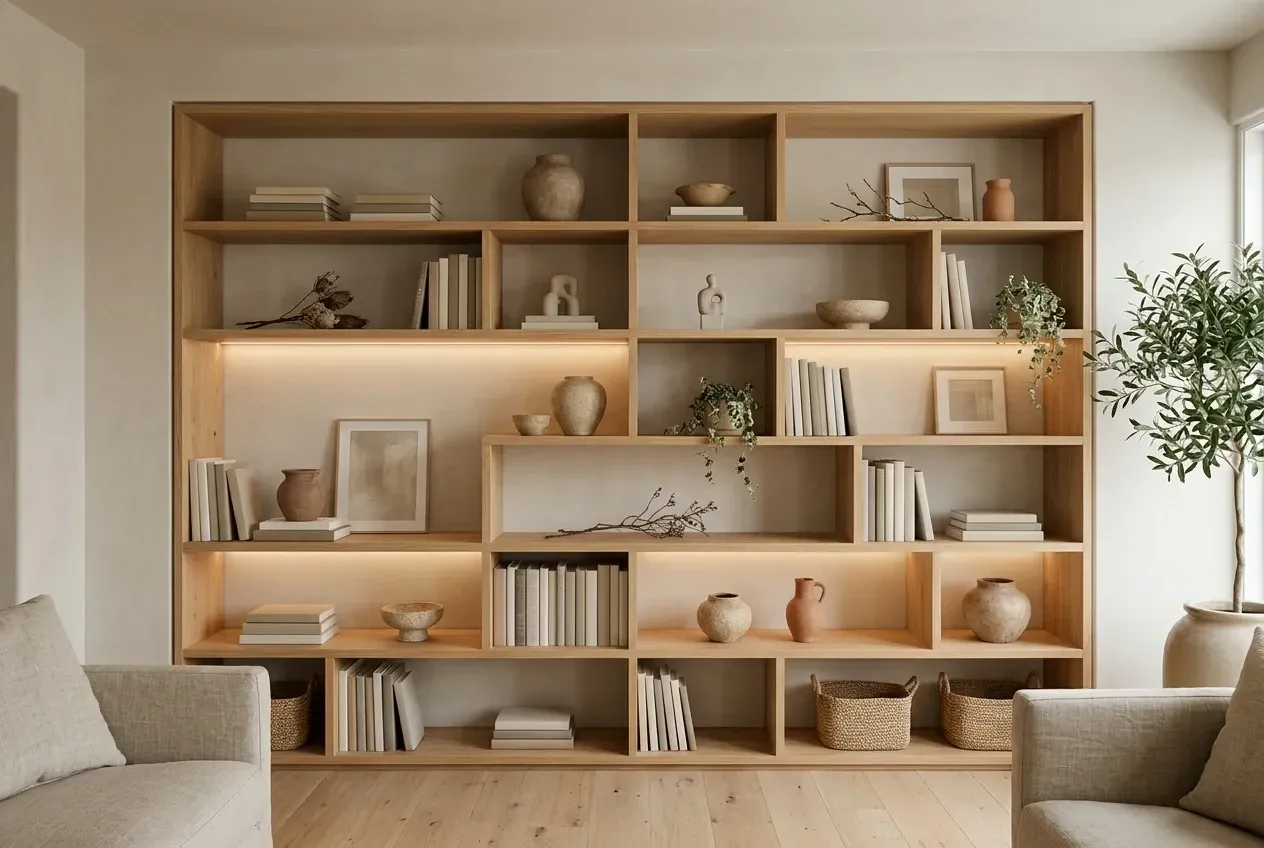
Room specifications
- Room ScaleSmall living room or home office (about 10 x 12 ft)
- Design StyleWarm Minimalist / Japandi
- Budget TierBudget ($)
- Palette Swatches4 colors
Open bookcases in small apartments frequently devolve into chaotic catch-all drop zones. When shelves are crammed edge-to-edge with cluttered paperbacks, mismatched tech cables, and loose trinkets, the bookcase visual mass overwhelms the living room, making the entire apartment feel claustrophobic.
Mastering how to style a bookshelf like a designer transforms ordinary shelving into an architectural focal point that radiates calm.
Whether styling floating ledges or an integrated bedroom corner desk, adhering to negative space ratios, alternating book orientation math, and curating warm Japandi ceramics turns storage into a display.
1. Bookshelf Styling Proportions
Reference these designer proportions before arranging volumes on open shelving.
| Styling Element | Target Formula | Visual Purpose |
|---|---|---|
| Negative space ratio | At least 33% (one-third) empty shelf area | Gives eyes breathing room; prevents visual spatial congestion. |
| Vertical book stacks | 4–6 volumes per cluster | Provides rhythm and structural verticality across shelf spans. |
| Horizontal book pedestals | 2–3 art monographs | Low profile lifts small pottery or scented candles to eye level. |
| Ceramic / decor clusters | Groupings of 1 or 3 objects | Odd-number groupings create asymmetrical organic balance. |
| Plant foliage projection | Trailing 6–8 in (15.2–20.3 cm) | Softens rigid 90-degree bookcase millwork with living biophilia. |
All metrics represent standard 12-inch deep open bookshelves. Adjust volume counts proportionally for extra-tall shelving units.
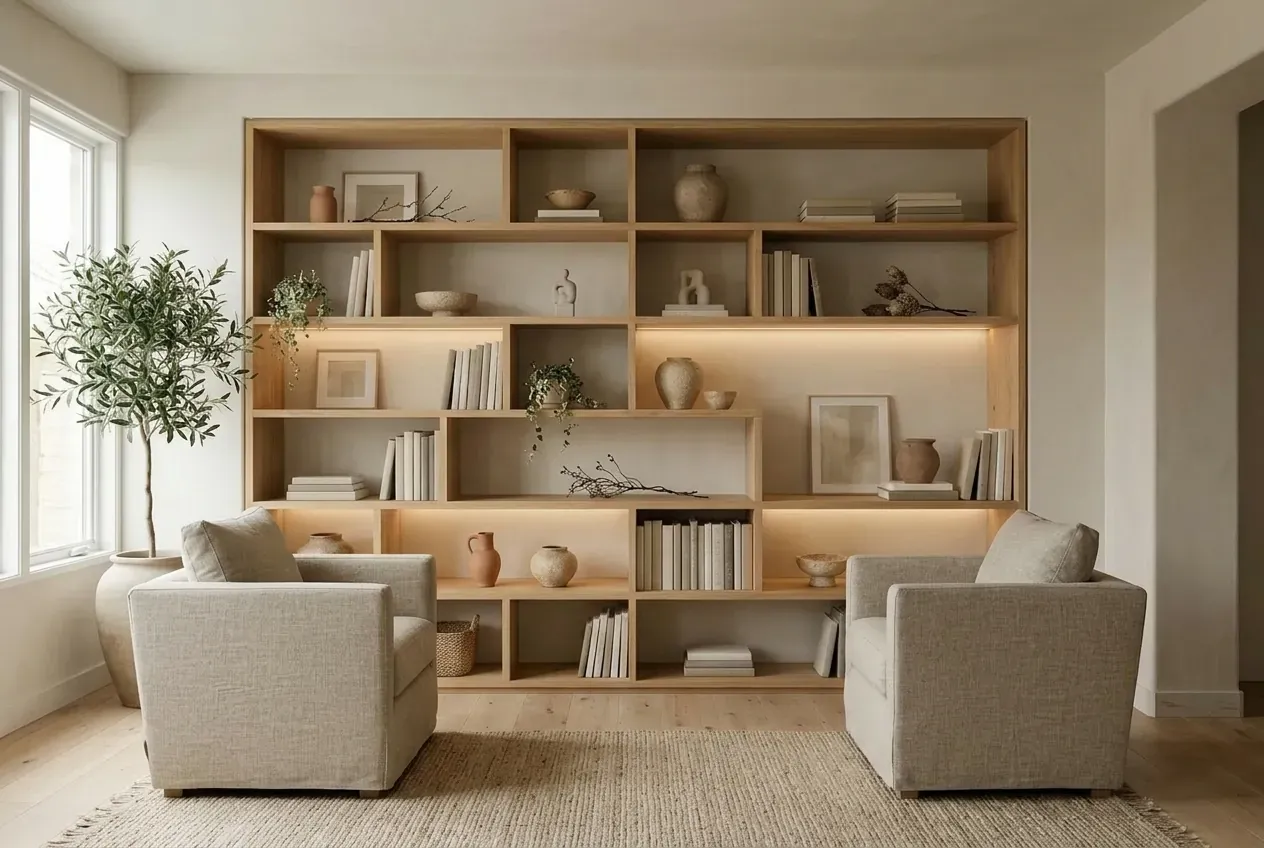 The same room seen from the opposite end, so you can judge the layout from the far side.
2. Bookshelf Setups for Small Spaces
Setup A: The Z-Pattern Japandi Rhythm
Best for 5-tier open oak bookcases (30 x 72 in / 76 x 183 cm).
- Top Tier: A single sculptural ceramic vase (
#BDB3A3) offset to the left, surrounded by 60% negative space. - Middle Tiers: A staggered Z-pattern alternating vertical book runs with horizontal flat stacks topped with river stones.
- Bottom Tier: Two woven seagrass bins that conceal unsightly charging cords and board games.
Setup B: The Low Credenza Bookshelf Run
Best for narrow apartments under 400 sq ft where tall units block sightlines.
- Setup: A low 32-inch high credenza shelf with books organized by neutral spine tone (
#F5F2EB,#D9CDB8). - Upper Wall: Leaves the upper wall completely open for an entryway mirror to bounce daylight.
Setup C: The Minimalist Monograph Pedestal
Best for micro-studios with limited book collections.
- Curated Display: Only display your 15 favorite hardcovers, showcasing cover art forward on acrylic stands like gallery objects.
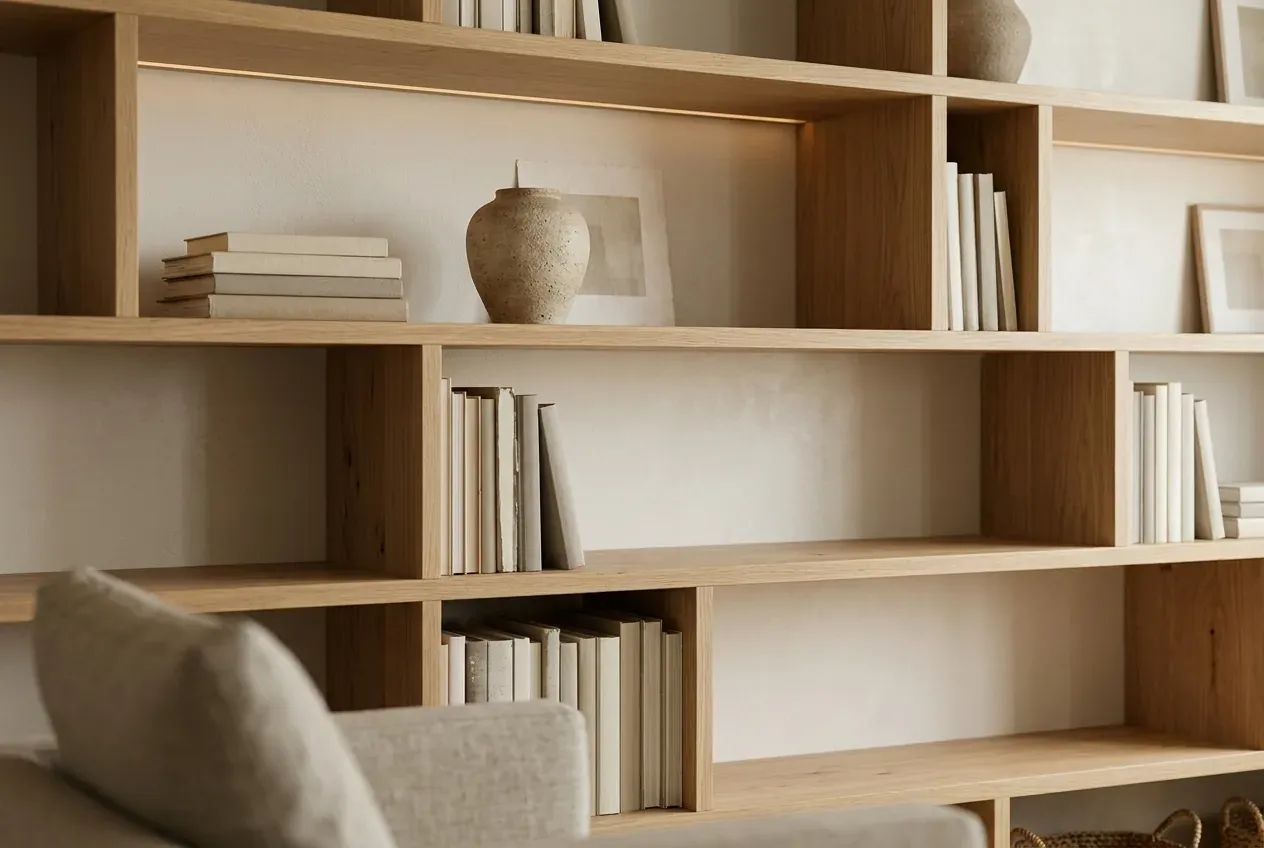 A closer look at the material finishes and the clearances that keep the layout usable.
3. Practical Weight Distribution and Renter Safety
- Weight Distribution Triangle: Always place heaviest encyclopedias, art folios, and storage boxes on the bottom two shelves. Placing heavy weight low shifts the bookcase center of gravity downward, dramatically reducing tip-over risks.
- Anti-Tip Wall Straps: Tall bookcases must be anchored to rental walls. Fix an anti-tip strap or cable to a wall stud where your lease allows (a screw hole is a small patch at move-out), and follow the maker’s instructions and the CPSC Anchor It! guidance. Adhesive-only straps are not a safe substitute for a tall, loaded bookcase.
- Dust Jacket Discipline: If personal book spines look visually chaotic with neon marketing colors, turn book spines backward for an all-neutral paper aesthetic, or group spines strictly by neutral tone.
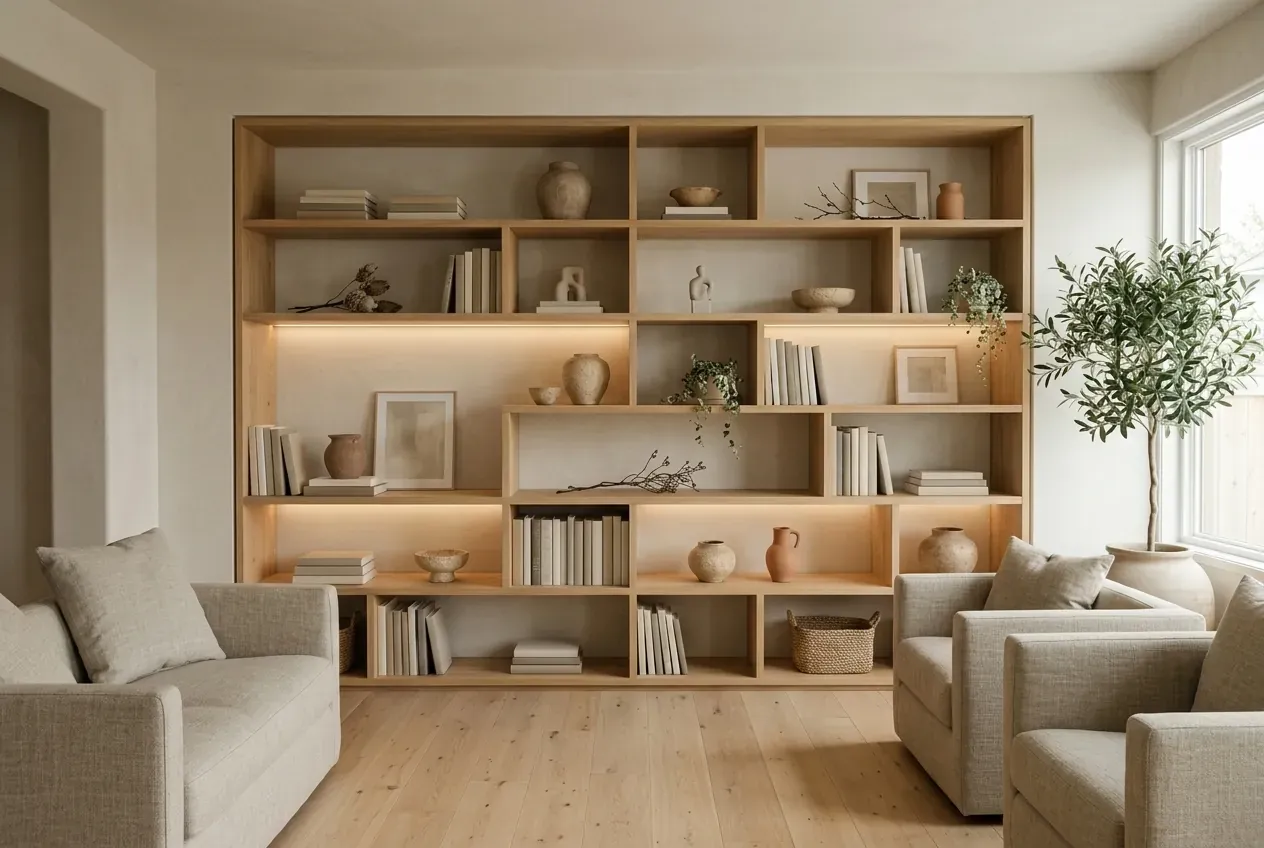 From above and to one side, the full footprint and the walkway read at a glance.
4. A Step-by-Step Way to Restyle a Bookshelf
Styling works best as a sequence, so you can stop when the shelf looks right rather than adding more.
- Empty one shelf at a time. Clear the bookshelf completely, or work one tier at a time if it is too big. Dust each shelf as you go.
- Sort what you have. Separate books you read, books you love to display, objects and items that should be stored away. Anything that does not fit these groups leaves the shelf.
- Build the base layer. Add the books first, mixing vertical runs with a few horizontal stacks to create pedestals.
- Add objects in odd groups. Place one, three or five objects per tier with different heights.
- Leave the empty space on purpose. The negative space ratio in the table above is part of the design, not leftover room.
- Step back and review. Photograph the shelf from across the room and edit anything that looks crowded.
Mistakes to avoid
- Spacing objects evenly like a store display, which looks rigid.
- Using many small, unrelated trinkets with no repeating color or material.
- Leaning books on every shelf, which hides the spines and the structure.
- Forgetting weight: heavy items belong on the lowest shelves, and tall bookcases should be anchored to the wall using the safety guidance in this guide.
Keeping it styled
Once a month, remove anything that does not belong, put back what has moved, and dust. A shelf that is edited regularly looks styled with very little effort.
5. Bookshelf Color Balance
Use roughly a 60-30-10 split. The base 60 is shelving and walls in Alabaster Chalk (#F5F2EB, approximate LRV 83). The secondary 30 is Light Oak timber (#C9A97C, approximate LRV 42) and Oat Linen bindings (#D9CDB8, approximate LRV 60). The accent 10 is Charcoal Ink bookends (#2F3135, approximate LRV 8) and Warm Greige pottery (#BDB3A3, approximate LRV 48).
Reserve at least one-third (33%) of every bookshelf shelf surface as empty negative space.
Curated Color Palette & Key Textures
- Alabaster Chalk #F5F2EB
- Light Oak #C9A97C
- Warm Greige #BDB3A3
- Charcoal Ink #2F3135
General references
Dimensions in these guides are typical planning ranges, not legal minimums, and they can differ by jurisdiction. Use the references below as starting points, then confirm local code and your lease before making changes.
FAQ
How do designers arrange books on an open bookshelf?
Designers alternate between vertical book groupings of 4 to 6 volumes and horizontal stacks of 2 to 3 larger art monographs topped with a sculptural object.
How do you style a bookshelf so it doesn't look cluttered in a small space?
Follow the 1/3 rule by leaving 33% of each shelf empty, remove busy paper dust jackets to reveal neutral cloth bindings, and stick to a tight 3-tone color palette.
What decorative items look best on a Japandi bookshelf?
Incorporate unglazed textured ceramic pottery, small woven fiber baskets, trailing indoor plants, and natural wood or brass bookends.
How much of a bookshelf should be left empty?
At least one-third (33%) of each shelf surface. A single top tier can go emptier, around 60%, with just one sculptural object.
Where do the heaviest books go on a bookcase?
On the bottom two tiers. On a 72 in (183 cm) bookcase with five equal tiers that is the lowest 28.8 in (73 cm), which also lowers the center of gravity.
Save this idea

Keep reading
Related rooms
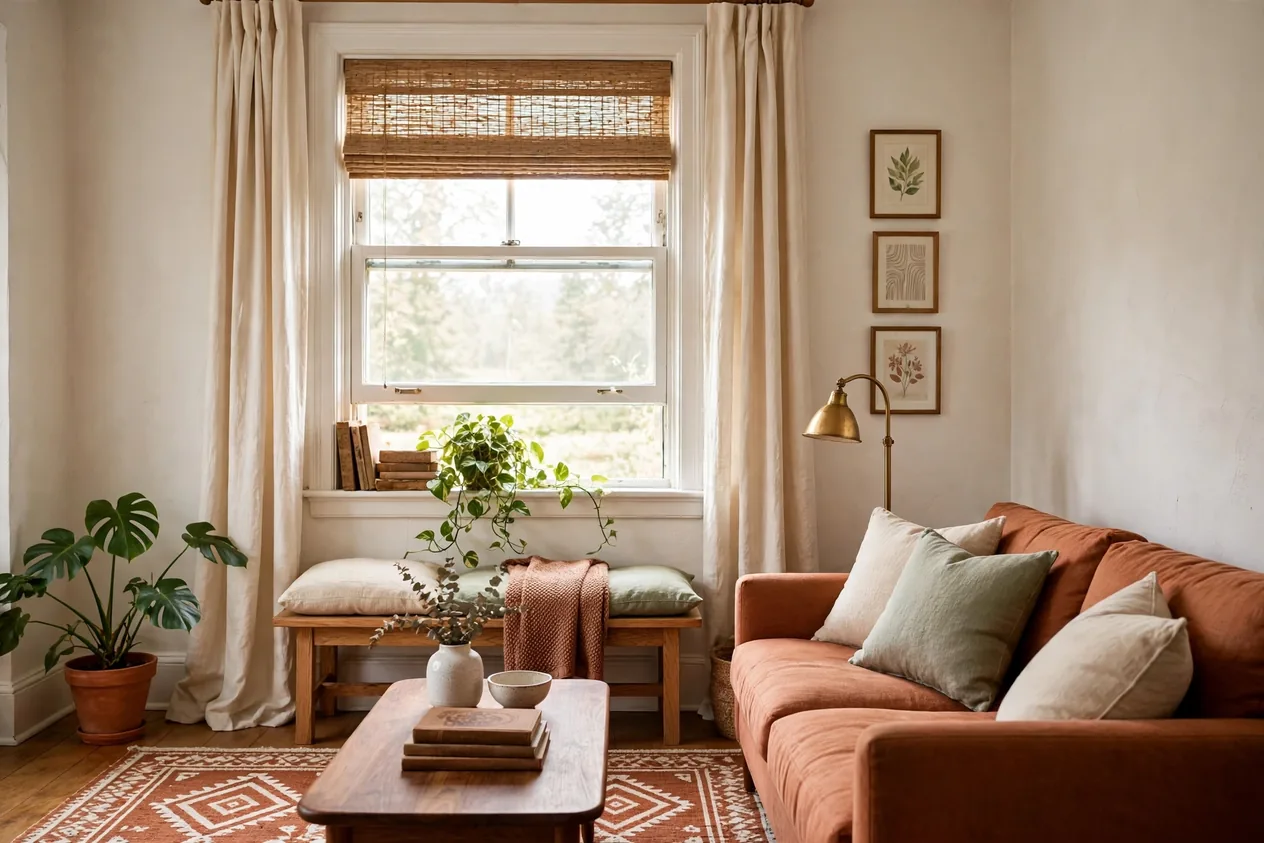
Standard Window Sizes: 24 x 36 to 48 x 72 in Chart
Standard window sizes in inches and cm: most run 24 to 48 in wide by 30 to 72 in high, and a bedroom window needs a 5.7 sq ft clear opening for egress.
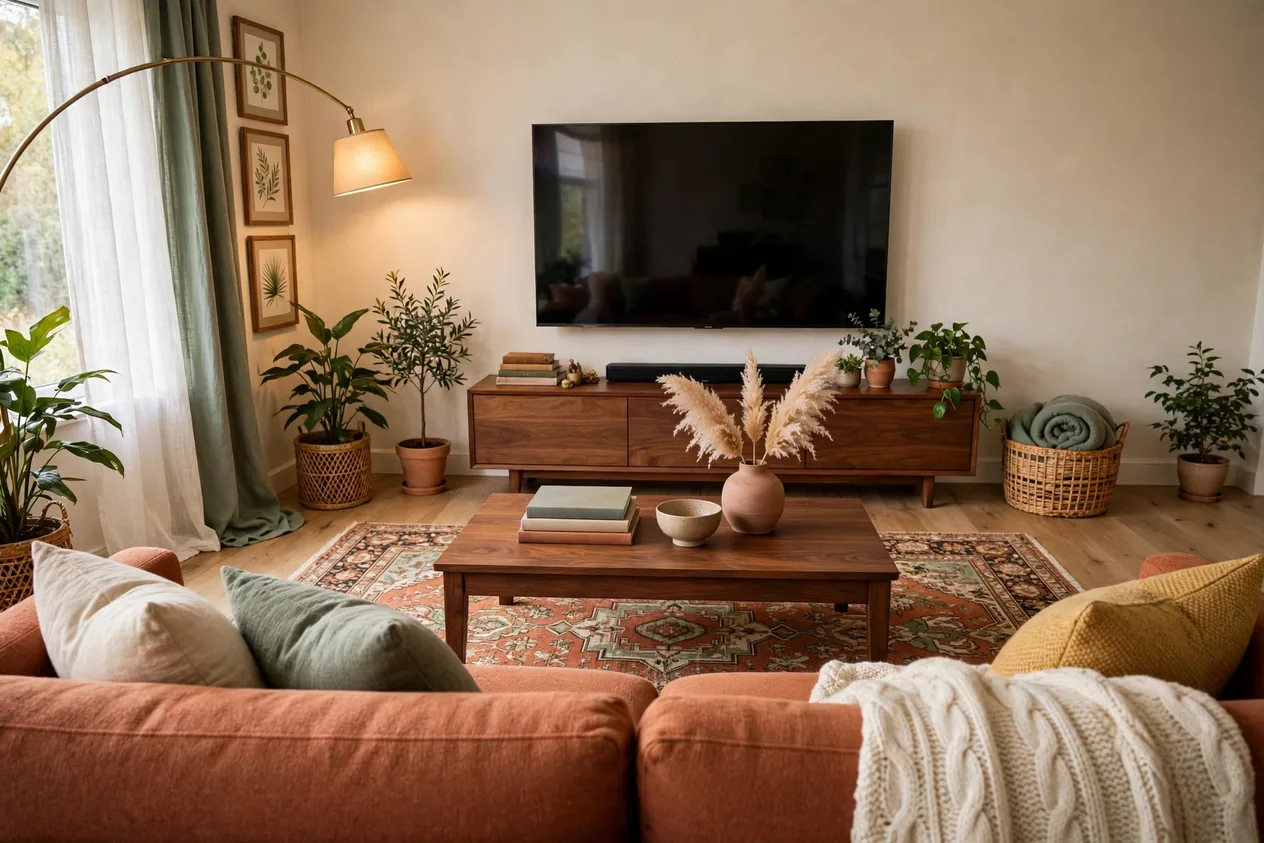
TV Dimensions by Screen Size: 65 in Is 56.7 x 31.9 in
TV dimensions by screen size in inches and cm: a 65 in TV is 56.7 x 31.9 in, a 55 in is 47.9 x 27.0 in, plus the viewing distance and stand width for each.
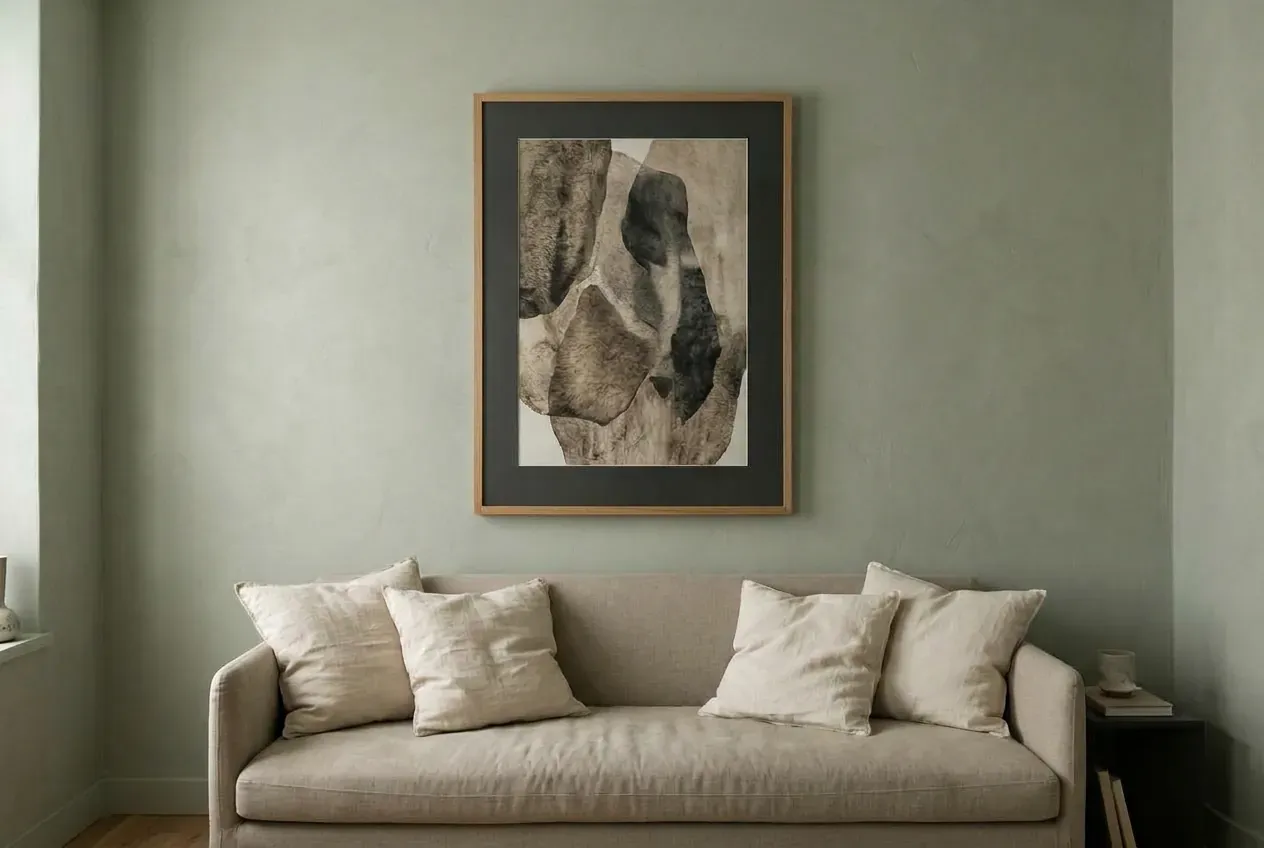
How High to Hang Pictures: 57 in (145 cm) Center
Hang pictures with the center 57 in (145 cm) up, the frame bottom 7 to 10 in (18 to 25 cm) above a sofa, and frames 2 to 3 in (5 to 8 cm) apart.