Minimalist Kitchen Color Palettes Using Open Shelving
Master minimalist kitchen color palettes with open shelving. Curated neutral paint codes, wood shelf specs, and styling rules to prevent visual clutter.
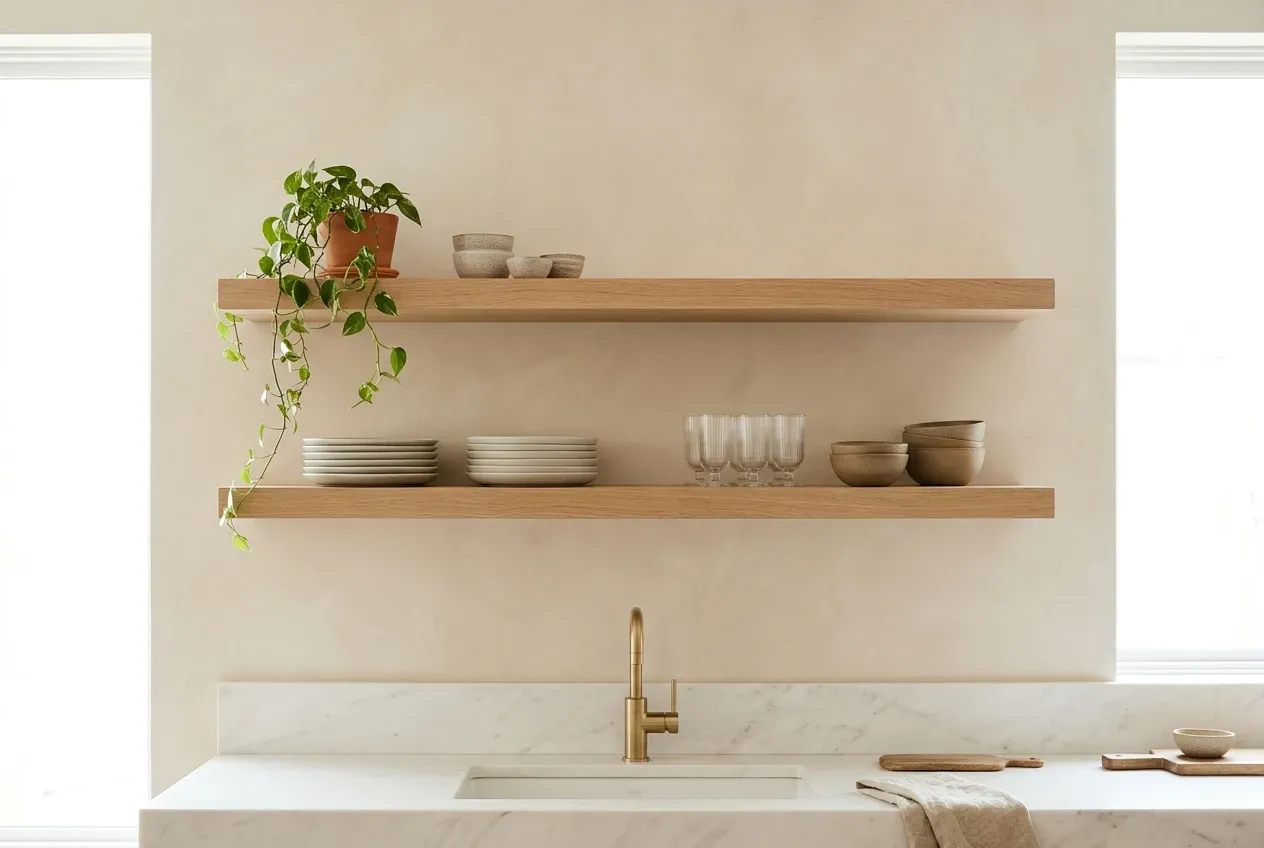
Room specifications
- Room ScaleSmall kitchen with open shelving
- Design StyleWarm Minimalist
- Budget TierMid-Range ($$)
- Palette Swatches4 colors
Replacing heavy, boxy upper cabinets with open floating shelving is one of the most effective architectural strategies for making a small kitchen feel expansive, luminous, and airy. However, open shelving presents an aesthetic hazard: exposing everyday dinnerware, spices, and cookware can instantly look cluttered if the color palette is uncontrolled.
To achieve an editorial, minimalist aesthetic, open shelving must be treated as a curated exhibition. By enforcing a restrained chromatic scheme, unifying dishware finishes, and calibrating timber undertones against wall paint, open shelves enhance kitchen architecture without overwhelming the senses.
Here is the definitive guide to styling minimalist kitchen color palettes with open shelving.
1. The Monochromatic Restraint Formula
When shelving is exposed, the dinnerware itself becomes part of the room’s color palette. Adhere to a strict 3-tone limit:
| Element | Recommended Finish / Hue | Hex Code / Spec | Design Rationale |
|---|---|---|---|
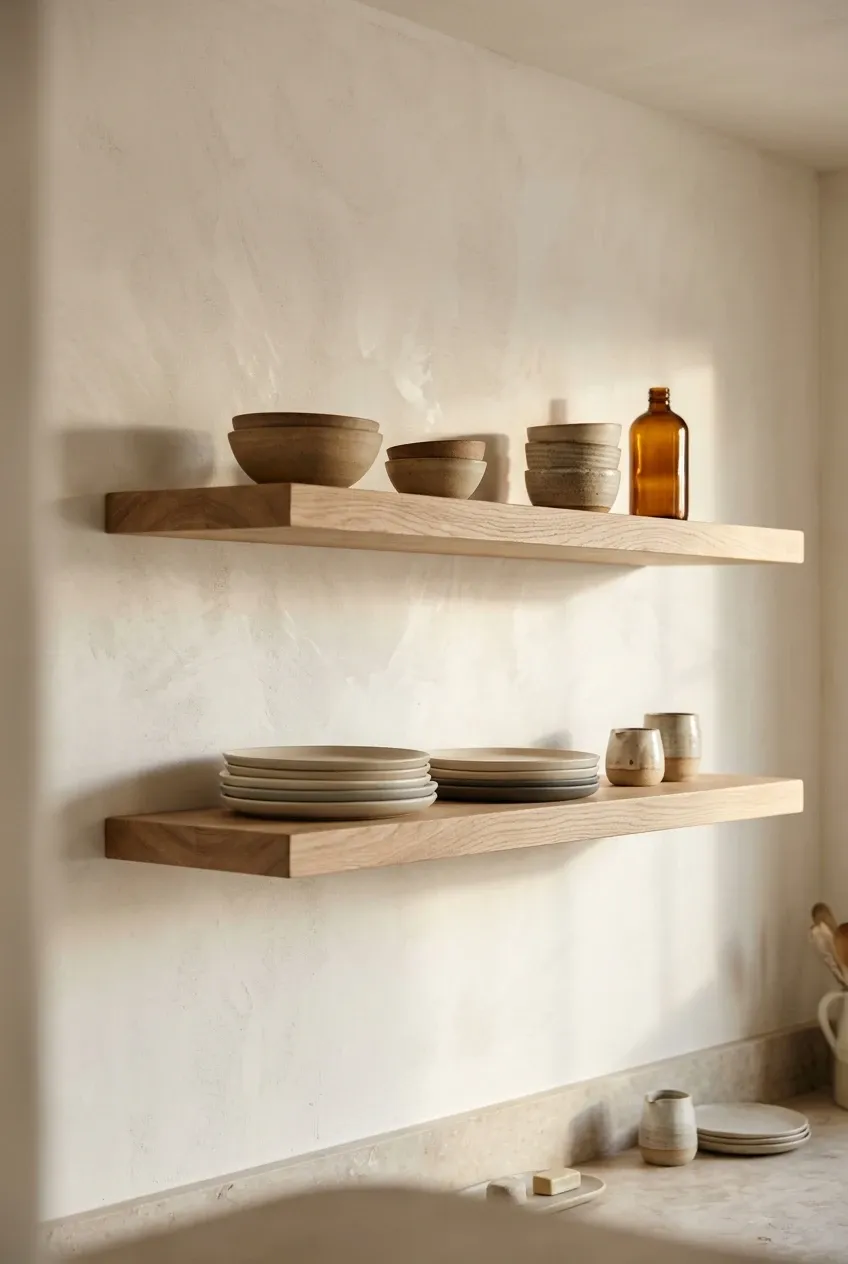
| Backdrop Drywall / Tile | Luminous Chalk Plaster | #F5F2EB (LRV 83) | Absorbs shadows; lets ceramics float gracefully. |
| Floating Shelves | Rift-Sawn White Oak | #D4B996 (Matte) | Warm horizontal lines that ground the room. |
| Curated Dinnerware | Matte Off-White Stoneware | #EDE8DF | Creates cohesive, serene repetition. |
| Accent Glass & Metal | Fluted Glass / Brushed Brass | #C5A059 | Bounces light and introduces refined sparkle. |
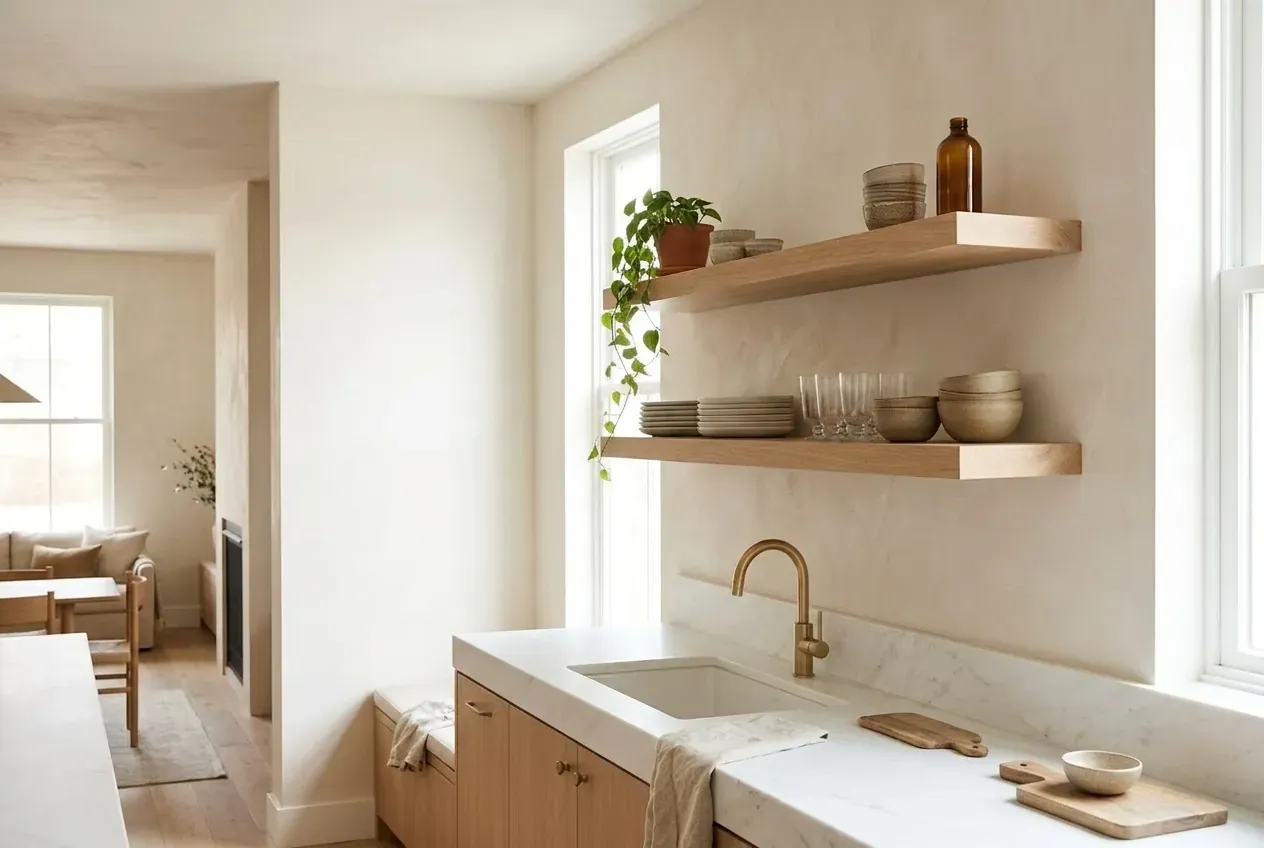 The same room seen from the opposite end, so you can judge the layout from the far side.
2. Shelf Dimensions & Architectural Clearance
- Shelf Depth: Restrict to 10 to 12 inches (25.4 to 30.5 cm). Deeper shelves cast dark shadow bands onto the countertop prep surface below.
- Shelf Thickness: Specify a substantial 1.75 to 2.25 inch (4.5 to 5.7 cm) thickness with concealed interior steel rod mounting brackets. Thin shelves sag under ceramic weight and read cheap.
- Vertical Spacing: Maintain 12 to 14 inches (30 to 35 cm) between shelves, and at least 18 to 20 inches (45 to 51 cm) clearance above the main countertop surface.
3. Sourcing Checklist: The 70/30 Curation Rule
To prevent open shelves from degenerating into a chaotic pantry:
- 70% Everyday Functional Uniformity: Stacks of matching matte stoneware plates, ceramic bowls, and drinking tumblers in neutral tones.
- 30% Sculptural Warmth: Wooden cutting boards leaned vertically, an artisan ceramic olive oil cruet, and a small trailing plant in an unglazed terracotta pot.
By pairing warm white oak shelves with a luminous plaster backdrop and uniform stoneware, open shelving transforms a compact kitchen into an airy architectural focal point.
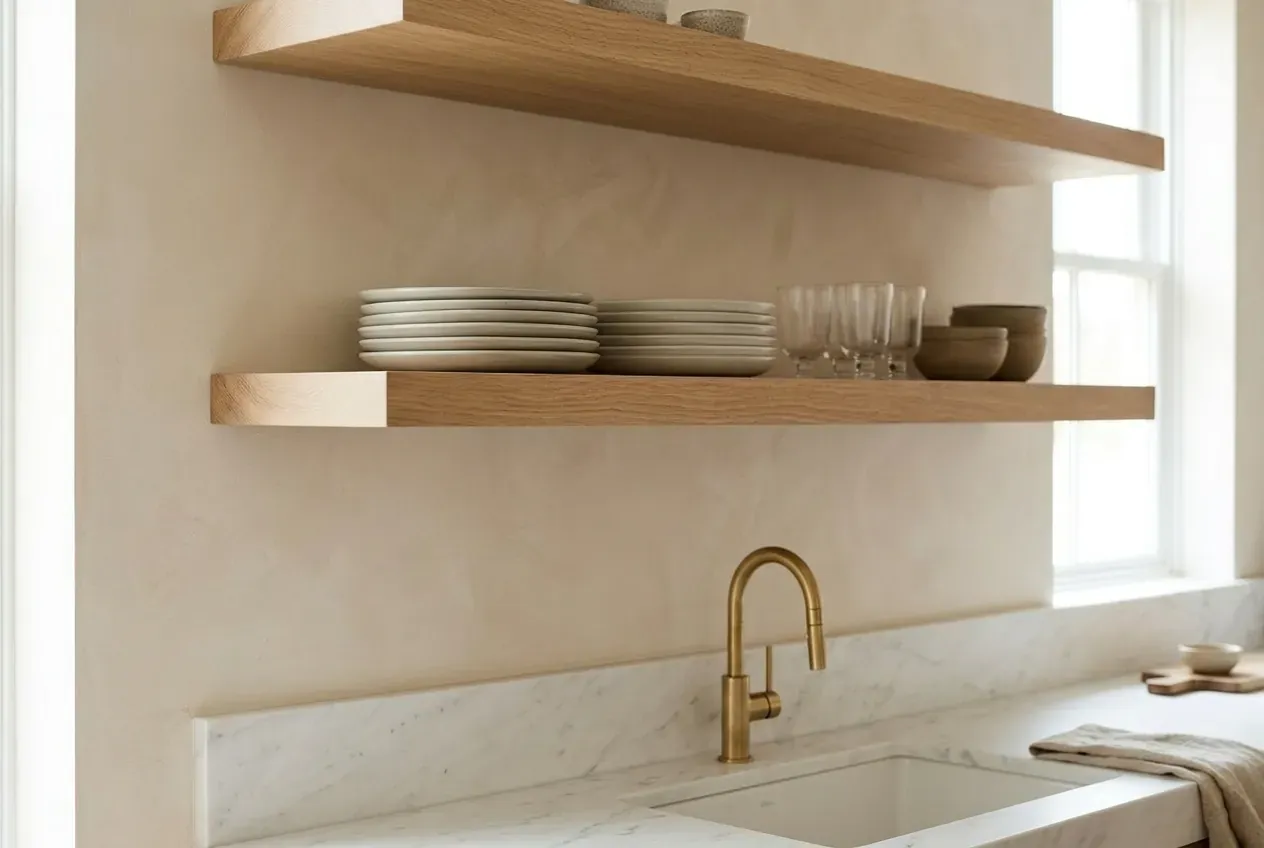 Close up: Shelf Depth: Restrict to 10 to 12 inches (25.4 to 30.5 cm). Deeper shelves cast dark shadow bands onto the countertop prep surface below.
4. What to Leave Off the Shelves
Open shelving works by subtraction. The restraint is what reads as minimal, not the shelving itself.
| Keep on the shelf | Leave off the shelf |
|---|---|
| Matching stoneware stacks | Mismatched mugs and novelty cups |
| One wood board, leaned | Plastic containers and packaging |
| A single plant in terracotta | Multiple small appliances |
| Uniform glassware | Cluttered spice jars |
Keep the top shelf the lightest and the bottom shelf the heaviest so the unit reads grounded rather than top-heavy.
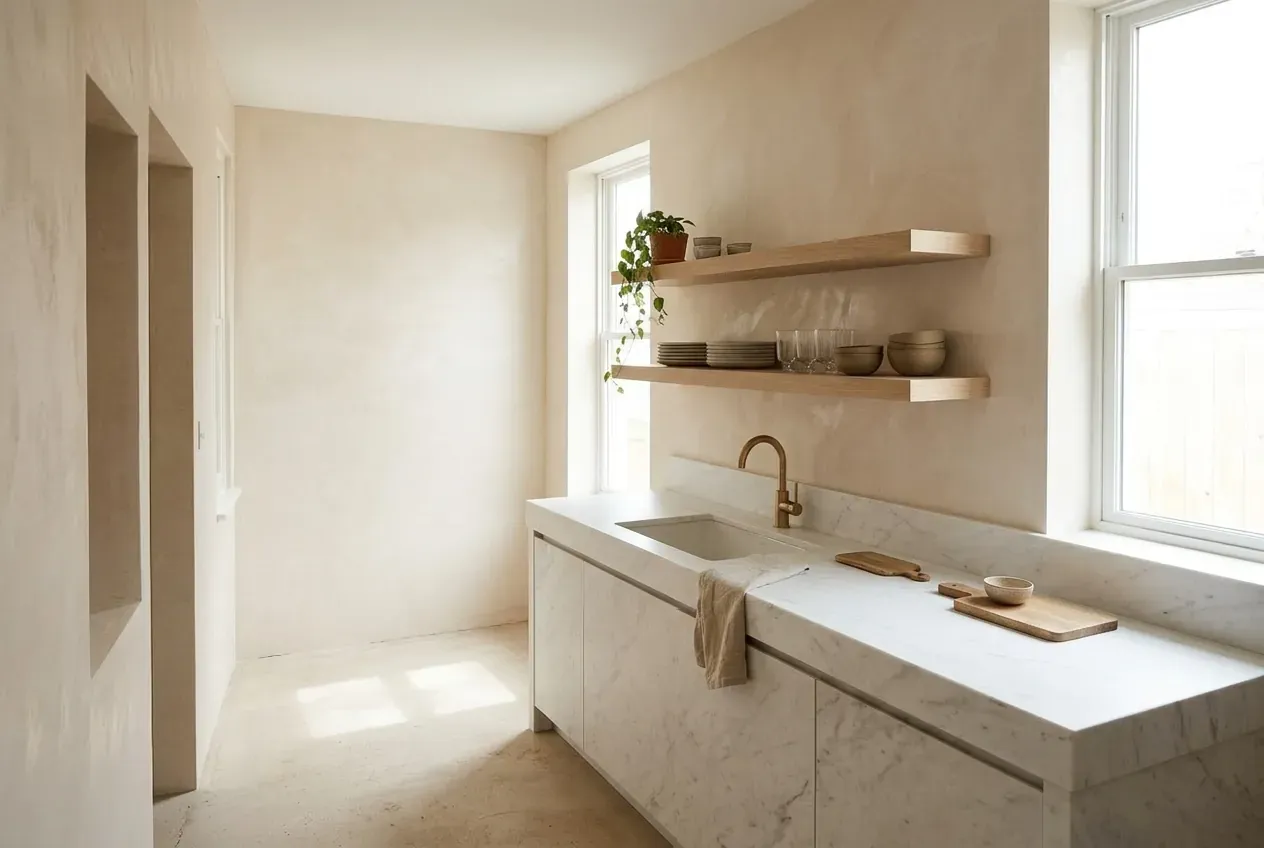 From above and to one side, the full footprint and the walkway read at a glance.
5. Rotating the Display Over Time
Even a perfect shelf drifts toward clutter within weeks. Set a monthly reset: pull everything down, wipe the shelves, and put back only the 70% everyday pieces plus the 30% accents. Anything that has not been used since the last reset goes into a closed cabinet, which keeps the open shelves a curated display rather than overflow storage.
Start with the three tones
- Limit the palette to a plaster backdrop, white oak shelves, and off-white stoneware.
- Keep shelves 10 to 12 in (25 to 30 cm) deep and 12 to 14 in (30 to 35 cm) apart.
- Follow the 70/30 rule: everyday uniformity plus one sculptural accent.
- Reset the shelves monthly and move unused items to a closed cabinet.
Curated Color Palette & Key Textures
- #F5F2EB
- #D4B996
- #EDE8DF
- #C5A059
General references
Dimensions in these guides are typical planning ranges, not legal minimums, and they can differ by jurisdiction. Use the references below as starting points, then confirm local code and your lease before making changes.
FAQ
How deep should open kitchen shelves be?
Restrict open shelves to 10 to 12 inches (25.4 to 30.5 cm) deep. Deeper shelves cast dark shadow bands onto the countertop prep surface below and push dinnerware out of comfortable reach.
How much space should you leave between open kitchen shelves?
Maintain 12 to 14 inches (30 to 35 cm) between shelves, and at least 18 to 20 inches (45 to 51 cm) of clearance above the main countertop surface so worktop tasks stay unobstructed.
How thick should a floating kitchen shelf be?
Specify 1.75 to 2.25 inches (4.5 to 5.7 cm) thick, with concealed interior steel rod mounting brackets. Thin shelves sag under ceramic weight and read cheap.
How do you keep open kitchen shelves from looking cluttered?
Enforce a strict 3-tone limit and the 70/30 curation rule: 70 percent matching everyday stoneware, bowls and tumblers in neutral tones, and 30 percent sculptural warmth such as a leaned wooden board and one trailing plant. Reset the shelves monthly and move anything unused into a closed cabinet.
What colours suit a minimalist kitchen with open shelving?
A luminous chalk plaster backdrop (#F5F2EB, LRV 83), rift-sawn white oak shelves, matte off-white stoneware, and fluted glass or brushed brass as the single accent. The dinnerware itself becomes part of the palette, so those three tones plus one metal are the whole scheme.
Save this idea

Keep reading
Related rooms
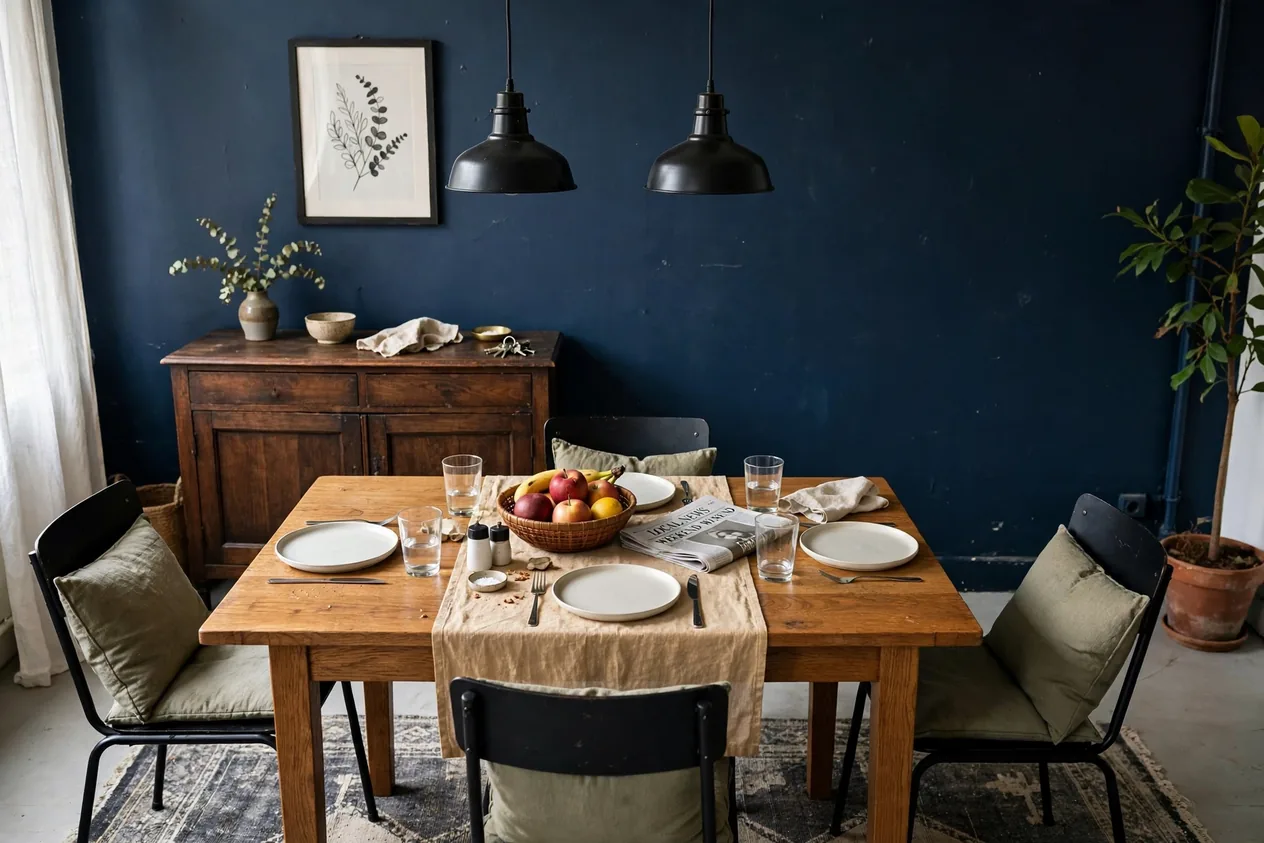
Pendant Light Height: Hang 30 to 36 in Over a Table
Hang pendants 30 to 36 in (76 to 91 cm) above a table or island, 7 ft (213 cm) above open floor, with worked drop lengths for 8 and 9 ft ceilings.
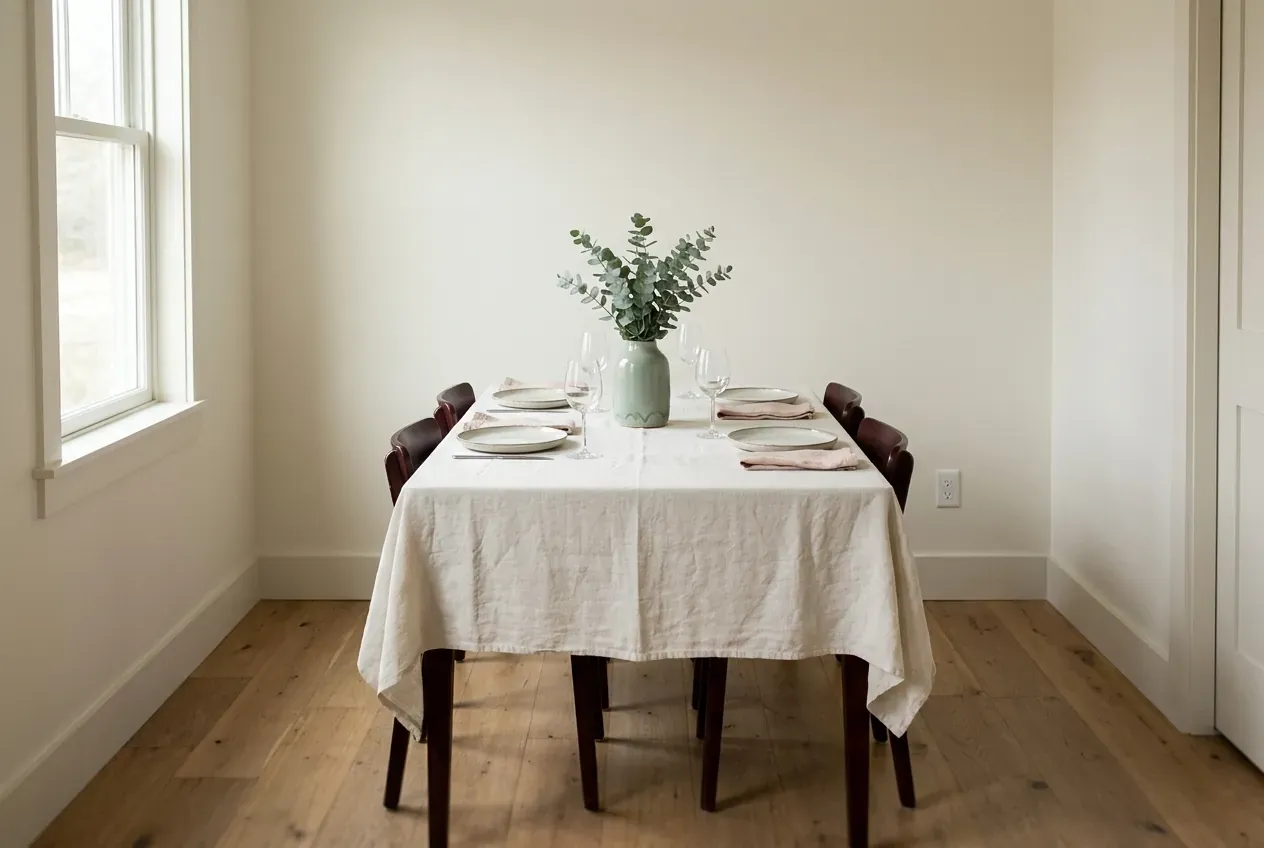
Tablecloth Size Guide: Table Size Plus 16 to 24 in
Tablecloth size guide: add twice the drop to your table, so an 8 to 12 in (20 to 30 cm) drop means table size plus 16 to 24 in. Round and rectangle chart.
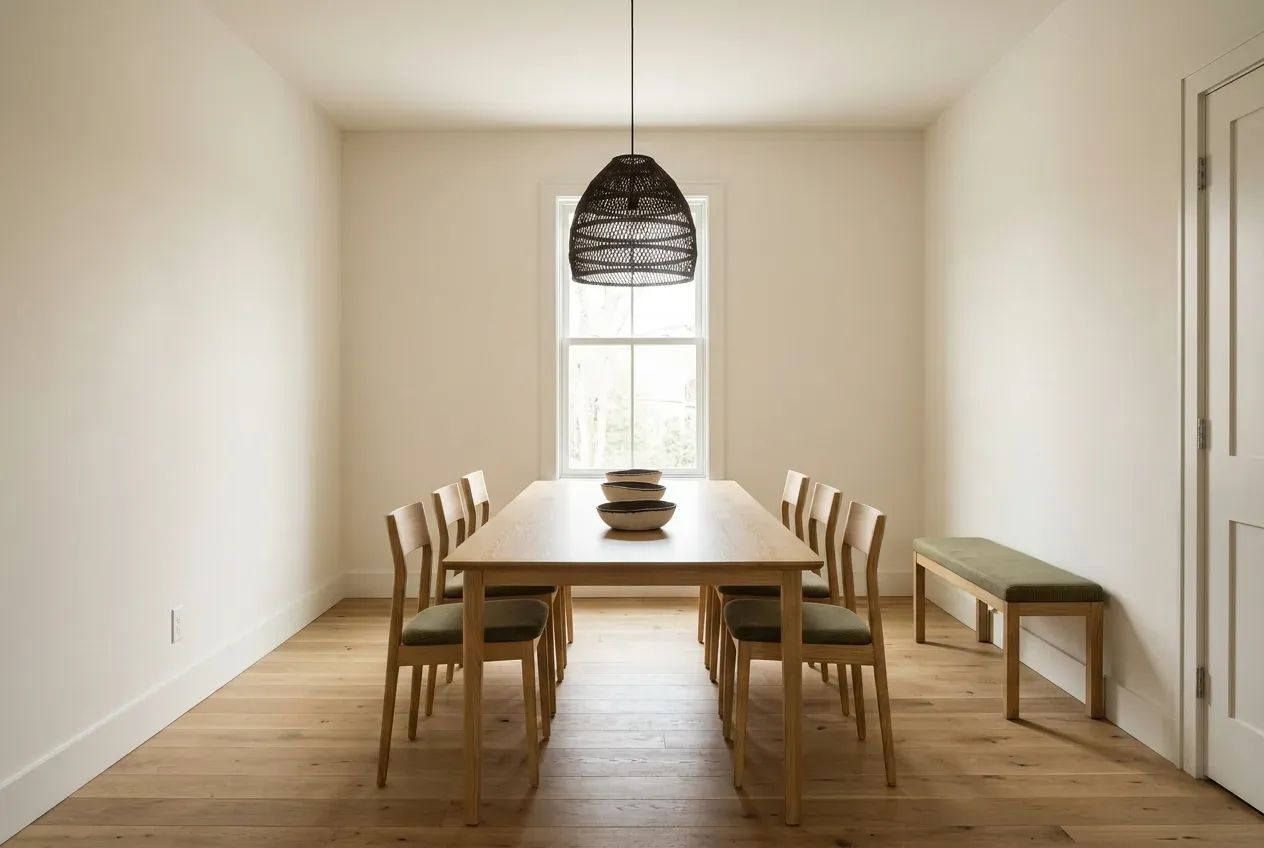
Dining Table Size for 6 and 8 People: 72 and 96 in
Dining table size for 6 people is 72 x 36 in (183 x 91 cm); for 8 people, 96 x 36 in. See the 24 in per diner maths and the room each table needs.