Small L-Shaped Desk for a Corner Layout
Small L-shaped desk guide: the arm length that fits a corner, the chair pushback zone at the inner angle, and when an L beats two straight desks.
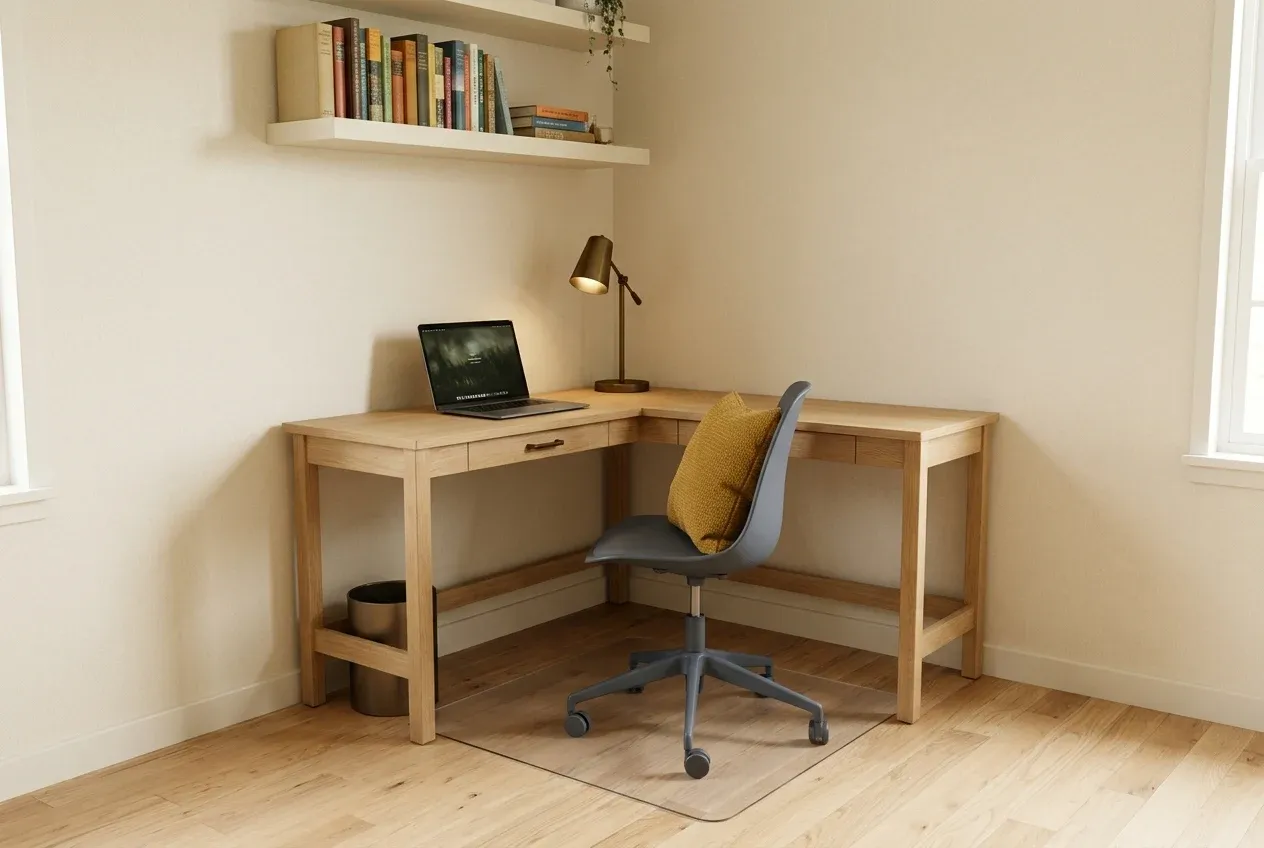
Room specifications
- Room ScaleSmall bedroom (about 10 x 10 ft) with one free corner
- Design StyleMustard Study / Mid-Century Modern
- Budget TierMid-Range ($$)
- Palette Swatches4 colors
To fit an L-shaped desk in a small room, choose a compact model with arms of 40 to 48 in (102 to 122 cm) and a depth of 18 to 20 in (46 to 51 cm), tuck it into a free corner, and keep a 36 in (91 cm) square of clear floor at the inner angle for the chair. A standard office L-desk of about 60 x 60 in (152 x 152 cm) will swallow a 10 x 10 ft bedroom.
An L beats two straight desks when you need one zone for a screen and another for paper, because the corner connects both surfaces without a second set of legs in the middle of the room. If you only work on a single laptop, a straight or triangular desk from the small bedroom corner desk guide is simpler.
Is an L-shaped desk right for you?
Choose an L when:
- You regularly use a monitor and a laptop, or a screen plus notes, at the same time.
- The corner has at least 40 in of clear wall on each leg.
- You can accept the desk taking a corner for good.
Choose something else when the room is under about 10 x 10 ft with a queen bed, when one wall holds a closet door, or when you only need a laptop surface. In those cases a 40 x 40 in triangular unit or a folding desk from the folding desk clearances guide leaves more floor.
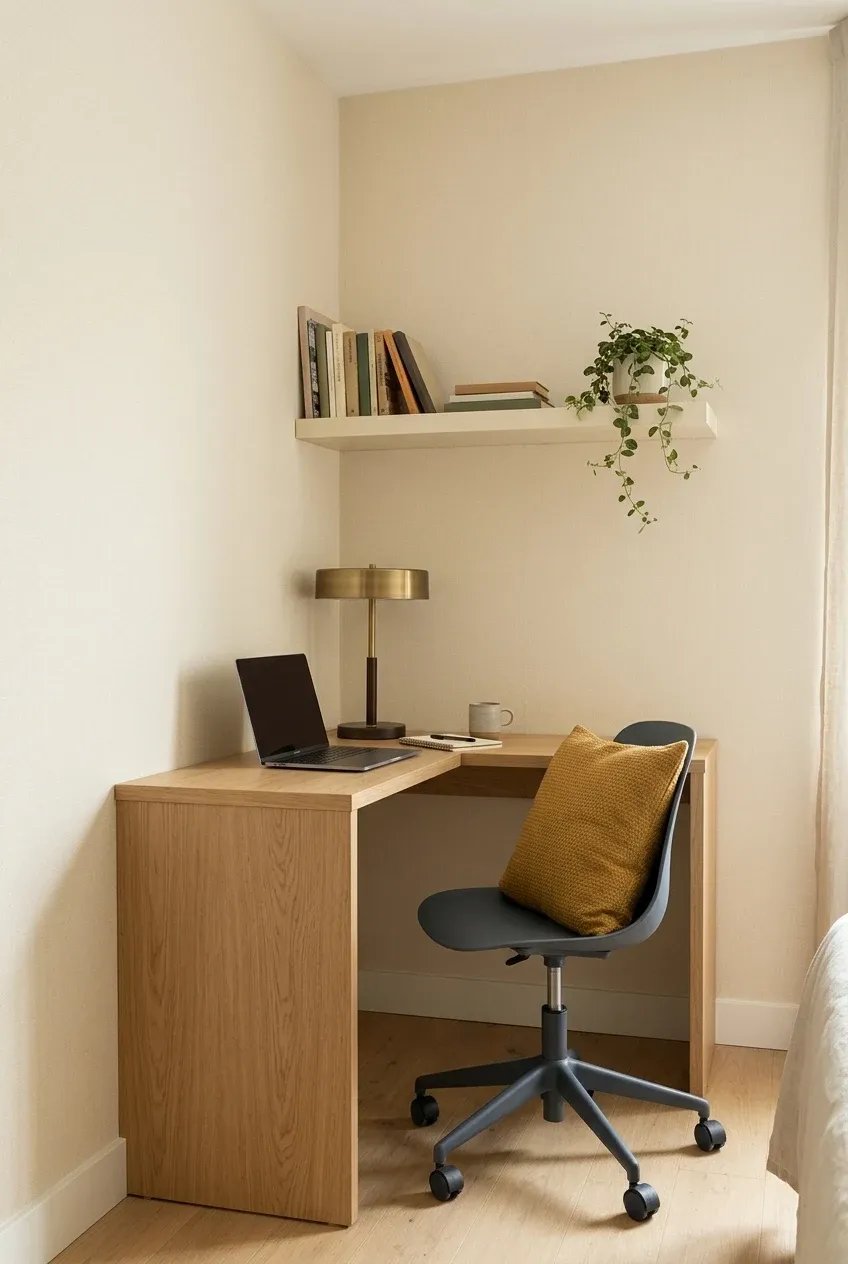
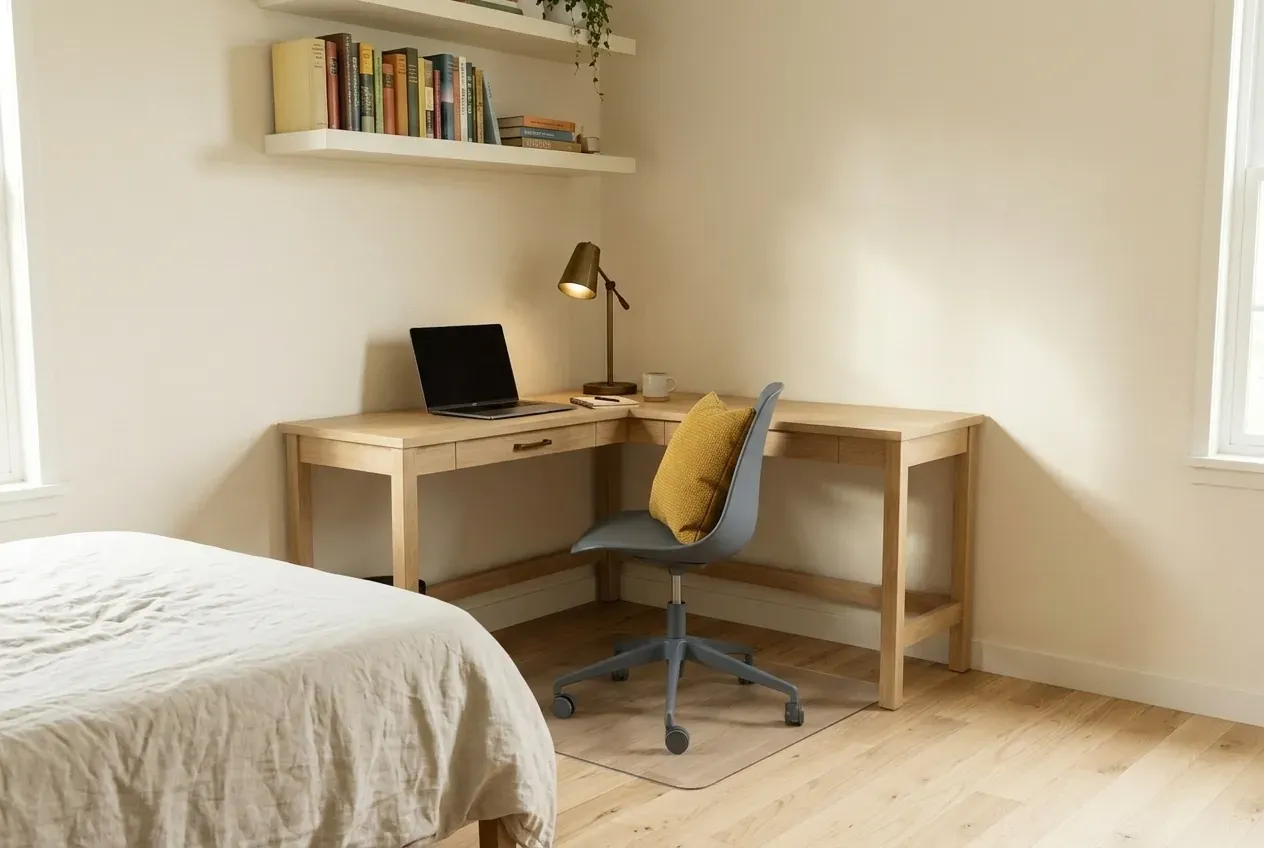 The same room seen from the opposite end, so you can judge the layout from the far side.
Sizing the arms and the inner angle
| Spec | Small-room range | Standard office desk |
|---|---|---|
| Arm length | 40 to 48 in (102 to 122 cm) | About 60 in (152 cm) |
| Desktop depth | 18 to 20 in (46 to 51 cm) | 24 to 30 in (61 to 76 cm) |
| Inner chair square | 36 x 36 in (91 x 91 cm) | 48 x 48 in (122 x 122 cm) |
| Desk height | 29 to 30 in (74 to 76 cm) | 29 to 30 in (74 to 76 cm) |
| Return end to bed | 24 in (61 cm) | n/a |
The inner chair square is the number people forget. It lets the chair swivel and roll back without hitting the bed frame. Also compare the arm depth with a plain straight desk to see how much surface you gain.
Fitting the L around the bed, window and door
- Pick the long arm. Run the longer arm along the window wall, with the screen at a right angle to the glass rather than facing straight into it. Put the monitor on the wall-side arm so midday light does not wash it out.
- Protect the bed path. Keep at least 24 in between the end of the shorter arm and the bed or closet-door swing. That is enough to make the bed and walk around it.
- Use the arms for different jobs. Main arm for the monitor or laptop; shorter return for notebooks, a printer or a mug, so the keyboard stays clear.
- Mind the diagonal. A 44 in L along both walls is a good test size. Tape a 44 in L along the corner walls, then mark a 36 in square inside it and check the chair never clips the mattress.
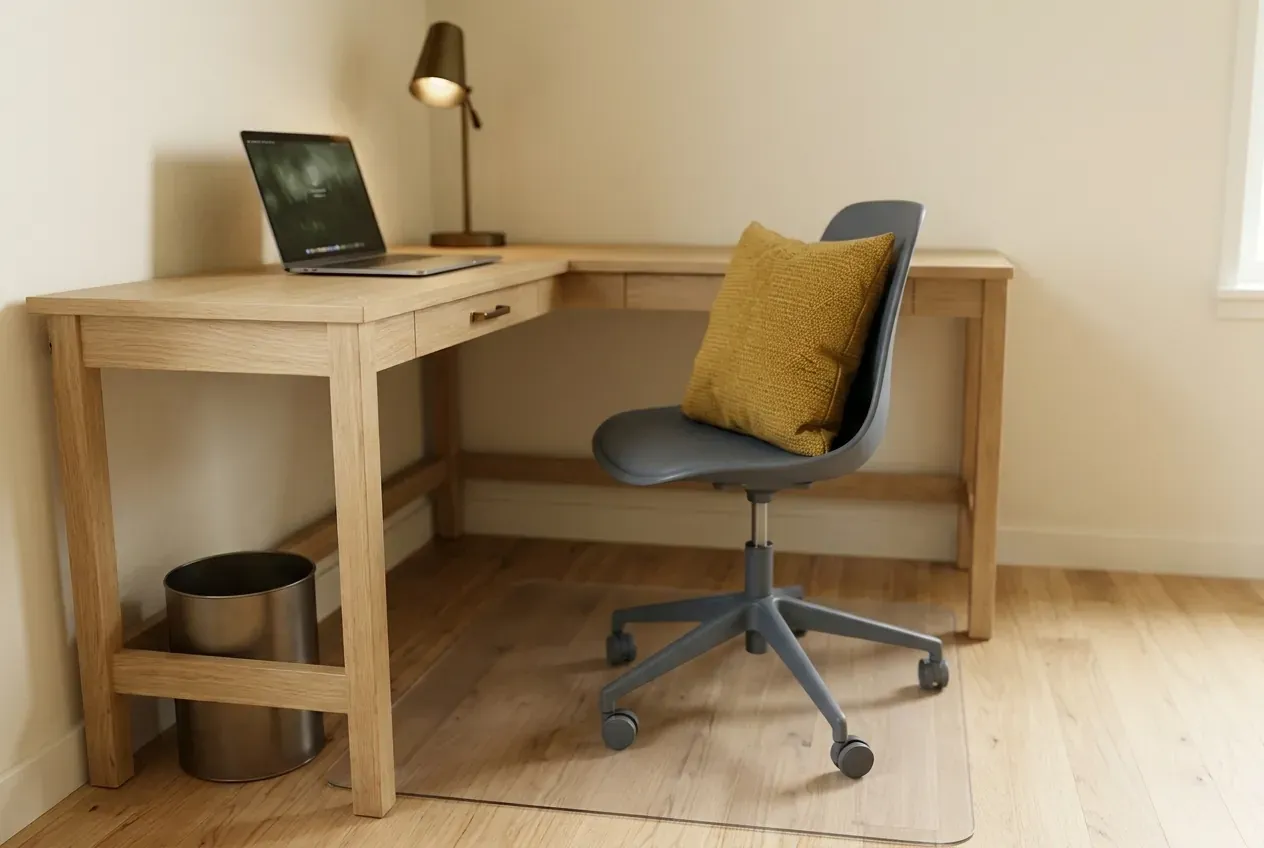 Close up: Keep each L-shaped desk arm at 40 to 48 in (102 to 122 cm) long and leave a 36 in (91 cm) square of clear floor at the inner angle for chair pushback.
Left or right return?
Most L-desks are reversible or sold in left and right versions. Put the return on the side nearer the wall, away from the door, so the open arm faces the room and you can step out without squeezing past a corner. If you are right-handed, keep the mouse arm clear of the wall.
Cables, shelf and light
A cable tray under the corner seam keeps power bricks off the floor, and a single floating shelf above one arm holds books without eating desk surface. Anchor shelves into studs if they will hold weight. A lumbar cushion on the chair adds warmth without adding clutter.
Set the screen about 20 to 26 in (51 to 66 cm) from your eyes with the top edge near eye level. On a shallow 18 to 20 in arm you may need a clamp-on monitor arm to get there without leaning forward. A pale wall with a warm wood desk and a darker chair keeps the corner calm.
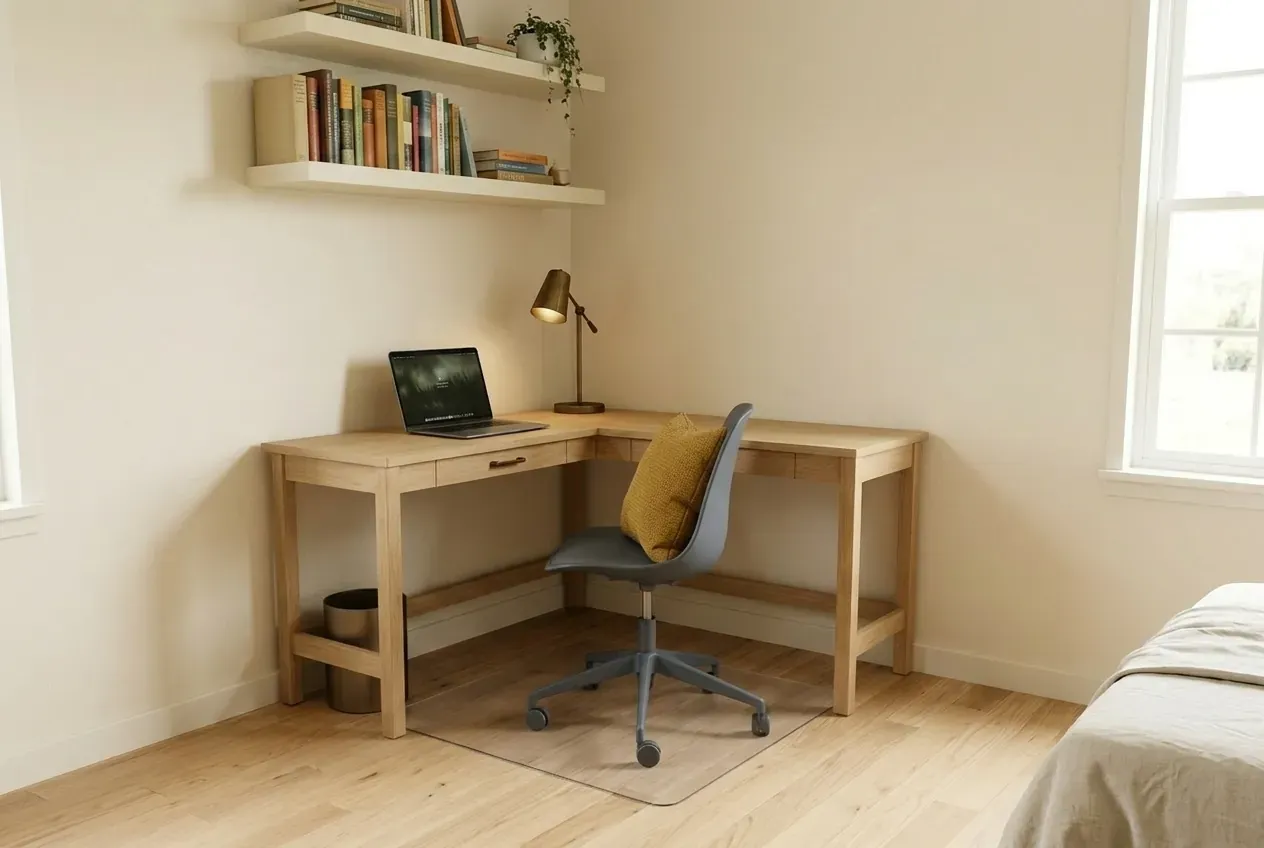 From above and to one side, the full footprint and the walkway read at a glance.
Common mistakes
- Ordering a standard office L-desk and finding it does not fit the corner.
- Forgetting the inner square and then hitting the bed with the chair.
- Placing the monitor facing the window instead of at a right angle to it.
- Using drywall anchors for a heavy shelf above the desk.
- Choosing a left return when the door side needed a right.
Before you buy
- Measure both walls from the corner: at least 40 in each.
- Tape the L and the 36 in inner square.
- Check 24 in between the return and the bed or closet door.
- Choose arm depth of 18 to 20 in and a height of 29 to 30 in.
- Plan the cable tray and outlet.
- Decide left or right return before ordering.
Curated Color Palette & Key Textures
- Cream Paper #F4F0E2
- Mustard Gold #D9A441
- Deep Bronze #8A6A22
- Slate Grey #4A5568
General references
Dimensions in these guides are typical planning ranges, not legal minimums, and they can differ by jurisdiction. Use the references below as starting points, then confirm local code and your lease before making changes.
FAQ
How do I fit an L-shaped desk in a small room?
Pick an apartment-sized L-desk with 40 to 48 in (102 to 122 cm) arms and 18 to 20 in (46 to 51 cm) depth, leaving a 36 in (91 cm) clear square for your chair.
How long should an L-shaped desk be?
For a 10 x 10 ft bedroom, 40 to 48 in (102 to 122 cm) per arm gives plenty of surface without crowding the bed.
Is an L-shaped desk good for a small space?
Yes—if you need separate zones for a monitor and writing, an L-desk turns a dead corner into usable surface more efficiently than two separate tables.
Save this idea

Keep reading
Related rooms
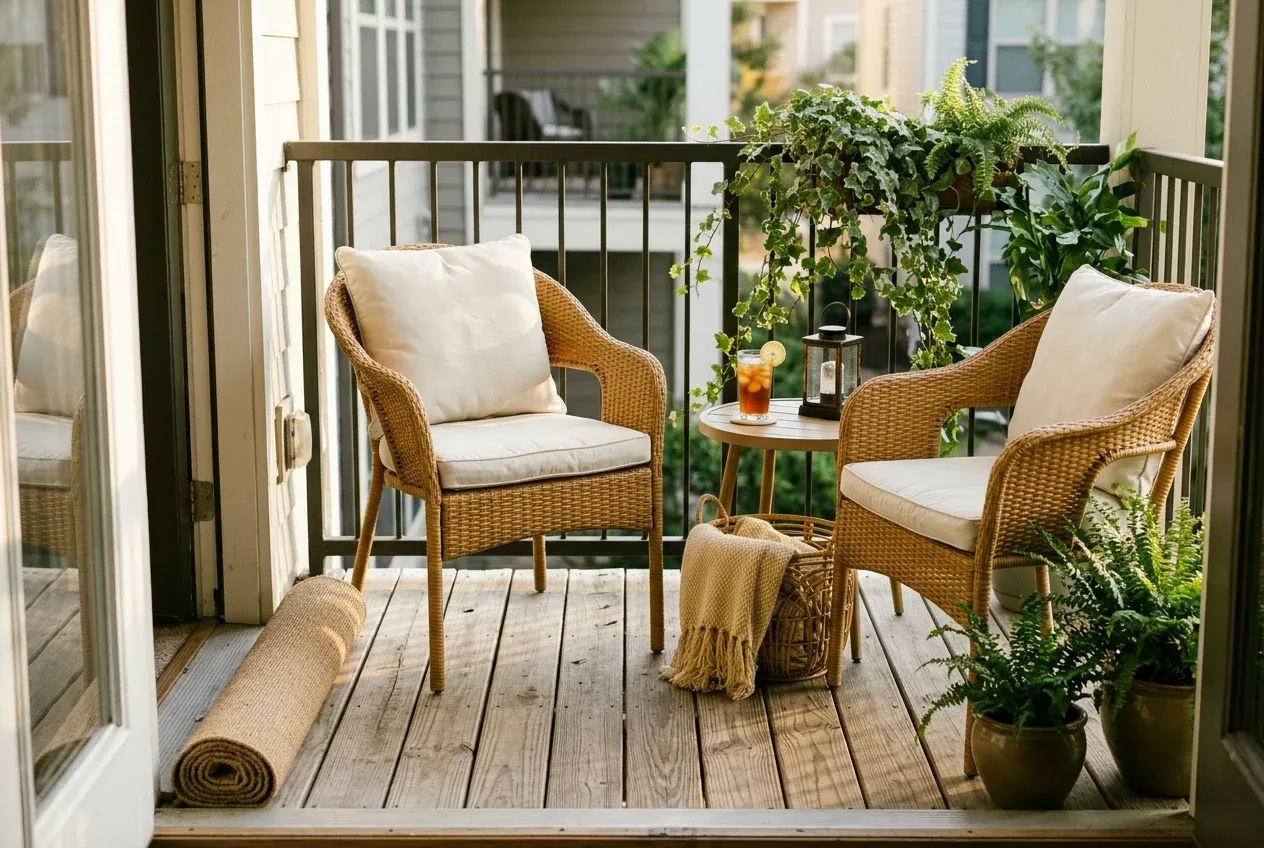
Wicker and Rattan Furniture for a Small Balcony
What wicker furniture is, how it differs from rattan and which version survives a small balcony: weave materials, weather limits and a 4 x 8 ft layout.
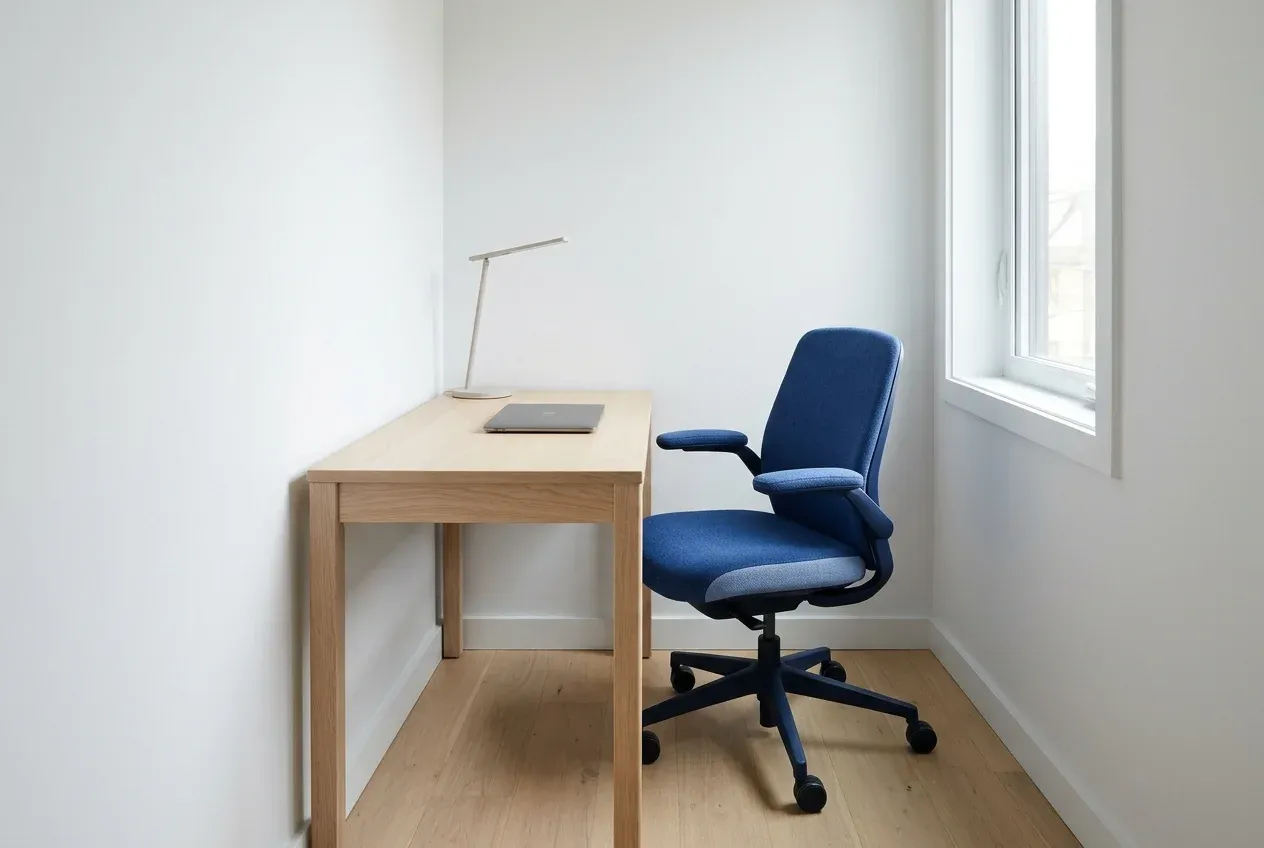
Most Comfortable Office Chair in a Studio Corner
Compact office chair comfort, measured: 16-20 in (41-51 cm) seat height, 2 in (5 cm) of knee room, folding arms, and a fit for 24 in (61 cm) deep desks.
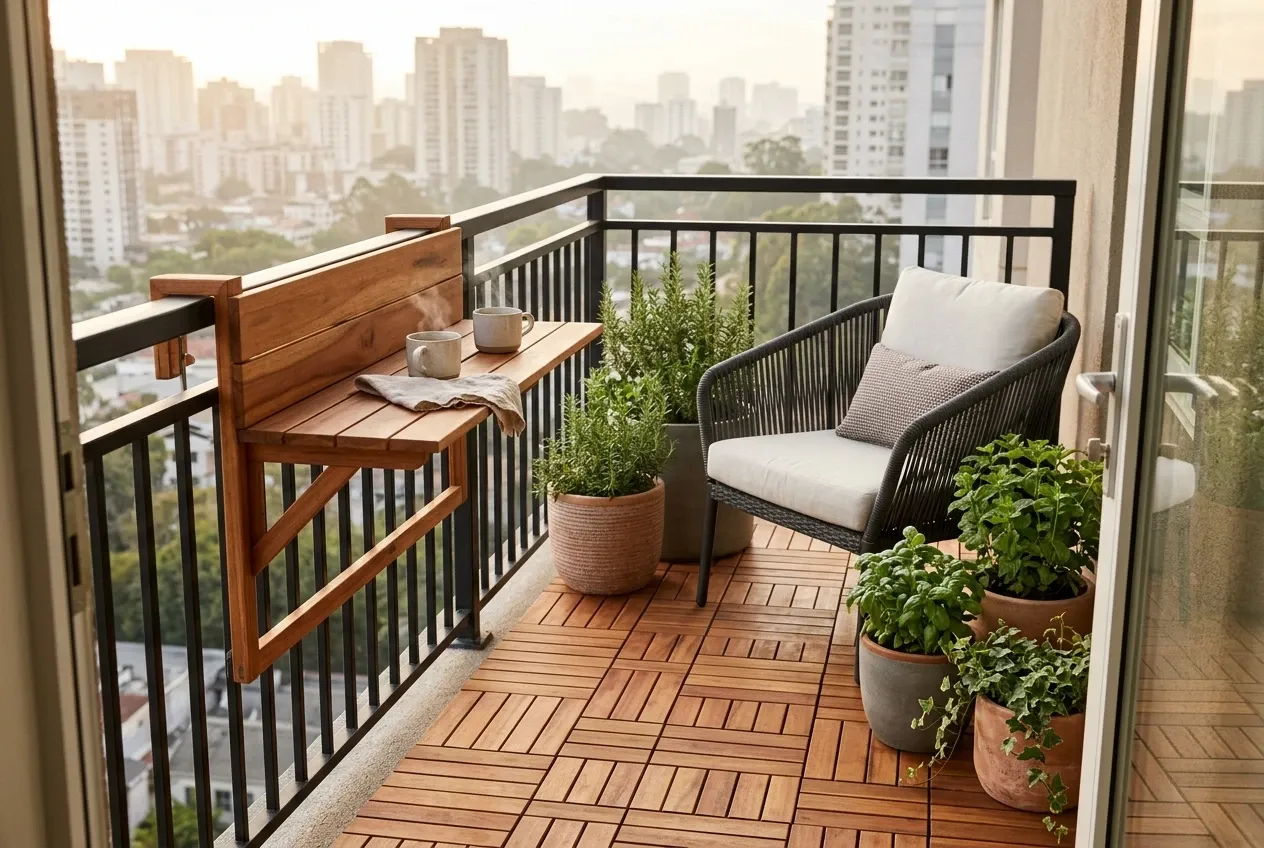
Small Balcony & Workspace Guide
A pillar guide to small balconies and home workspaces: furniture clearances, privacy screens, desk depths, and lighting for compact apartments.