Most Comfortable Office Chair in a Studio Corner
Compact office chair comfort, measured: 16-20 in (41-51 cm) seat height, 2 in (5 cm) of knee room, folding arms, and a fit for 24 in (61 cm) deep desks.
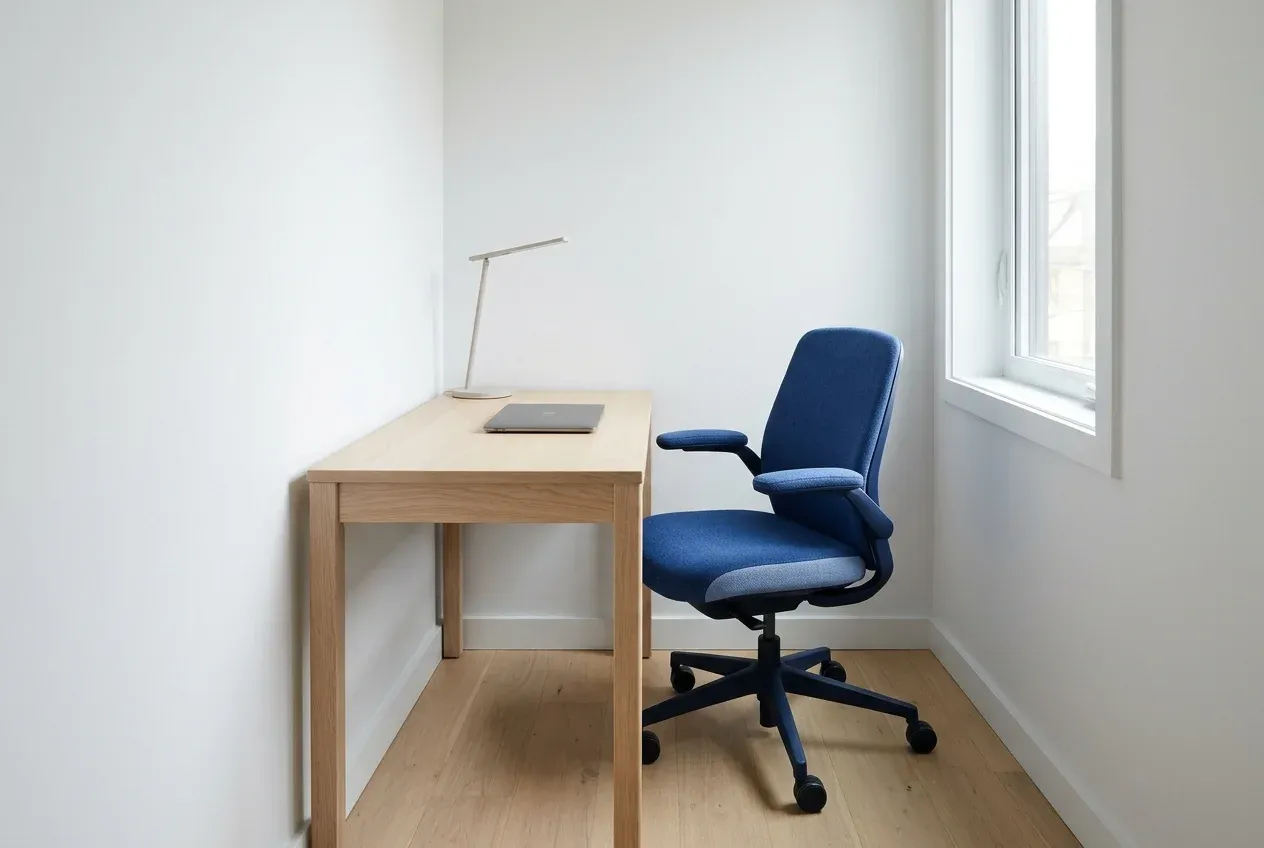
Room specifications
- Room ScaleStudio workspace (about 4 x 5 ft) in a corner of a 300 sq ft apartment
- Design StyleFocused Minimal Workspace
- Budget TierMid-Range ($$)
- Palette Swatches4 colors
The most comfortable compact office chair for a small studio corner is defined not by plush padding, but by four ergonomic numbers: 16–20 in (41–51 cm) seat height, a 2 in (5 cm) knee gap, belt-height lumbar support, and folding armrests. When you sit at a shallow 24 in (61 cm) apartment desk for eight hours, a chair that fails any one of those measurements forces you to hunch forward or leaves the backrest protruding into your walkway.
The Most Comfortable Office Chair: Four Numbers
For broader desk placement in tight rooms, check our bedroom desk clearance guide and living-room desk layouts.
Blueprint: 4 x 5 ft (1.2 x 1.5 m) Studio Corner Workspace
- Desk Depth: 24 in (61 cm) deep by 42 in (107 cm) wide against the wall.
- Seat Height: 16–20 in (41–51 cm) from floor so elbows rest level at 24–27 in (61–69 cm).
- Pull-Out Zone: 18 in (46 cm) minimum clear floor behind the chair for standing up.
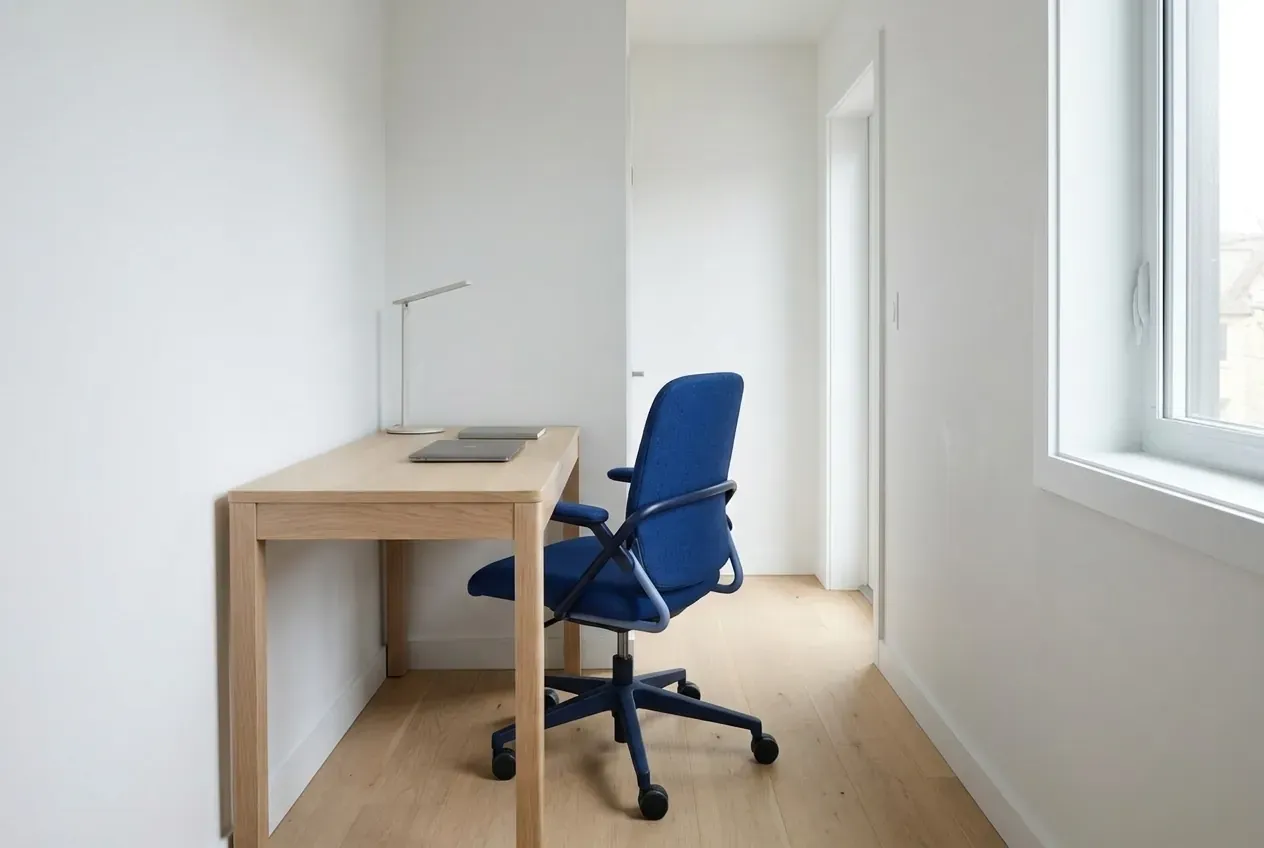 The same room seen from the opposite end, so you can judge the layout from the far side.
Seat Depth and the Knee Rule
Seat depth—the distance from the backrest to the front waterfall edge—is the most overlooked spec in ergonomic chairs. Sit all the way back against the lumbar pad and check the gap behind your calves: you need 2 in (5 cm) (roughly three fingers) of clear space between the cushion edge and the back of your knee.
If the seat pan is too deep, it presses into your popliteal blood vessels, cutting off circulation or forcing you to perch on the front edge without back support. Look for a sliding seat pan (16–19 in / 41–48 cm range), or use a firm 2 in (5 cm) lumbar pillow to shorten an overly deep seat.
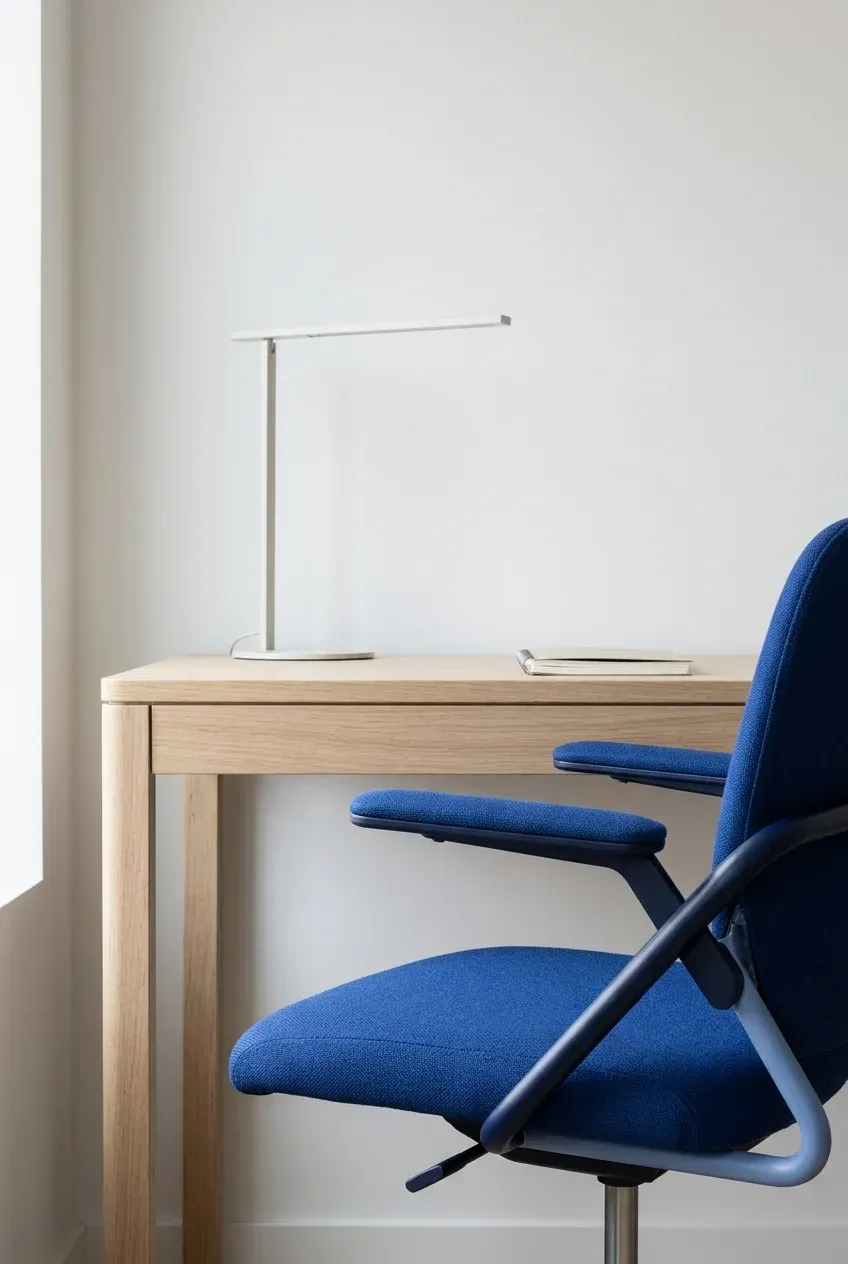
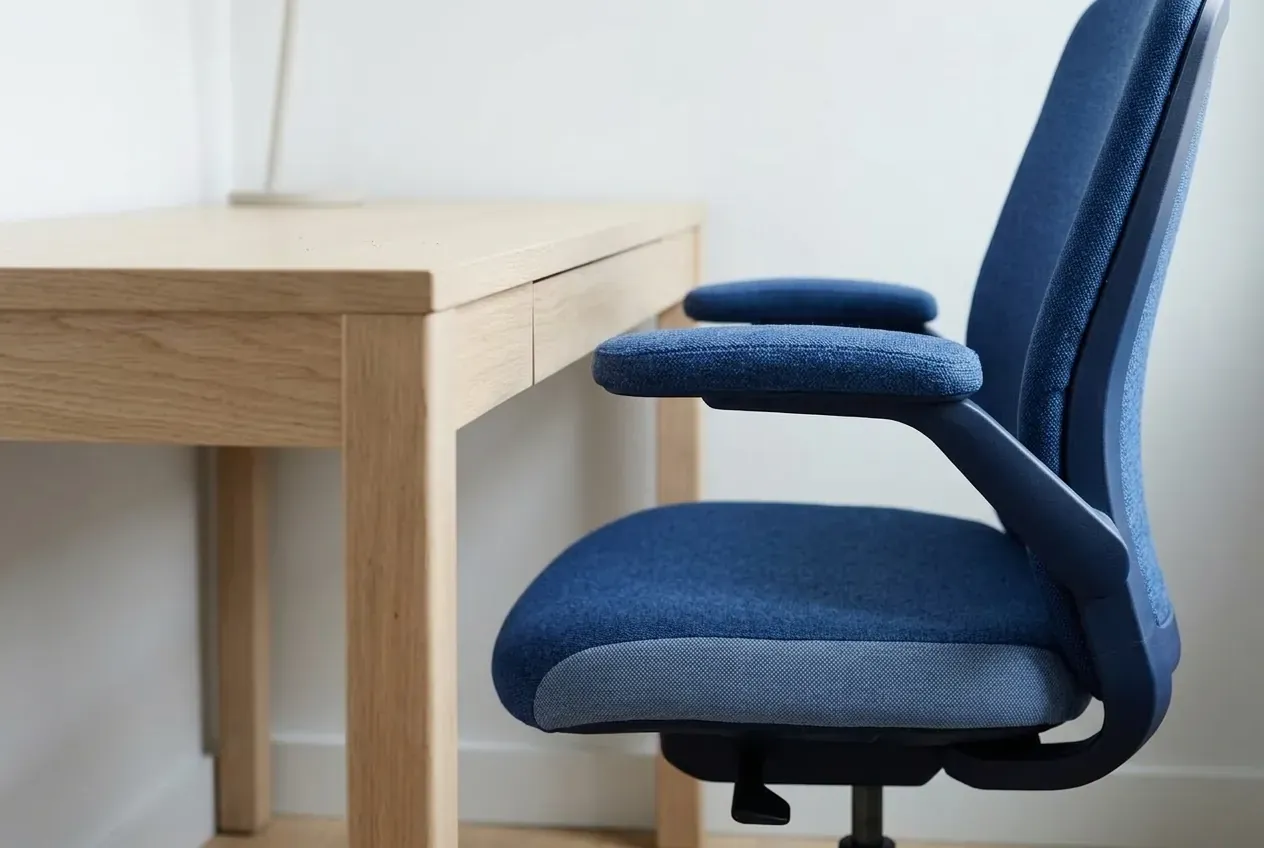 Close up: Set seat height so your elbows sit at 24-27 in (61-69 cm) and leave 2 in (5 cm) between the seat edge and the back of your knee.
Arms on a Shallow Desk
| Armrest Type | Clearance Under 29 in (74 cm) Desk | Small-Studio Verdict |
|---|---|---|
| Flip-Up / Folding Arms | Tucks completely under the desktop | Best—saves 6–8 in (15–20 cm) of walkway |
| Height-Adjustable Fixed | Needs 5 in (13 cm) drop below apron | Often hits keyboard trays on 24 in desks |
| Armless Task Chair | Slides flush to the wall | Cleanest footprint; less shoulder support |
On a 24 in (61 cm) deep desk, fixed arms that hit the desk edge keep the chair sticking 8 in (20 cm) out into the room. Flip-up arms solve both posture and circulation.
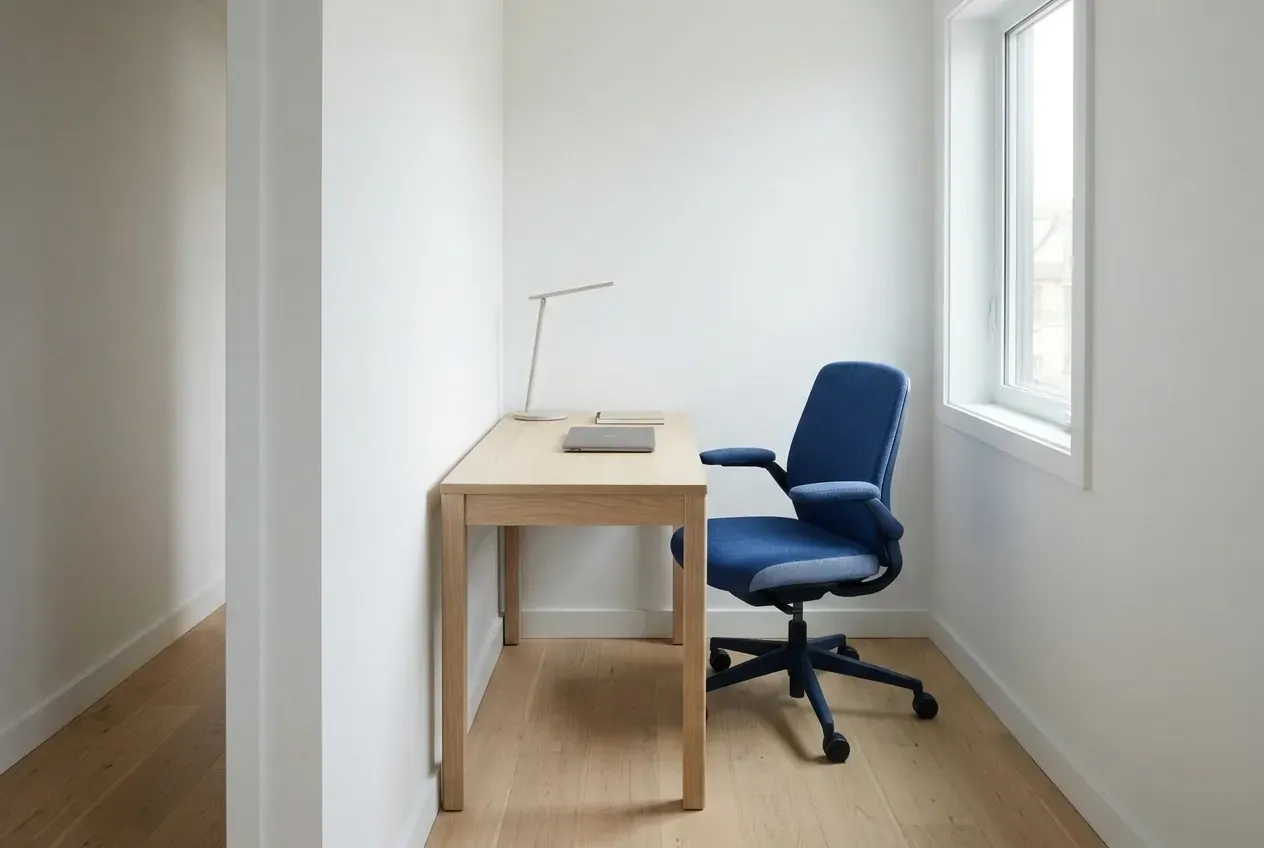 From above and to one side, the full footprint and the walkway read at a glance.
Fitting It Into a Corner
In a 4 x 5 ft (1.2 x 1.5 m) corner (or when sharing a two-person studio office), keep a 18 in (46 cm) pull-out zone behind the chair and swap hard nylon castors for soft polyurethane rollerblade wheels so a Cobalt Study #2F4C8C task chair glides silently without chewing up rental oak floors.
Daily Ergonomic Setup in 3 Minutes
- Monitor Eye Line: Once your seat height is locked at 16–20 in (41–51 cm), raise your laptop or monitor on a 5 in (13 cm) stand so the top third of the screen sits at eye level.
- Foot Support: If raising the chair to match a fixed 29 in (74 cm) dining-height desk lifts your heels, slide a 3 in (8 cm) angled footrest underneath to relieve lower-back tension.
- Rug Protection: Place a low-pile flatweave mat—never thick shag—underneath the 4 x 5 ft (1.2 x 1.5 m) chair zone so castors roll smoothly.
Before finalizing your purchase, verify the chair’s base diameter—most five-star castor bases span 24–26 in (61–66 cm), which fits neatly inside a 4 x 5 ft (1.2 x 1.5 m) corner only when the desk leaves 18 in (46 cm) behind you. Pair Study White #F2F4F8 walls with a Cobalt Study #2F4C8C task chair and Navy Ink #141F3D desk accessories so the workspace feels intentional rather than squeezed into the living area.
Test the lumbar tension and tilt-lock lever during your first week at the desk: a slight 100-degree recline relieves lower-spine compression far better than sitting ramrod straight at 90 degrees, while still keeping your shoulders aligned over a 24 in (61 cm) deep keyboard zone.
When all four measurements align, an 18 in (46 cm) pull-out zone is plenty for comfortable, pain-free work in a 4 x 5 ft (1.2 x 1.5 m) corner.
Related reading: L-shaped desk corner layouts, closet offices and their dimensions and compact corner desk dimensions for a studio.
Curated Color Palette & Key Textures
- Study White #F2F4F8
- Cobalt Mist #8FA9D6
- Cobalt Study #2F4C8C
- Navy Ink #141F3D
General references
Dimensions in these guides are typical planning ranges, not legal minimums, and they can differ by jurisdiction. Use the references below as starting points, then confirm local code and your lease before making changes.
FAQ
What makes an office chair comfortable?
Adjustable seat height, 2 in (5 cm) of clearance behind the knee, lumbar support at belt height, and arms that clear a shallow desk.
What seat height should an office chair be?
16-20 in (41-51 cm) from floor to seat, adjusted so your forearms sit level at 24-27 in (61-69 cm) desk height.
Do I need armrests on a small desk?
Only if they fold or tuck. Fixed arms need 5 in (13 cm) under the desk; on a 24 in (61 cm) deep desk they usually stop the chair sliding in.
Save this idea

Keep reading
Related rooms
Wicker and Rattan Furniture for a Small Balcony
What wicker furniture is, how it differs from rattan and which version survives a small balcony: weave materials, weather limits and a 4 x 8 ft layout.
Small Balcony & Workspace Guide
A pillar guide to small balconies and home workspaces: furniture clearances, privacy screens, desk depths, and lighting for compact apartments.
Small Apartment Bicycle Storage: Wall Mounts vs Floor Stands
Bicycle storage guide for small apartments: wall-mount versus floor-stand, the 68 in length and handlebar depth to plan for, and renter-safe mounting.