How to Install Curtain Rods Without Drilling: Renter Guide
Learn how to install curtain rods in a rental without drilling. Tension math, bracket weight ratings, mounting heights, and zero-damage removal rules.
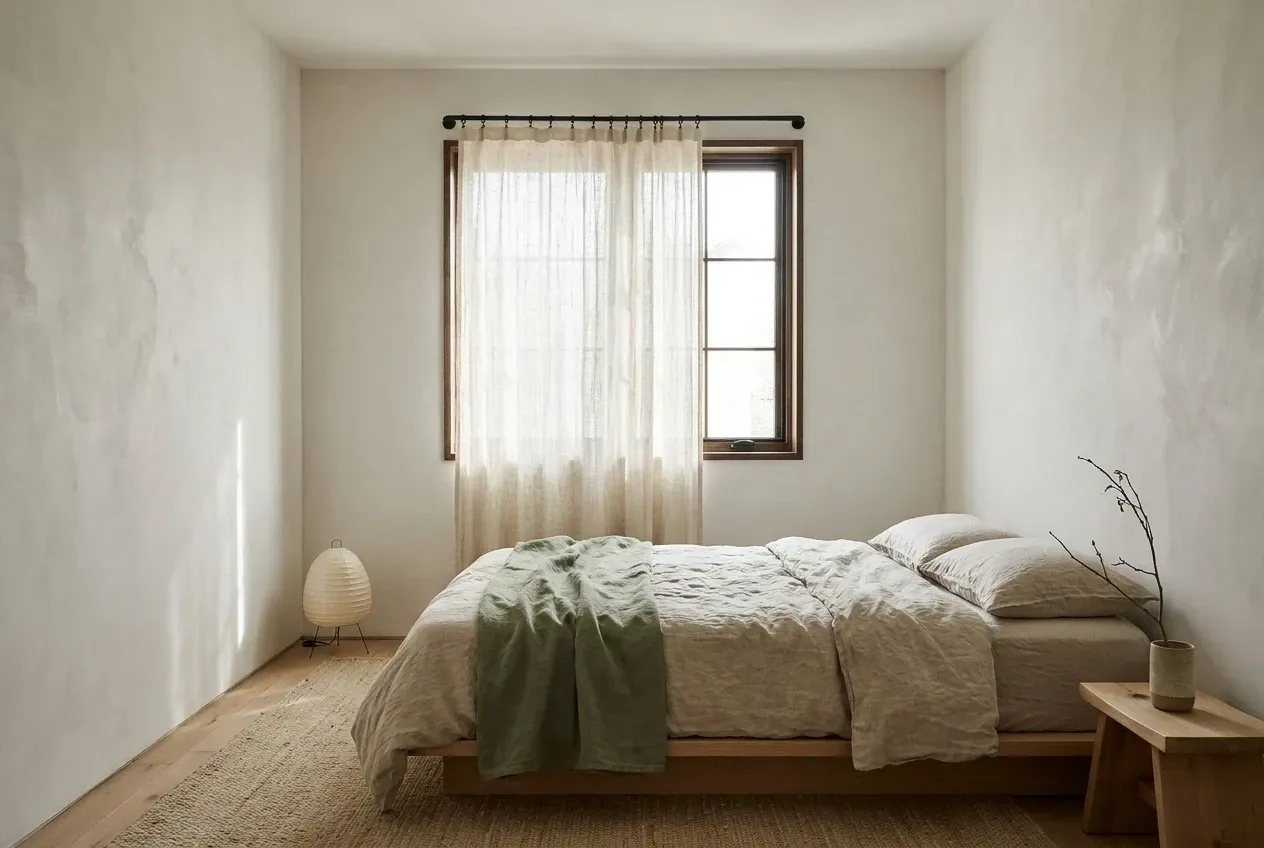
Room specifications
- Room ScaleSmall bedroom (about 10 x 11 ft)
- Design StyleWarm Minimalist / Japandi
- Budget TierBudget ($)
- Palette Swatches4 colors
Figuring out how to install curtain rods in a rental apartment often feels risky when your lease forbids drilling into drywall. Yet leaving your bedroom window uncovered exposes you to streetlights, heat gain, and morning glare.
When you rush into buying a temporary rod without checking its load capacity, the hardware fails predictably: an undersized tension spring slips down the trim in the middle of the night, or an over-weighted adhesive hook tears a strip of latex paint off the drywall. Panel size sets the weight the rod must carry, so check the standard curtain sizes chart before you choose hardware.
To complete a relaxing Japandi bedroom or frame an accent wall, you must match your window casing depth, curtain textile weight, and rod hardware with precision. The mounting height and side extension matter just as much — the curtain rod height and spacing rules work through the 4 to 6 inch offset above the casing.
1. Which No-Drill Rod Fits Your Window
Select your mounting method based on your window casing profile and curtain weight.
| Renter-Friendly Curtain Rod Type | Where It Mounts | Best For | Weight Caution |
|---|---|---|---|
| Spring tension rod | Inside window jamb | Lightweight sheers and linen panels | Typically holds 5–10 lbs (2.3–4.5 kg). Slips if frame is oily. |
| Heavy-duty twist rod | Inside window jamb | Medium blackout liners + cotton drapes | Typically holds 15–25 lbs (6.8–11.3 kg). Needs flat 1.5 in jamb. |
| Adhesive bracket rod | Drywall above frame | Outside-mount drapery pools | Typically holds 8–12 lbs (3.6–5.4 kg). Weakens in high humidity. |
| Clip-on frame bracket | Top lip of trim casing | Outside-mount without wall glue | Typically holds 10–15 lbs (4.5–6.8 kg). Requires sturdy wooden trim. |
Always check the product spec sheet for the exact load rating of the rod and brackets before hanging your panels.
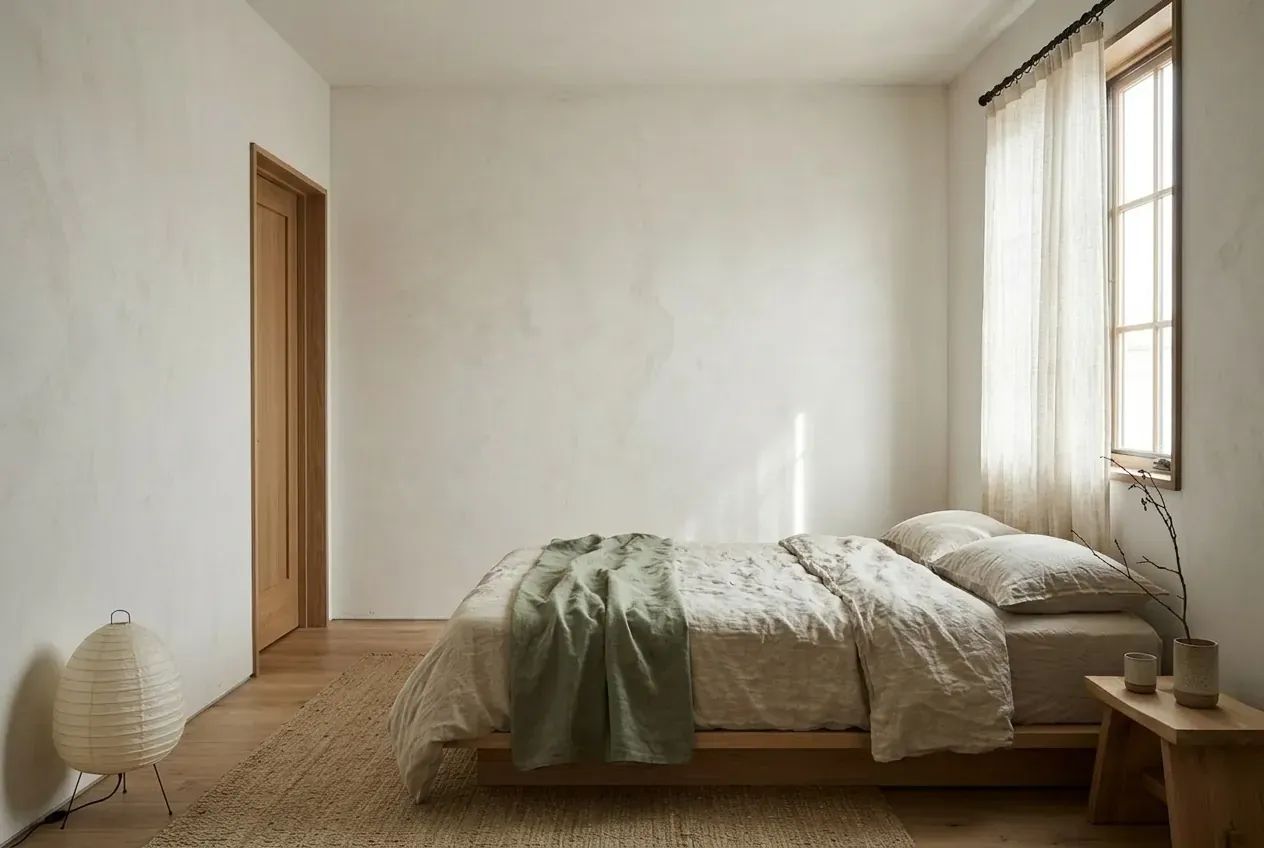 The same room seen from the opposite end, so you can judge the layout from the far side.
2. Small-Bedroom Window Setups
Each blueprint pairs a renter friendly curtain rod with a fabric weight it can actually carry.
Setup A: Inside-the-Frame Sheer
Best for rental rooms where deep sills or baseboard radiators prevent floor-length drapes.
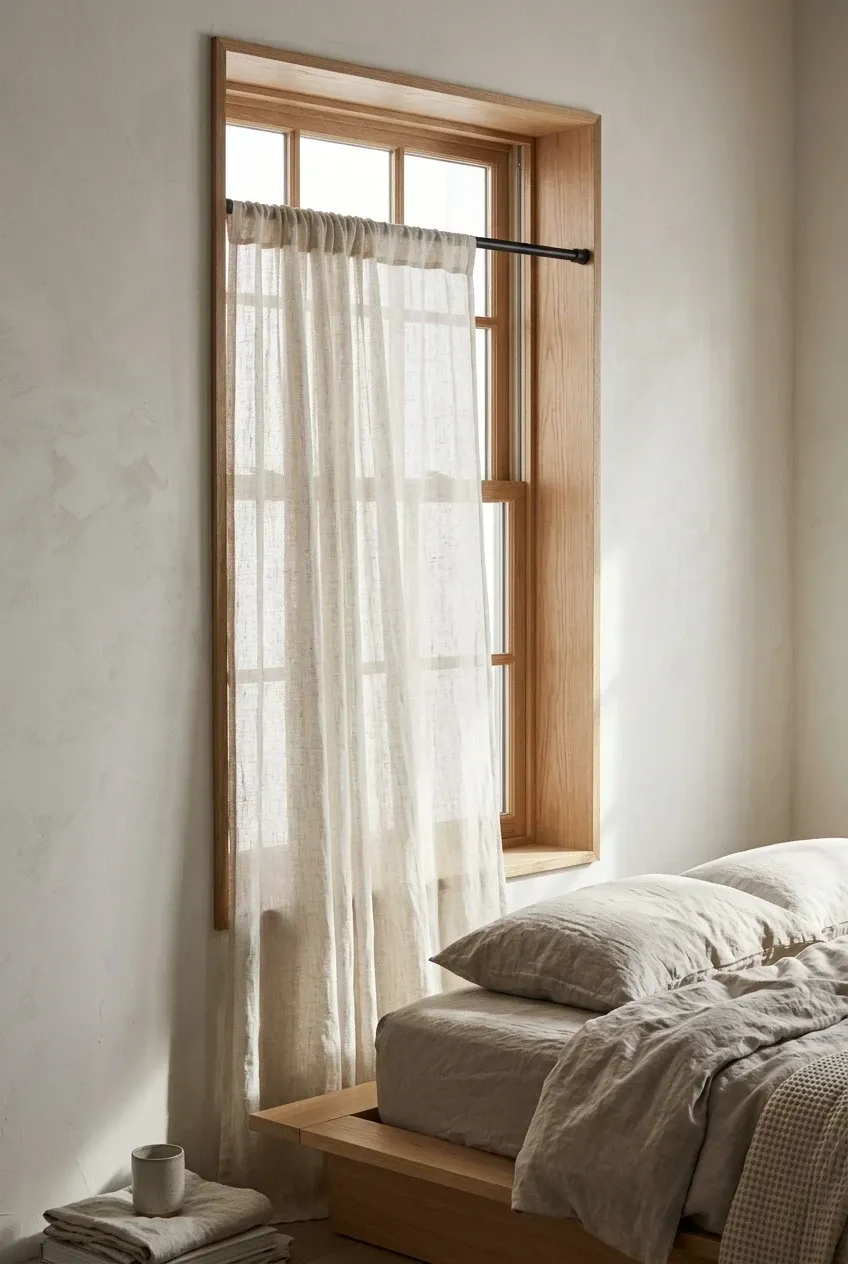
- Rod Choice: Slim 0.75-inch (1.9 cm) diameter steel spring tension rod mounted inside the upper window jamb.
- Textile: Unlined washed Belgian flax sheer curtains in Natural Cream (
#F5F2EB). - Clearance: Rod sits 1 inch (2.5 cm) back from the front face of the window frame, letting fabric hang freely without touching glass condensation.
Setup B: Blackout Liner Layer
Best for light sleepers facing bright streetlamps or morning sun.
- Dual Setup: Mount an interior tension rod holding a white blackout cellular shade directly inside the window recess.
- Secondary Layer: Install clip-on trim brackets along the exterior casing header to hang decorative linen drapery that stacks outside the frame.
- Coverage: Extends 4 inches (10.2 cm) beyond the frame on each side to eliminate side light halos.
Setup C: Short Curtain Over a Radiator-Free Sill
Best for bedrooms where the sill sits 30 inches (76.2 cm) above the floor.
- Drape Length: Hang panels that stop precisely 0.5 inches (1.3 cm) above the sill, keeping fabric from bunching over heaters.
- Aisle Space: Leaves an open walkway beneath the window for a low platform bed or nightstand.
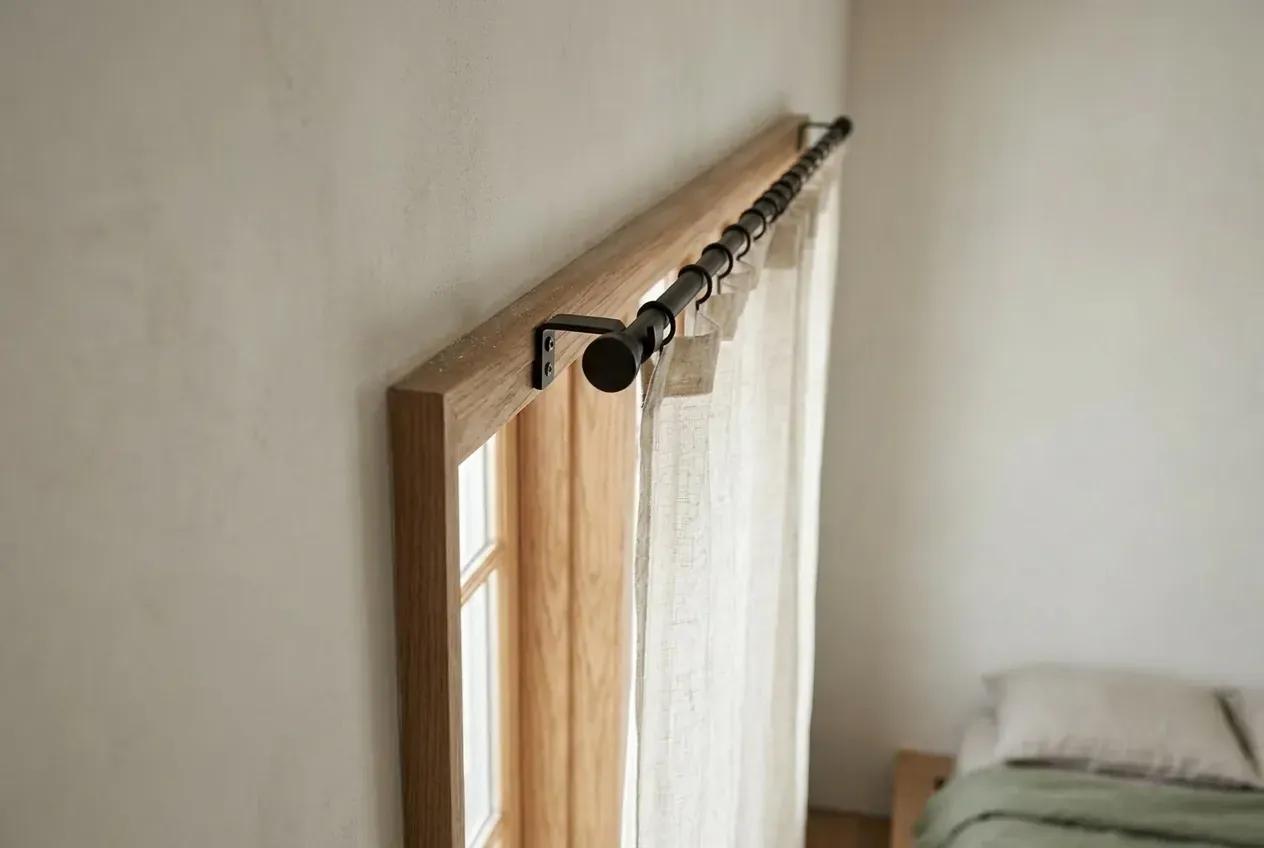 Close up: Measure the window opening width in inches (cm) and leave 4 in (10 cm) above the frame when the rod mounts outside it.
3. Fabric Weight Math and Installation Safety
No drill curtain rods solve a rental problem, but the hardware still has a physical limit. Curtain fabric is deceptive: a single lined blackout panel can weigh 4 to 6 lbs (1.8 to 2.7 kg). Follow these essential safety protocols:
- Weigh Before Hanging: Weigh your drapery panels on a household kitchen scale before hanging them. Never exceed 75% of your rod’s rated capacity to account for downward pulling force when opening and closing curtains.
- Heat and Humidity Risks: Window trim absorbs solar heat and condensation. Adhesive brackets can soften and fail when exposed to prolonged 90°F+ (32°C+) direct summer sun. Clean the surface with isopropyl alcohol before applying adhesive pads.
- Cord and Child Safety: Choose cordless tension shades or keep continuous cord loops anchored tightly to the wall frame with safety clips, well out of reach of children and pets.
- Radiator Clearances: Never allow curtain fabric to touch electric baseboard heaters or steam radiators. Keep a vertical gap of at least 6 to 8 inches (15.2 to 20.3 cm) above heating elements.
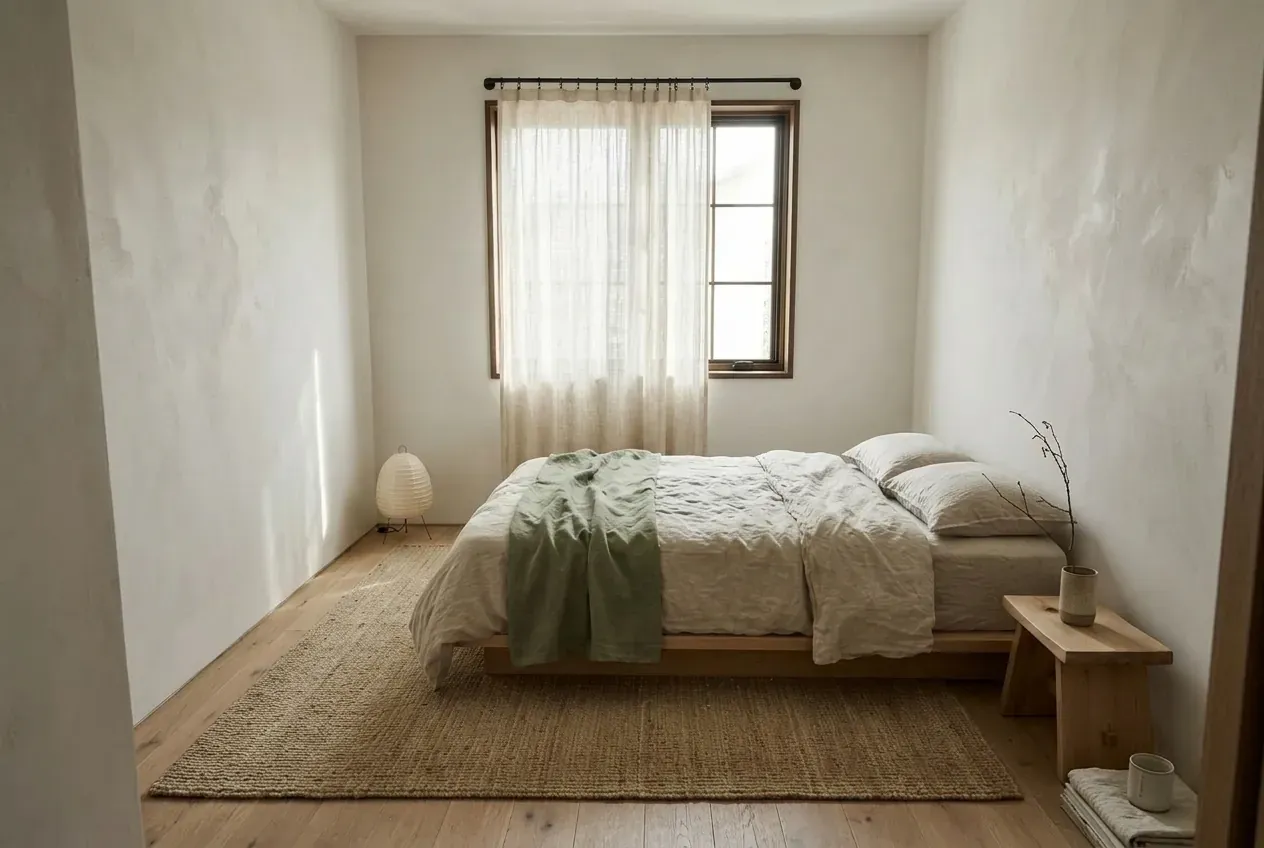 From above and to one side, the full footprint and the walkway read at a glance.
4. Colors That Keep the Window Calm
A serene window treatment filters harsh daylight into a soft, diffused glow.
Let the walls and ceiling carry most of the room in Alabaster Chalk (#F5F2EB, approximate LRV 83) so the window surround stays bright and glare-free. Hang curtain panels in Oat Linen (#D9CDB8, approximate LRV 60) for textured depth and warm, filtered afternoon light. Keep the darkest tone for small touches: Charcoal Ink (#2F3135, approximate LRV 8) on slim metal tension rods, plus a folded Sage Moss throw (#9AA58A, approximate LRV 38) on the bed.
5. How to Hang a No-Drill Curtain Rod in 5 Steps
Measure first, then hang. Rushing the mounting step is what pulls paint or drops a rod at 2 a.m.
- Clean and dry the contact surface. Wipe the inside jamb or the drywall above the frame with isopropyl alcohol and let it dry fully. Oil, dust, and cooking film are the main reason tension rods slip and adhesive pads release.
- Set an inside-mount tension rod. Twist the rod to extend it 1 to 2 inches (2.5 to 5.1 cm) wider than the opening, then compress it and seat both rubber ends against the jamb. Press each end for 10 seconds. The rod should sit 1 inch (2.5 cm) back from the front face of the frame so fabric clears the glass.
- Mark an outside-mount rod. Measure 4 inches (10.2 cm) above the top of the window trim and mark both ends. Extend the rod 3 to 6 inches (7.6 to 15.2 cm) past the frame on each side so the panels stack over the wall, not the glass, and no side-light halo leaks in.
- Level the rod before loading it. Check with a spirit level, or measure down from the ceiling at both ends and match the two numbers. A rod that is 0.25 inch (6 mm) out of level is visible once heavy panels hang on it.
- Load-test, then hang the fabric. Press an adhesive bracket firmly for 60 seconds and let it cure for 24 hours before hanging anything. Test a tension rod by pulling down gently with about 5 lbs (2.3 kg) of force. Never load a rod past 75% of its rated weight.
On adhesive brackets: apply them to smooth, well-primed paint only. Over flaking or poorly primed walls the pad takes the paint with it at removal. Warm the bracket with a hair dryer and pull slowly, parallel to the wall, at move-out.
Measure the window opening width in inches (cm) and leave 4 in (10 cm) above the frame when the rod mounts outside it.
Curated Color Palette & Key Textures
- Alabaster Chalk #F5F2EB
- Oat Linen #D9CDB8
- Light Oak #C9A97C
- Sage Moss #9AA58A
General references
Dimensions in these guides are typical planning ranges, not legal minimums, and they can differ by jurisdiction. Use the references below as starting points, then confirm local code and your lease before making changes.
FAQ
How do you hang curtain rods without drilling holes in drywall?
Clean the surface with isopropyl alcohol first, then choose a mount: an inside-mount tension rod extends 1 to 2 inches (2.5 to 5.1 cm) wider than the opening and seats both rubber ends in the jamb, while an outside-mount adhesive bracket presses 4 inches (10.2 cm) above the trim and cures 24 hours before you hang fabric.
Do adhesive curtain rod brackets damage rental paint?
Adhesive brackets are safe on smooth painted drywall if removed slowly with a hair dryer, but they can pull off paint chips if applied over poorly primed or flaking walls.
How wide should a curtain rod be compared to the window?
An inside-mount tension rod must match the exact opening width, while an outside-mount rod should extend 3 to 6 inches (7.6 to 15.2 cm) past the frame on each side.
Save this idea

Keep reading
Related rooms
Bunk Bed Dimensions: 5 Sizes, Clearances & Safety Gaps
A twin bunk is 77 x 41 in (196 x 104 cm) and about 62 in tall: all 5 standard sizes, the 5 in guardrail rule, deck spacing and the ceiling check.

Standard Bed Sizes: Queen 60 x 80 in (152 x 203 cm)
Standard bed sizes in inches and cm: a double (full) is 54 x 75 in, a queen 60 x 80, a king 76 x 80, a California king 72 x 84, plus the room each needs.
Rug Size for a King Bed: 8x10 Shows 22 in Each Side
Rug size for a king bed: an 8x10 ft rug shows 22 in (56 cm) each side and 43 in past the foot; a 9x12 shows 34 in. See the maths, a chart and a calculator.