Blackout Curtain Sizes for Small Windows: Fullness Guide
Blackout curtain sizes for small windows: panels totalling 1.5 to 2x the window width, a 4 to 6 in (10 to 15 cm) wrap, and light-gap fixes that work.
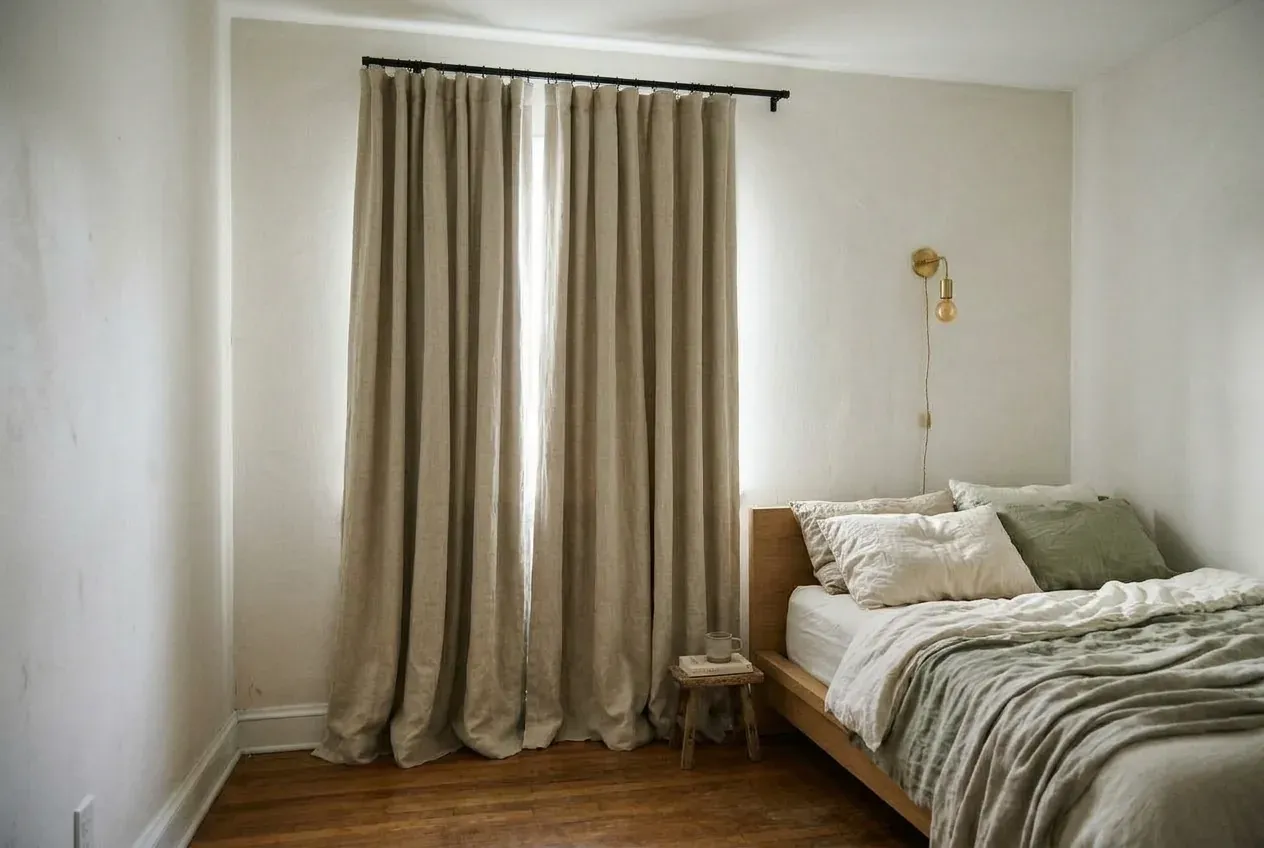
Room specifications
- Room ScaleSmall bedroom (about 10 x 11 ft)
- Design StyleWarm Minimalist / Japandi
- Budget TierMid-Range ($$)
- Palette Swatches4 colors
For blackout curtain sizes for small windows, buy panels that total 1.5 to 2 times the window width, mount the rod 4 to 6 in (10 to 15 cm) above the frame and 4 to 6 in past each side, and overlap the two panels in the middle by 2 to 3 in (5 to 8 cm). Coverage blocks light, not just fabric thickness.
A small bedroom with one window is hard to keep dark. The window is the only daylight source, so it is also the only source of 5 a.m. summer sun, and because the room is small the bed is close to the glass. Most failures come from sizing. A blackout panel exactly as wide as the window lets light stream down both sides and across the top, and the room ends up almost as bright as before.
Blackout curtain sizes for small windows: how wide should the panels be?
Start with the window width, add the wrap on each side, then multiply for fullness. The standard curtain sizes chart gives panel widths and lengths to match against your total.
A 36 in (91 cm) window with a 4 in wrap on each side needs coverage of 44 in (112 cm). At 2x fullness that is 88 in (224 cm) of total panel width, or two 44 in panels. One 44 in panel gives a flat, tight curtain with a permanent light gap. Fullness creates folds, and the folds overlap instead of lying flat.
| Measurement | Minimum | Target |
|---|---|---|
| Rod past the window | 4 in (10 cm) | 4 to 6 in (10 to 15 cm) |
| Rod above the window | 4 in (10 cm) | 4 to 6 in (10 to 15 cm) |
| Panel fullness | 1.5x width | 2x width |
| Centre overlap | 2 in (5 cm) | 2 to 3 in (5 to 8 cm) |
| Side return to the wall | Flush | 2 to 4 in (5 to 10 cm) |
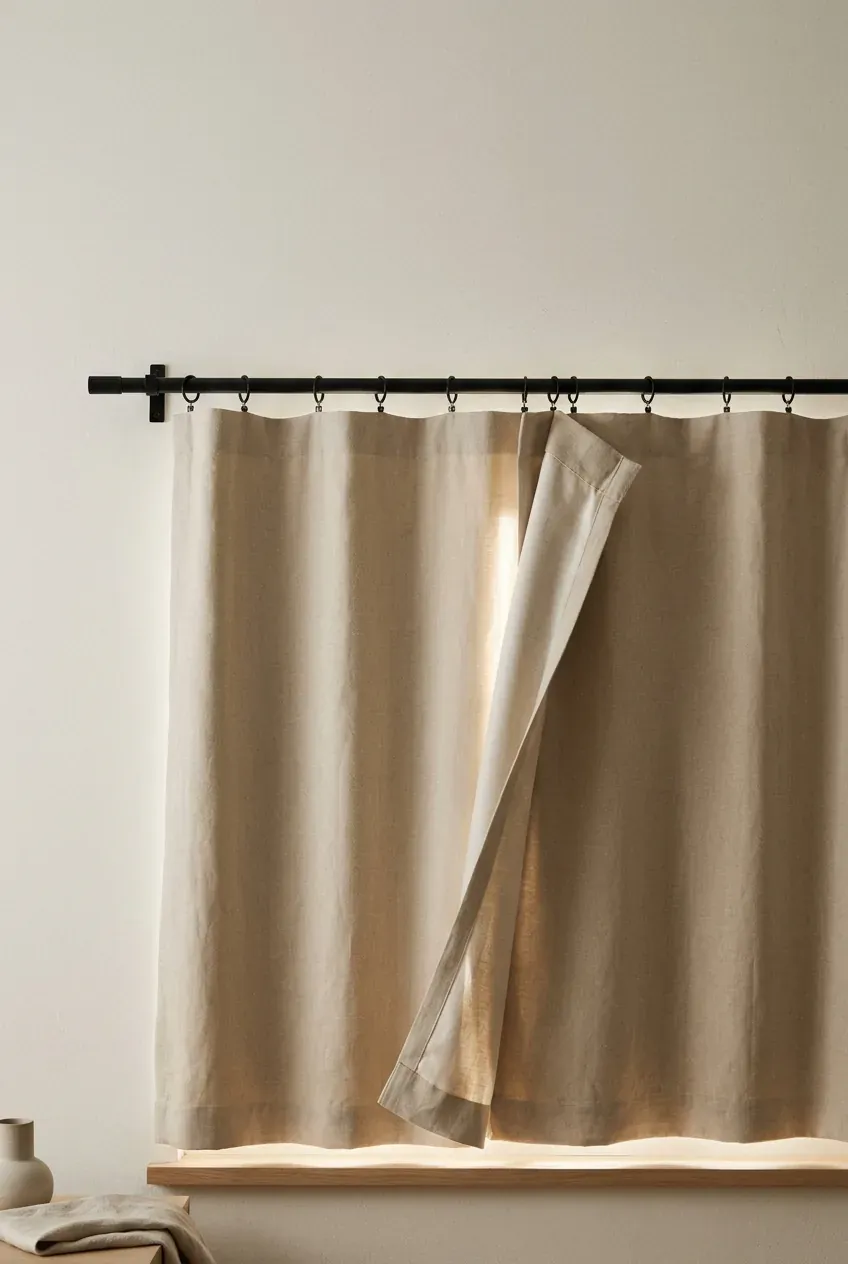
Fabric weight matters in a small room too. Heavier fabric hangs straight and stays where you put it. Lightweight blackout fabric creases, curls at the edges and drifts open at the centre, which reopens the gap you just closed. Hold a panel to a bright window before buying: if you can see the weave glowing, no sizing will make it black out.
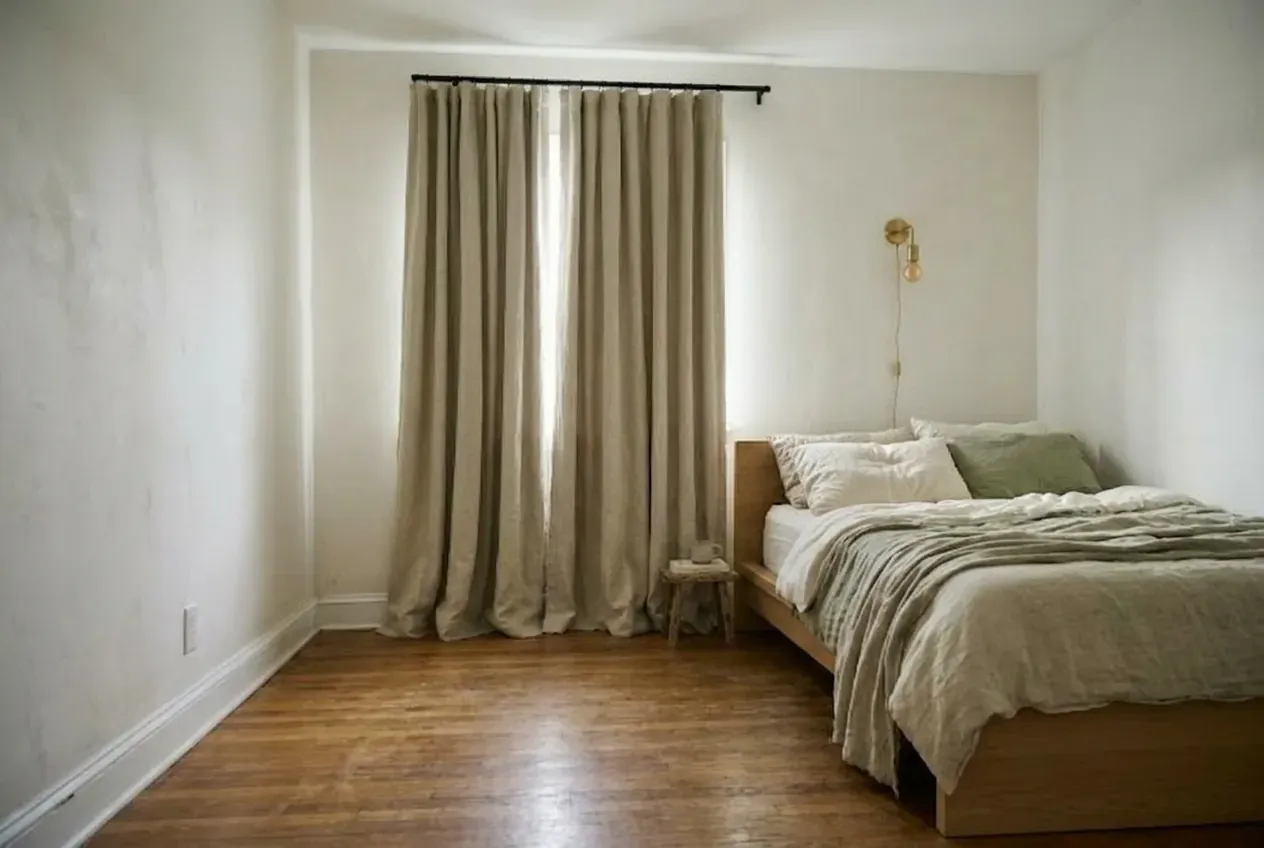 The same room seen from the opposite end, so you can judge the layout from the far side.
Which length?
Choose from three lengths:
- Sill length, ending 1 in (2.5 cm) below the sill. Best when a radiator, bench or desk sits under the window.
- Below the sill, ending 4 to 6 in (10 to 15 cm) below it.
- Floor length, ending 0.5 in (1.3 cm) above the floor. This blocks the most light, because no light pools under the hem.
Measure from the planned rod height to your chosen drop, and pick the longest length that clears your furniture and any heater.
Setups for common small windows
A standard single window. A 36 x 48 in window gets a rod 48 to 52 in wide, set 4 to 6 in above the frame, with two 44 in panels at floor length. You get a near-dark room with a 2 to 3 in overlap in the middle.
A window above a radiator. A 30 in window with a radiator below needs a 40 in rod, 4 in above the frame, and two 36 in thermal-backed panels at sill length, ending 1 in below the sill so heat can still rise. This keeps the heater clear, which matters for safety as well as warmth.
A very narrow, high window. For a 24 in window, use a wrap-around or ceiling track set about 6 in past each side, and one wide panel returned to the wall. A single panel has no centre seam to leak through.
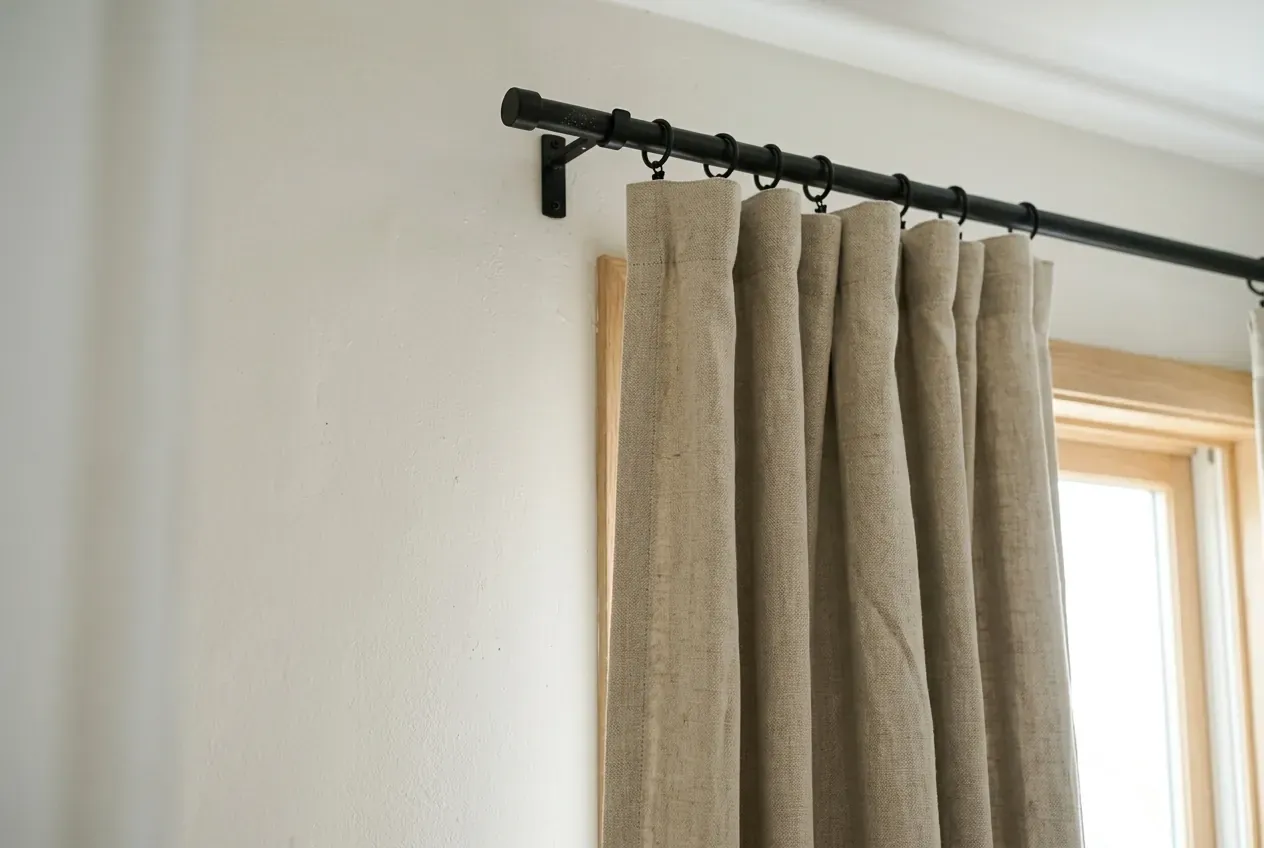 Close up: Panel width 1.5x to 2x the window; rod 4 to 6 in (10 to 15 cm) past each side.
Fixing the four light gaps
Even a well-sized panel leaks until you deal with each edge.
- Top gap. Light arcs over the frame and down the wall. Raise the rod 4 to 6 in above the window and choose a panel with a firm header.
- Side gaps. These are the biggest leak in most rooms. Use a wrap-around rod or side-return bracket to turn the edge back to the wall.
- Centre gap. Overlap the panels by 2 to 3 in and add a small clip.
- Bottom gap. End the hem about 0.5 in above the floor instead of 3 in short.
A lined panel with thermal backing also helps with heat: it reduces heat gain through a sunny window and slows overnight heat loss. How much depends on the product, so treat any claim on the pack as the maker’s figure rather than a guarantee. In a small room with one exterior wall the comfort difference is usually noticeable in both seasons.
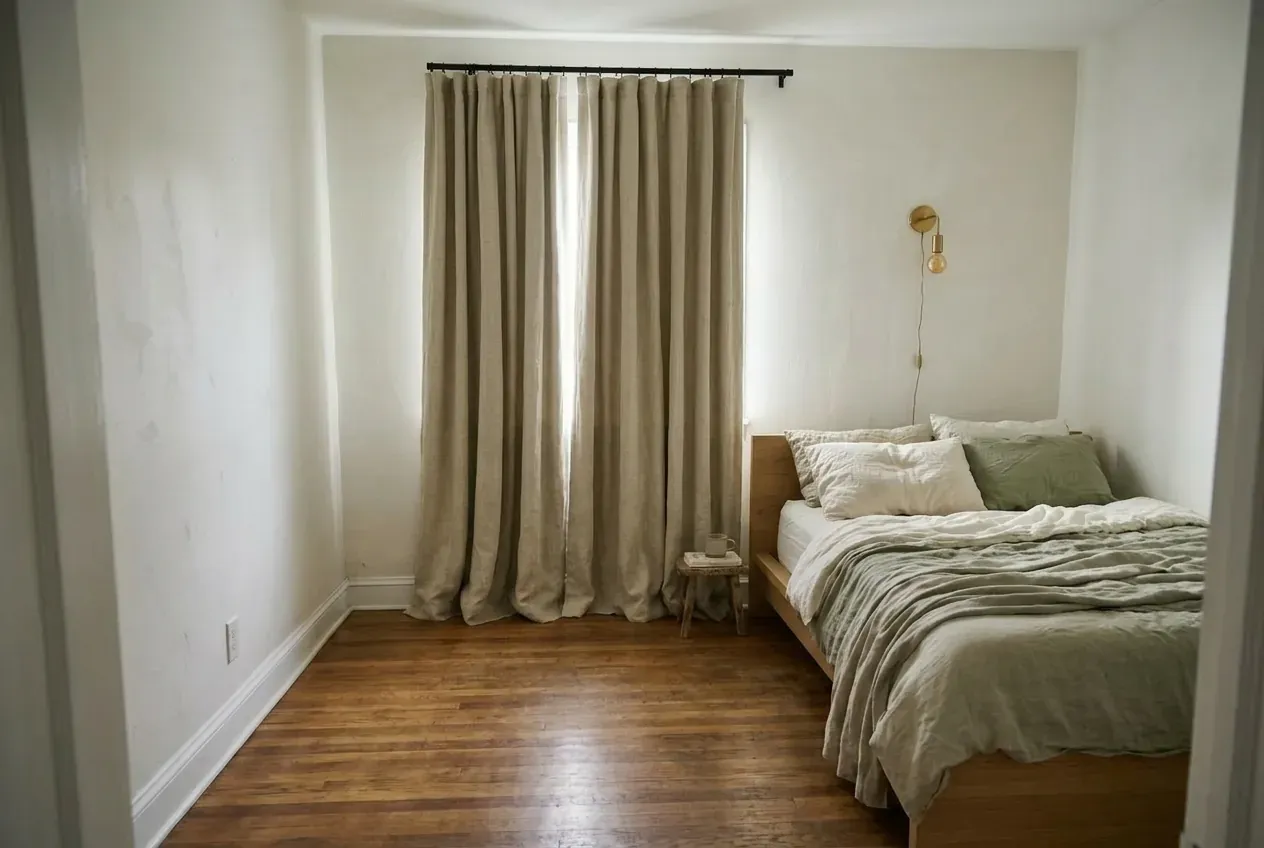 From above and to one side, the full footprint and the walkway read at a glance.
Hanging it in a rental
A blackout setup should come down at move-out with nothing to repair.
- Tension rod or adhesive bracket. A tension rod needs no drilling and suits lighter panels. For heavier lined panels, use an adhesive bracket rated for the load. The curtain rod install guide covers heights, load ratings and no-drill methods in detail.
- Do not screw into the window frame. It is the most common lease problem with curtains. Keep mounting on the wall or inside the recess.
- Check the weight. A lined blackout panel can weigh a few pounds. Confirm the rod and brackets are rated above the total, because a sagging rod reopens the top gap.
- Protect the paint. Wipe the wall before pressing adhesive and release it with dental floss rather than prying.
- Keep the window operable. Never cover an emergency exit. Fire egress always comes first.
The colour of the panels sets the tone of the room, since they cover a large vertical area. Warm, soft tones in the same family as the walls look calmer than stark dark panels. The curtain colour guide helps with choosing, and a plug-in warm sconce gives you light once the curtains are drawn. If the window is full height, the floor-to-ceiling window guide covers track and drop measurements.
Before you order
- Measure the window width and add 4 to 6 in on each side.
- Multiply the covered width by 1.5 or 2 and buy panels to match.
- Choose sill, below-sill or floor length.
- Check the fabric against a bright window.
- Weigh the panels against the rod or bracket rating.
- Hang them, close them at night, and look for leaks before trimming anything.
Curated Color Palette & Key Textures
- Alabaster Chalk #F5F2EB
- Oat Linen #D9CDB8
- Light Oak #C9A97C
- Sage Moss #9AA58A
General references
Dimensions in these guides are typical planning ranges, not legal minimums, and they can differ by jurisdiction. Use the references below as starting points, then confirm local code and your lease before making changes.
FAQ
How wide should blackout curtains be for a small window?
Use panels totalling 1.5 to 2 times the window width. A 36 inch (91 cm) window needs 54 to 72 inches (137 to 183 cm) of total panel width so the fabric has folds and the light gaps close.
How do you stop light leaking around the edges of blackout curtains?
Extend the rod 4 to 6 inches (10 to 15 cm) past each side of the window and 4 to 6 inches above it, then overlap the two panels in the center. Wrapping the sides back to the wall closes the last sliver.
Do blackout curtains keep a room cooler?
Yes, when they have a thermal backing. A lined blackout panel reduces heat gain through a sunny window and slows winter heat loss at night, which matters in a small room with one exterior wall. The size of the effect depends on the product.
What length should blackout curtains be?
Choose one of three lengths: sill length ending 1 inch (2.5 cm) below the sill, below-sill ending 4 to 6 inches (10 to 15 cm) below, or floor length ending 0.5 inch (1.3 cm) above the floor. Floor length blocks the most light.
Are blackout curtains renter friendly?
Yes. Use a tension rod or an adhesive bracket so nothing is drilled, and pick a full-coverage panel so you do not need hardware on the frame. Both leave no holes at move-out.
Save this idea

Keep reading
Related rooms
Bunk Bed Dimensions: 5 Sizes, Clearances & Safety Gaps
A twin bunk is 77 x 41 in (196 x 104 cm) and about 62 in tall: all 5 standard sizes, the 5 in guardrail rule, deck spacing and the ceiling check.
Standard Bed Sizes: Queen 60 x 80 in (152 x 203 cm)
Standard bed sizes in inches and cm: a double (full) is 54 x 75 in, a queen 60 x 80, a king 76 x 80, a California king 72 x 84, plus the room each needs.
Rug Size for a King Bed: 8x10 Shows 22 in Each Side
Rug size for a king bed: an 8x10 ft rug shows 22 in (56 cm) each side and 43 in past the foot; a 9x12 shows 34 in. See the maths, a chart and a calculator.