Standard Rug Sizes Chart: Rug Size by Bed and Room
Standard rug sizes by bed and room, plus runner rug measurements: runners come in 2x6, 2.5x8 and 2.5x10 ft, and a queen bed takes a 6x9 ft rug.
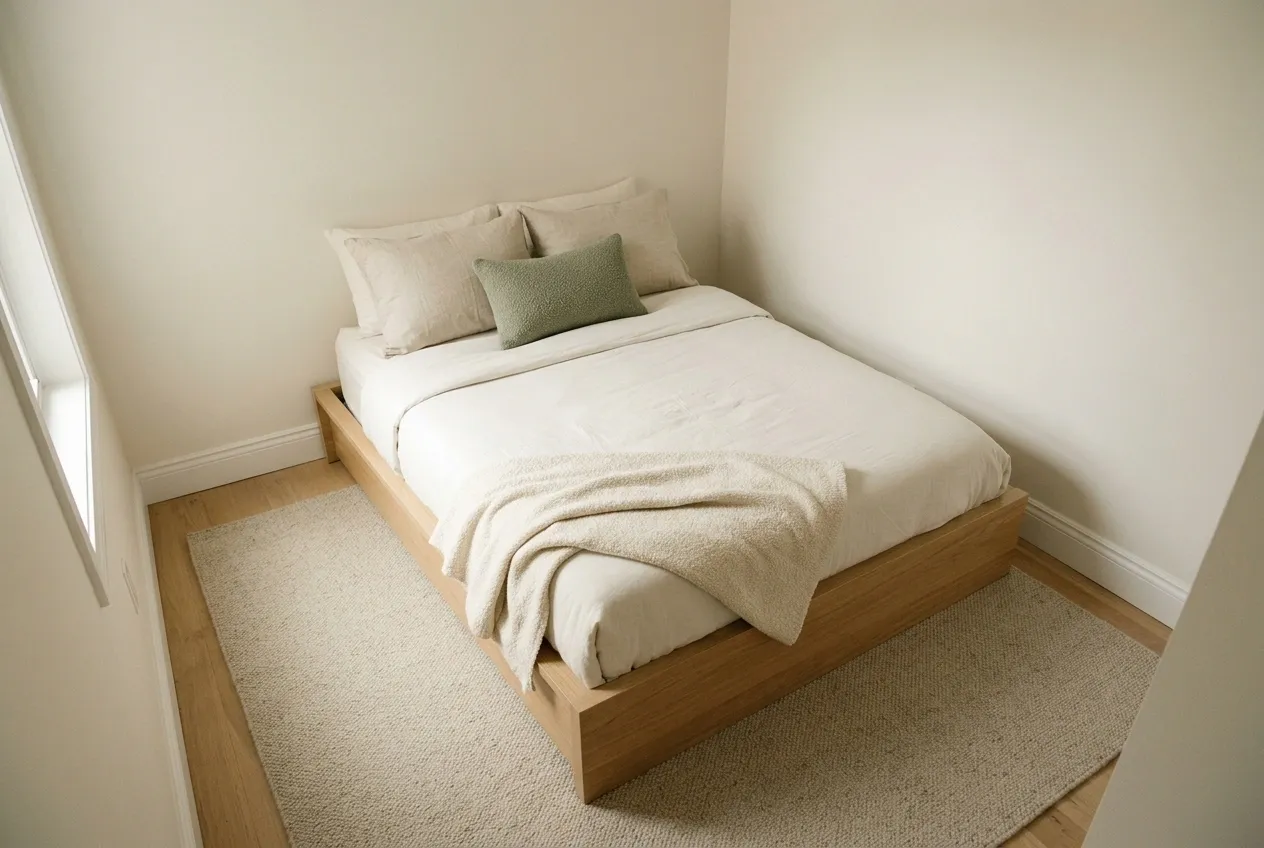
Room specifications
- Room ScaleSmall bedroom (about 10 x 11 ft)
- Design StyleWarm Minimalist / Japandi
- Budget TierMid-Range ($$)
- Palette Swatches4 colors
Rug size under a bed calculator
Pick the bed and the rug. It shows how much rug is left at each side and past the foot, with the long edge across the bed.
A 6 x 9 ft rug (72 x 108 in) under a queen bed, long edge across the bed and 53 in (134.6 cm) of the 80 in mattress on the rug, shows 24 in (61 cm) at each side and 19 in (48.3 cm) past the foot. That is inside the 18 to 24 in target. Design guideline, not building code.
Top-down view to scale with the headboard at the top. The filled block is the bed and the shaded area is the rug: green leaves 18 in or more at each side, red is under 12 in or narrower than the bed. The outer frame only bounds the drawing.
Full-page version: Rug Size Calculator: Rug Size Under a Bed
For a queen bed (60 x 80 in, or 152 x 203 cm), a 6x9 ft rug is the best fit: with its long edge across the bed it leaves 24 inches (61 cm) of rug on each side. A 5x8 works at 18 inches (46 cm), and an 8x10 gives 30 inches (76 cm) in a larger room. For other beds the same arithmetic gives 5x8 for a full, 5x8 for a twin and 8x10 for a king. Rug sizes are named short edge x long edge, and every figure here assumes the long edge runs across the bed, parallel to the headboard.
The rule behind all of these is simple: leave 18 to 24 inches (46 to 61 cm) of rug showing on each side of the bed where the room allows, and do not go below about 12 inches (30 cm). That overhang is where your feet land when you get up, and it is what makes the bed look anchored rather than parked on a mat.
Rug size by bed size
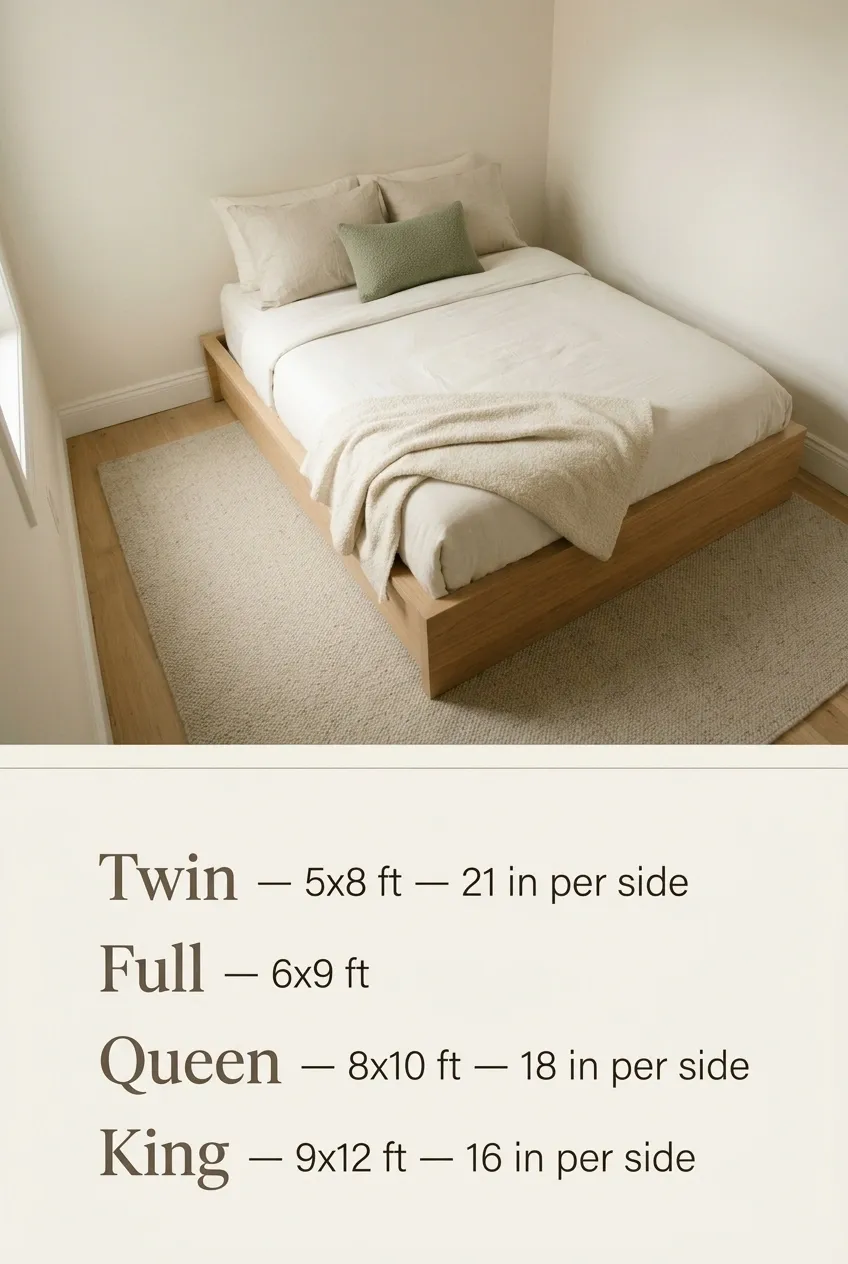
The mattress sizes below are listed in full in the standard bed sizes chart.
| Bed | Mattress | Best rug | Rug per side | Notes |
|---|---|---|---|---|
| Twin | 38x75 in (97x191 cm) | 5x8 ft | 29 in (74 cm) | A 4x6 leaves 17 in (43 cm) per side |
| Full | 54x75 in (137x191 cm) | 5x8 ft | 21 in (53 cm) | A 6x9 leaves 27 in (69 cm) per side |
| Queen | 60x80 in (152x203 cm) | 6x9 ft | 24 in (61 cm) | A 5x8 leaves 18 in (46 cm); an 8x10 leaves 30 in (76 cm). Full chart: rug size for a queen bed |
| King | 76x80 in (193x203 cm) | 8x10 ft | 22 in (56 cm) | A 9x12 leaves 34 in (86 cm) per side |
| Cal King | 72x84 in (183x213 cm) | 8x10 ft | 24 in (61 cm) | A 9x12 leaves 36 in (91 cm) per side |
Measure your own mattress rather than trusting the label, since frames and toppers vary.
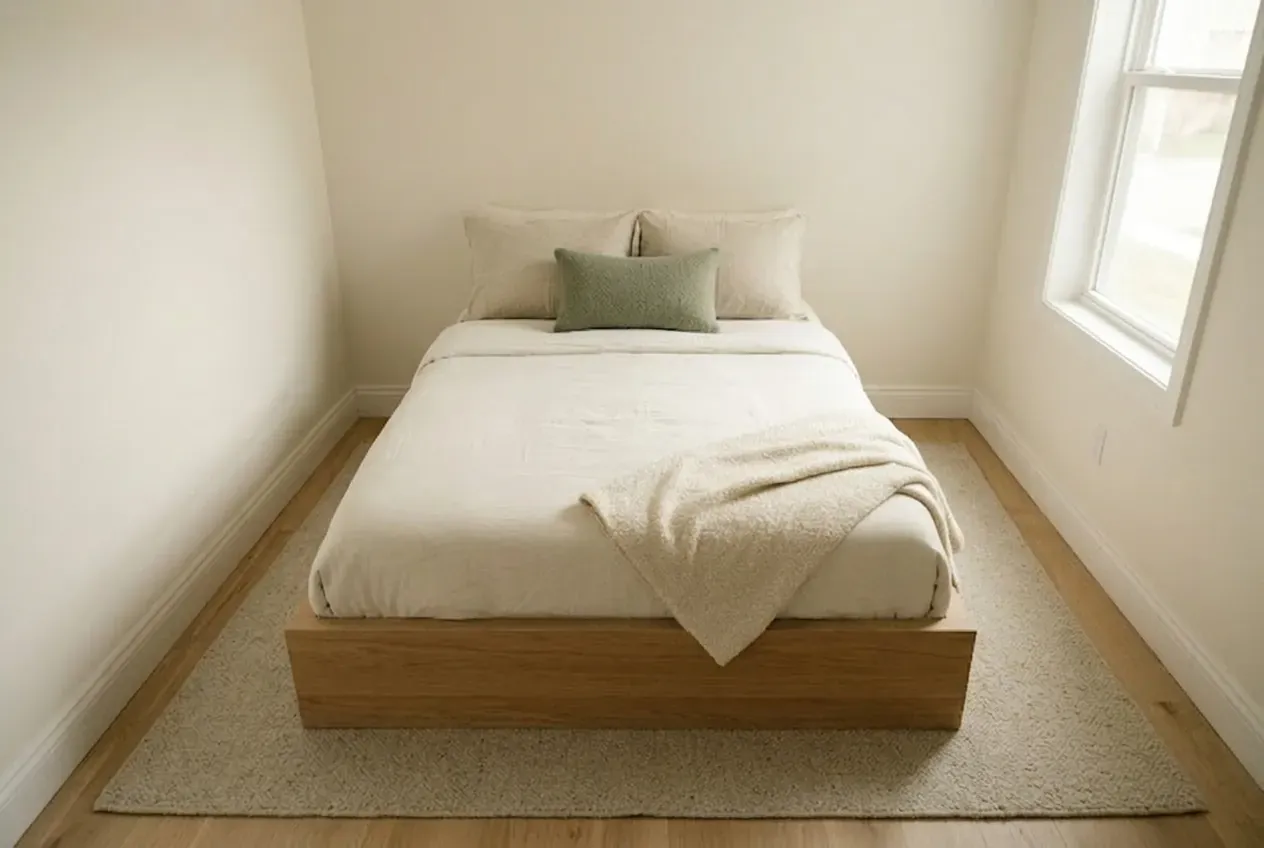 The same room seen from the opposite end, so you can judge the layout from the far side.
Work it out yourself
Subtract the mattress width from the rug’s long edge, then divide by two. A 6x9 rug’s long edge is 108 inches (274 cm) and a queen is 60 inches (152 cm) wide, so 108 minus 60 is 48 and half of that is 24 inches (61 cm) per side.
Length works from the short edge, which runs along the bed. A 6x9 rug is 72 inches (183 cm) deep. With the lower two-thirds of an 80-inch queen on the rug (53 inches, 135 cm), the rug shows 72 minus 53, or 19 inches (48 cm), past the foot. Turn the rug the other way, short edge across, and the sides shrink: an 8x10 turned that way gives (96 minus 60) / 2, or 18 inches (46 cm), per side.
On a king, an 8x10 gives (120 minus 76) / 2, or 22 inches (56 cm), per side and a 9x12 gives 34 inches (86 cm). The rug size for a king bed guide covers every rug size for a king and a California king.
Rug size by room size
A rug should leave 8 to 18 inches (20 to 46 cm) of bare floor to the walls. This matrix gives the largest standard rug that leaves at least 8 inches (20 cm) on every side, with the bare floor it leaves at the sides and at the ends.
| Room | Room (cm) | Largest rug | Bare floor at the sides / ends |
|---|---|---|---|
| 9x10 ft | 274x305 cm | 5x8 ft | 24 in (61 cm) / 12 in (30 cm) |
| 10x10 ft | 305x305 cm | 5x8 ft | 30 in (76 cm) / 12 in (30 cm) |
| 10x12 ft | 305x366 cm | 8x10 ft | 12 in (30 cm) / 12 in (30 cm) |
| 12x12 ft | 366x366 cm | 8x10 ft | 24 in (61 cm) / 12 in (30 cm) |
| 12x14 ft | 366x427 cm | 9x12 ft | 18 in (46 cm) / 12 in (30 cm) |
| 12x15 ft | 366x457 cm | 9x12 ft | 18 in (46 cm) / 18 in (46 cm) |
| 14x16 ft | 427x488 cm | 10x14 ft | 24 in (61 cm) / 12 in (30 cm) |
In a bedroom, check this matrix against the bed table above and take the smaller rug. A 10x12 ft bedroom takes an 8x10 by the room maths but a 6x9 is the comfortable pick under a queen.
Where to put the rug
Three placements cover almost every bedroom. Each diagram is drawn to scale for a 60 x 80 in (152 x 203 cm) queen and shows how much rug appears around the bed.
Under the lower two-thirds (front legs on the rug). The usual choice for small bedrooms. Start the rug about 27 inches (69 cm) down from the headboard wall so the pillows and headboard stay on bare floor. You get a soft landing on both sides and at the foot, the rug resists creeping, and it costs less than full coverage. Use a 6x9 for a queen and an 8x10 for a king.
All legs on the rug. In a larger bedroom, use an 8x10 for a queen, or a 9x12 if both nightstands should sit on the rug. A king takes a 9x12, or a 10x14 with two nightstands. Leave 8 to 18 inches (20 to 46 cm) of bare floor at the walls.
Foot of the bed only (no legs on the rug). For a narrow room where a rug cannot pass under both sides. A 4x6 suits a twin or full, a 5x8 a queen. Butt the long edge against the foot of the bed frame and centre it.
Two runners. If a big rug is out of budget, a 2.5x8 runner along each side gives you the soft landing. Keep 30 inches of clear walkway so you are not shuffling sideways. More on placement is in the rug size for a queen bed guide, and for a queen-sized room plan see the 10x10 queen bed layout.
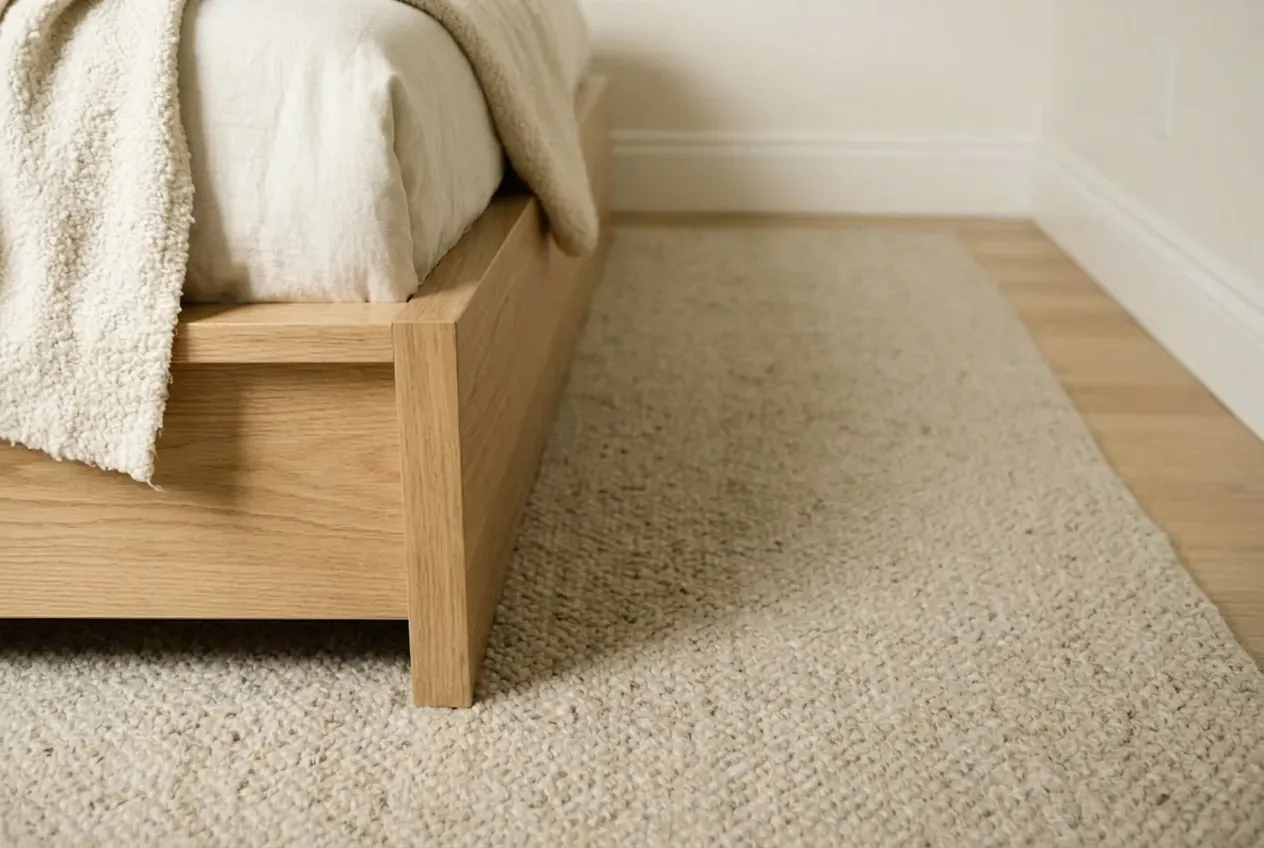 Close up: Leave 18 to 24 in (46 to 61 cm) of rug showing on each side of a queen bed so your feet land on fabric, not bare floor.
Standard rug sizes and runner rug measurements
Here is every common commercial size, what it fits, and where it usually goes wrong.
| Size | Metric | Typical use | Watch out for |
|---|---|---|---|
| 2x3 ft | 61x91 cm | Doorway mat, beside a bed | Too small alone; reads as a bath mat |
| 2.5x8 ft | 76x244 cm | Bedside runner, galley kitchen | Needs about 30 in (76 cm) of clear walkway |
| 3x5 ft | 91x152 cm | Small entry, single chair | Only fits one piece of furniture |
| 4x6 ft | 122x183 cm | Foot of a twin or full bed | Floats under a queen or larger |
| 5x8 ft | 152x244 cm | Twin or full bed, tight fit for a queen, small dining nook | Only 18 in (46 cm) per side on a queen |
| 6x9 ft | 183x274 cm | Queen bed, 10x12 ft living room | 24 in (61 cm) per side on a queen; only 16 in (41 cm) on a king |
| 8x10 ft | 244x305 cm | King bed, queen in a large room, most apartment living rooms | 22 in (56 cm) per side on a king; 30 in (76 cm) on a queen |
| 9x12 ft | 274x366 cm | King bed with nightstands, 12x14 ft room | 34 in (86 cm) per side on a king; too large for rooms under about 150 sq ft |
| 10x14 ft | 305x427 cm | King with full nightstands | Rarely needed in a rental bedroom |
| 12x15 ft | 366x457 cm | Open-plan living plus dining | Only in larger studios |
| Round 5-8 ft | 152-244 cm | Awkward corners, round tables | Softens boxy rooms; hard to layer |
Manufactured sizes vary by a couple of inches, and a “5x8” is often closer to 5 ft 3 in by 7 ft 6 in. Check the spec sheet before taping an outline.
Living room and dining room
The bedroom rule is overhang; the other rooms have their own.
- Living room: the rug should reach at least 6 inches under the front legs of the sofa and chairs, or everything looks like it is floating. The small living room rug guide and the narrow room rug guide go deeper.
- Dining room: extend the rug 24 inches beyond every table edge, so chairs stay on it when pulled out. A 36x60 in table needs an 84x108 in footprint, which means an 8x10 in standard sizes. See the dining nook guide.
- Open plan: one rug per zone, never one rug spanning two. The studio zoning guide and the open-plan layout guide show how.
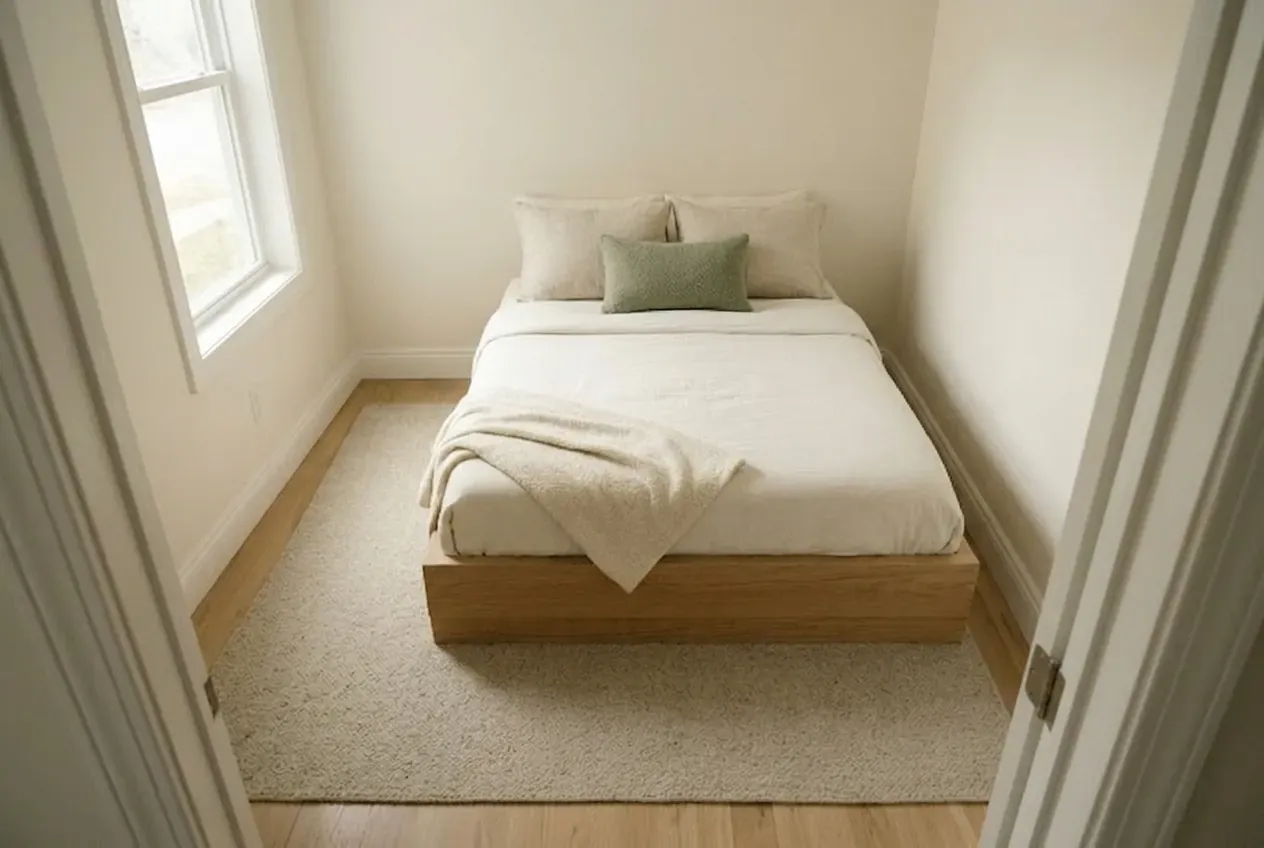 From above and to one side, the full footprint and the walkway read at a glance.
Rug versus room
A correctly sized rug still looks wrong if it crowds the walls.
- Leave 8 to 18 inches of exposed floor between the rug and the baseboard. In a small room, closer to 8 inches reads as room-scale.
- Keep about 30 inches of clear path between the rug edge and any wall or furniture it does not sit under.
- Thick pile catches door sweeps, so use a low-pile flatweave where an interior door swings.
- Use a pad. Without one the rug slides and grinds grit into the floor; see the rug pad size guide.
- Do not tape a rug to finished hardwood. Let the pad and furniture legs hold it.
Light, low-pile wool or cotton in a neutral shade reflects daylight and makes a small floor look larger. A pattern is fine if it stays close to the wall colour, so the texture, not the contrast, does the work.
For specific rooms and rug types, see sizing a kitchen rug, the rug under a dining table, washable rugs that fit a washing machine and clear the door, the best rugs and pads for rental hardwood, and layered jute rugs for a larger look on a budget.
Before you buy
- Measure the mattress and the room.
- Subtract mattress width from the rug long edge and halve it; aim for 18 to 24 inches.
- Tape the rug outline starting below the pillow line.
- Check that nightstand legs sit fully on or fully off the rug.
- Check door swings, closet doors and a 30 inch walkway.
- Order a pad cut slightly smaller than the rug.
Curated Color Palette & Key Textures
- Alabaster Chalk #F5F2EB
- Oat Linen #D9CDB8
- Light Oak #C9A97C
- Sage Moss #9AA58A
General references
Dimensions in these guides are typical planning ranges, not legal minimums, and they can differ by jurisdiction. Use the references below as starting points, then confirm local code and your lease before making changes.
FAQ
What size rug goes under a queen bed?
A 6x9 ft (183x274 cm) rug is the best fit under a queen bed: with its long edge across the bed it leaves 24 inches (61 cm) of rug on each side. A 5x8 ft (152x244 cm) leaves 18 inches (46 cm) and an 8x10 ft (244x305 cm) leaves 30 inches (76 cm). Use a 9x12 ft (274x366 cm) if you want the nightstands fully on the rug.
What size rug for a king bed?
An 8x10 ft (244x305 cm) rug gives 22 inches (56 cm) of rug on each side of the 76-inch (193 cm) wide king mattress, and a 9x12 ft (274x366 cm) rug gives 34 inches (86 cm). Choose the 9x12 if the room is at least 12x14 ft.
Should a rug go under the whole bed or just the foot?
Run the rug under the lower two-thirds of the bed, starting just below the pillows. This keeps the rug from creeping and gives you a soft landing on both sides and at the foot without the cost of a full-coverage rug.
What are the standard rug sizes?
The common commercial sizes are 2x3, 3x5, 4x6, 5x8, 6x9, 8x10, 9x12, 10x14, and 12x15 ft. Runners come in 2x6, 2.5x8, and 2.5x10 ft. Manufactured sizes vary by 2 to 3 inches, so always check the product spec sheet.
How much floor should show around a rug?
Leave an exposed border of 8 to 18 inches (20 to 46 cm) between the rug edge and the walls. In a small room, stay closer to 8 inches (20 cm) so the rug reads as room-scale rather than a floating mat.
What size rug for a full bed?
A 5x8 ft (152x244 cm) rug is the best fit under a full bed (54x75 in): it leaves 21 inches (53 cm) of rug on each side. A 6x9 ft (183x274 cm) leaves 27 inches (69 cm).
What size rug fits a 10x12 ft room?
An 8x10 ft (244x305 cm) rug is the largest standard size that leaves at least 8 inches (20 cm) of bare floor on every side, 12 inches (30 cm) all round. A 6x9 ft is the comfortable pick when a bed sits on it.
Save this idea

Keep reading
Related rooms
Standard Window Sizes: 24 x 36 to 48 x 72 in Chart
Standard window sizes in inches and cm: most run 24 to 48 in wide by 30 to 72 in high, and a bedroom window needs a 5.7 sq ft clear opening for egress.
TV Dimensions by Screen Size: 65 in Is 56.7 x 31.9 in
TV dimensions by screen size in inches and cm: a 65 in TV is 56.7 x 31.9 in, a 55 in is 47.9 x 27.0 in, plus the viewing distance and stand width for each.
How High to Hang Pictures: 57 in (145 cm) Center
Hang pictures with the center 57 in (145 cm) up, the frame bottom 7 to 10 in (18 to 25 cm) above a sofa, and frames 2 to 3 in (5 to 8 cm) apart.