Floor-to-Ceiling Windows in a Small Rental
Floor-to-ceiling windows decor for renters: one continuous 96 in (244 cm) curtain drop on a ceiling track 3 to 4 in off the glass, no drilling needed.
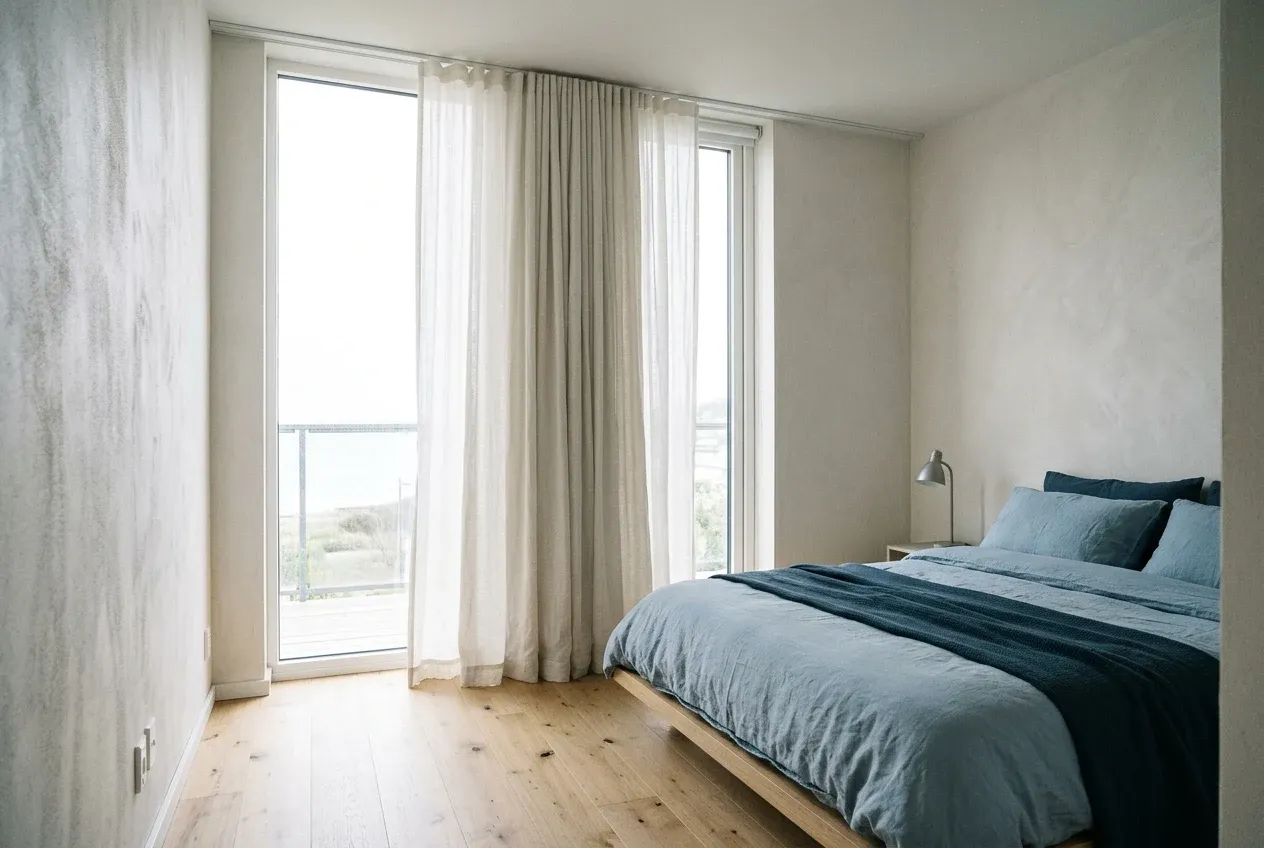
Room specifications
- Room ScaleSmall apartment bedroom (about 10 x 12 ft) with one full-height 96 in window
- Design StyleSoft Coastal Light / Sheer Modern
- Budget TierBudget ($)
- Palette Swatches4 colors
To cover floor-to-ceiling windows in a rental, hang one continuous floor-length panel from a slim ceiling-fixed or adhesive track set 3 to 4 in (8 to 10 cm) in front of the glass. Because full-height glazing leaves no wall above the window for a normal rod bracket, the track has to mount to the ceiling, or you need a tension or adhesive-based system.
Floor-to-ceiling windows flood a bedroom of around 10 x 12 ft with daylight, but they leave renters stuck the moment they want curtains. The fixes are ceiling-level mounting, careful three-point measuring, and lightweight fabric that stacks off the glass.
What counts as floor-to-ceiling
These are full-height glazing panels, with glass and mullions running from the baseboard to the ceiling slab, so there is no upper header to fix brackets into. That means the curtain has to hang from the ceiling or from something that braces against it.
Set the track or tension system about 1/2 in (1 cm) below the ceiling line and run one 96 in (244 cm) panel down to 1/4 in (0.6 cm) above the floor, so the fabric hangs without a horizontal splice. For the difference between drapes and curtains, see that guide.
Keep the track 3 to 4 in out from the glass, so pleated linen clears mullions, latches and window cranks.
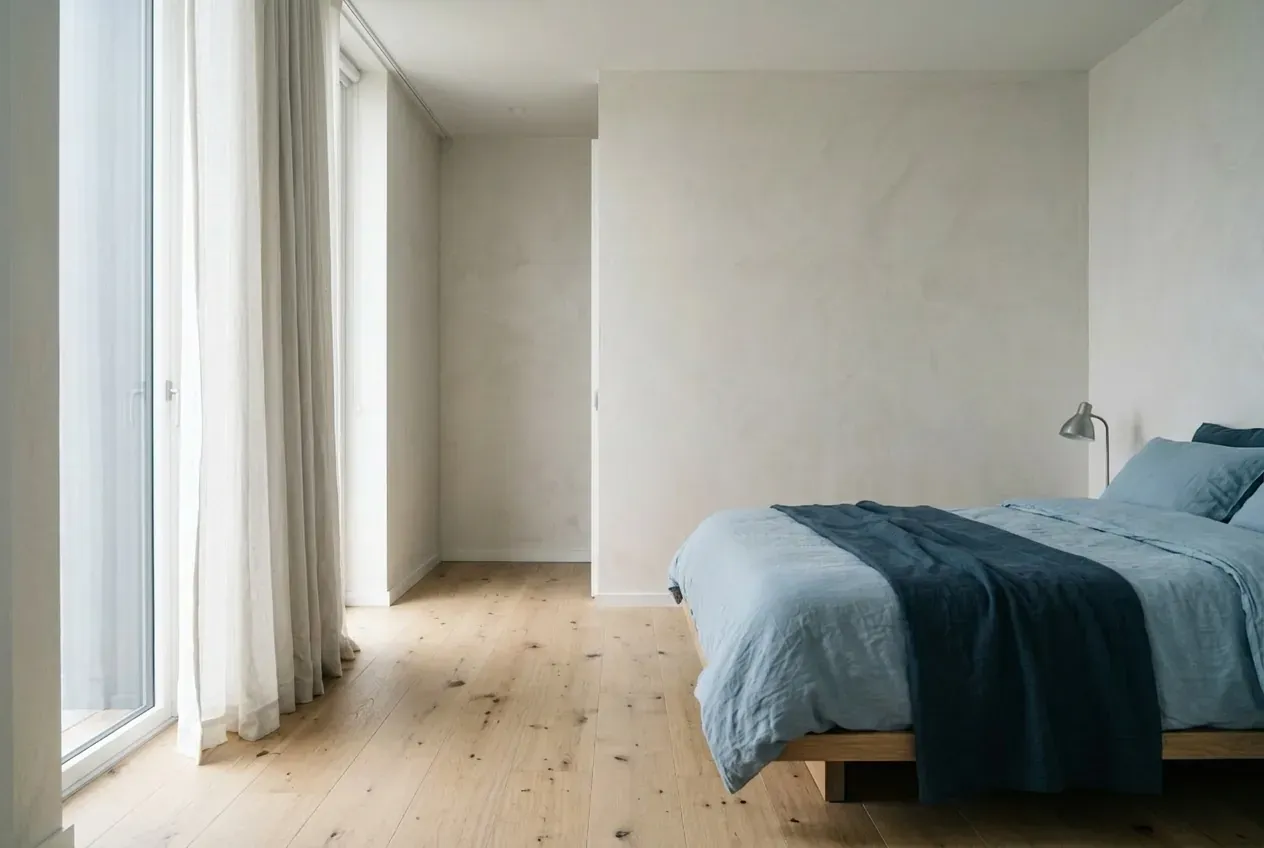 The same room seen from the opposite end, so you can judge the layout from the far side.
How to measure the drop
Never assume the ceiling is dead level. Measure the floor-to-ceiling distance in three places: left edge, middle and right edge. Order panels for the shortest measurement minus 1/4 in, so the hem hovers over the floor without puddling or dragging in dust.
A slab slope of around half an inch is common in some buildings, and using the shortest drop stops one corner of the hem dragging.
Then work out the stack. Add 8 to 12 in (20 to 30 cm) of track extension onto the solid wall at each side, so open curtains rest on the wall and not the glass. As a rule, a 72 in (183 cm) wide full-height window wants at least 10 in (25 cm) of wall stack on each side.
Ways to hang it without a header
If the lease forbids drilling into concrete or the ceiling, there are three renter-friendly mounts.
- Heavy-duty tension rod. Suits recessed window alcoves up to about 96 in (244 cm) wide, with lightweight sheer linen.
- Adhesive ceiling track. Some plastic tracks use strong adhesive tape and carry sheer and medium-weight cotton on smooth painted ceilings. Check the maker’s weight rating and surface requirements.
- Small anchors. Where tiny screws are allowed, a slim track leaves only pinholes to fill with spackle at move-out.
As a guide when you rely on adhesive, keep sheer 96 in panels light, around 3 lb (1.4 kg) per track section or less, and always follow the product’s printed limit. Warm ceilings and long spans make adhesive less reliable, so check the track after the first few weeks.
| Window span | Rod type | Panel width |
|---|---|---|
| Under 6 ft (183 cm) | Standard 1 in rod | 1.5x the glass |
| 6 to 9 ft (183 to 274 cm) | Heavy 1.25 in rod | 1.5x the glass |
| 9 to 12 ft (274 to 366 cm) | Two rods or a track | 1.5x per side |
| Full wall | Ceiling track | 2x the glass |
For standard-height windows and no-drill hardware, the curtain rod install guide covers heights, load ratings and renter methods. The curtain colour guide helps with fabric tone.
 Close up: Hang one curtain drop from 1/2 in (1 cm) above the ceiling line to 1/4 in (0.6 cm) off the floor so a single 96 in (244 cm) panel covers the full glazing without a middle break.
Light and privacy
Daytime and night-time needs differ. Use a double track and hang a translucent sheer for daytime privacy in front and a lined blackout panel that slides across at night. Keep the sheer close to the wall colour, so a huge glass span reads as soft, glowing architecture rather than a heavy block of fabric. The blackout curtains guide explains fullness and light gaps for the heavier layer.
A weighted hem tape along the bottom edge helps tall linen panels hang straight, and stops them billowing in when the window is tilted open.
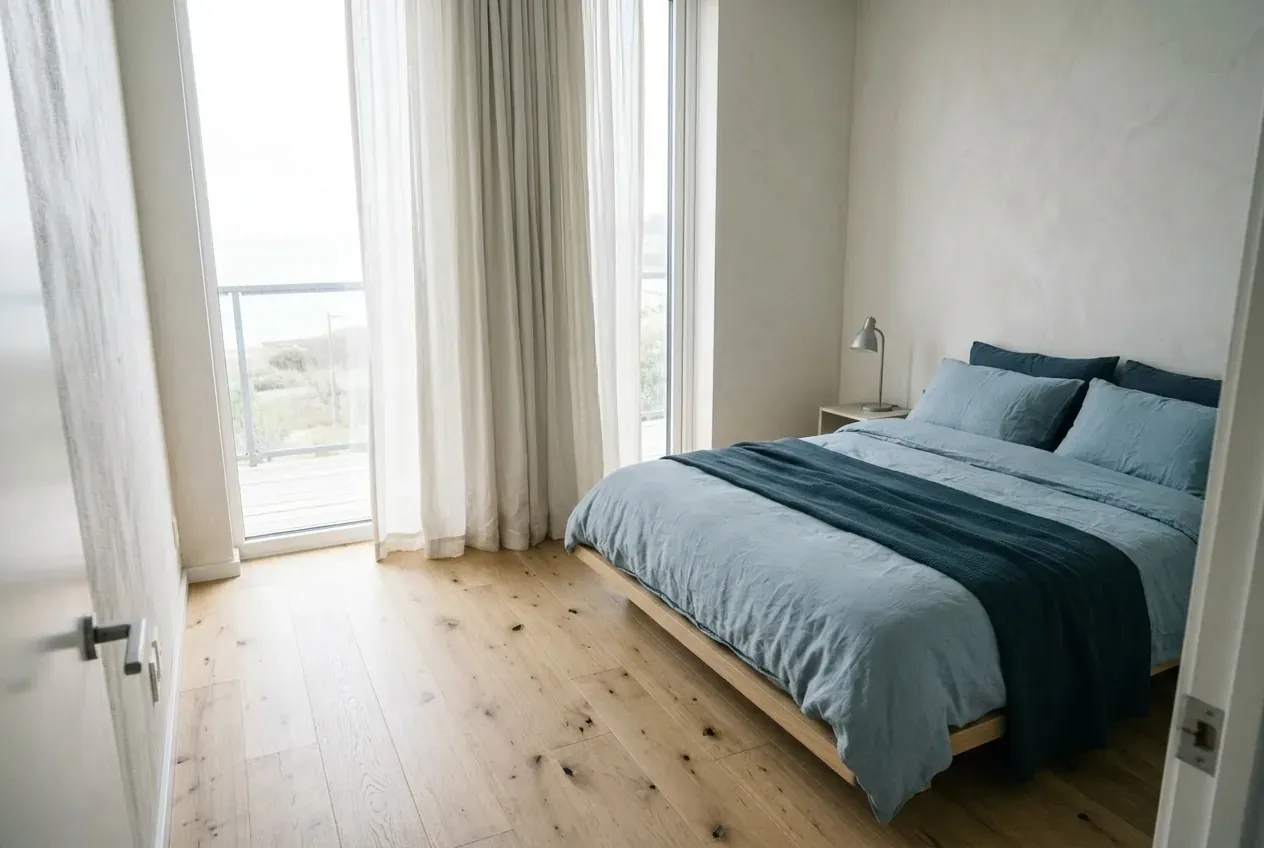 From above and to one side, the full footprint and the walkway read at a glance.
Common mistakes
- Ordering one length for the whole span without measuring three points.
- Mounting the track flush to the glass so it catches on latches.
- Loading an adhesive track with heavy lined drapes.
- Forgetting wall stack, so the curtain always covers part of the glass.
- Blocking an operable door or egress window with fabric that cannot be pushed aside.
For a lined, floor-length setup in a living space, see drapes for a small living room.
Before you order
- Measure the drop at left, middle and right, and use the shortest.
- Decide on ceiling track, adhesive track or tension rod.
- Check the maker’s weight rating against your fabric.
- Plan the wall stack on each side.
- Choose a sheer plus a blackout layer if you need both privacy and sleep.
- Check any lease rule on ceiling fixings.
Curated Color Palette & Key Textures
- Chalk Linen #F3F1EC
- Coastal Blue #A8C4D4
- Harbour Navy #3E5A6E
- Soft Pewter #8A8F96
General references
Dimensions in these guides are typical planning ranges, not legal minimums, and they can differ by jurisdiction. Use the references below as starting points, then confirm local code and your lease before making changes.
FAQ
How do I cover floor-to-ceiling windows?
Mount a slim ceiling-fixed or adhesive track 3 to 4 in (8 to 10 cm) in front of the glass and hang one continuous floor-length panel.
How long should floor-to-ceiling curtains be?
Measure at three points and size the finished drop to stop 1/4 in (0.6 cm) off the floor—typically 95.5 to 96 in (243 to 244 cm) in an 8 ft apartment.
Can I hang curtains on floor-to-ceiling windows without drilling?
Yes—use a recessed tension rod for sheers or a lightweight adhesive-backed ceiling track rated for your panel weight.
Save this idea


Keep reading
Related rooms

Bunk Bed Dimensions: 5 Sizes, Clearances & Safety Gaps
A twin bunk is 77 x 41 in (196 x 104 cm) and about 62 in tall: all 5 standard sizes, the 5 in guardrail rule, deck spacing and the ceiling check.

Standard Bed Sizes: Queen 60 x 80 in (152 x 203 cm)
Standard bed sizes in inches and cm: a double (full) is 54 x 75 in, a queen 60 x 80, a king 76 x 80, a California king 72 x 84, plus the room each needs.

Rug Size for a King Bed: 8x10 Shows 22 in Each Side
Rug size for a king bed: an 8x10 ft rug shows 22 in (56 cm) each side and 43 in past the foot; a 9x12 shows 34 in. See the maths, a chart and a calculator.