Record Player Cabinet for a Small Living Room
Record player cabinet guide for small rooms: the width, shelf gap and ventilation a turntable and vinyl need, plus renter-safe TV-console swaps.
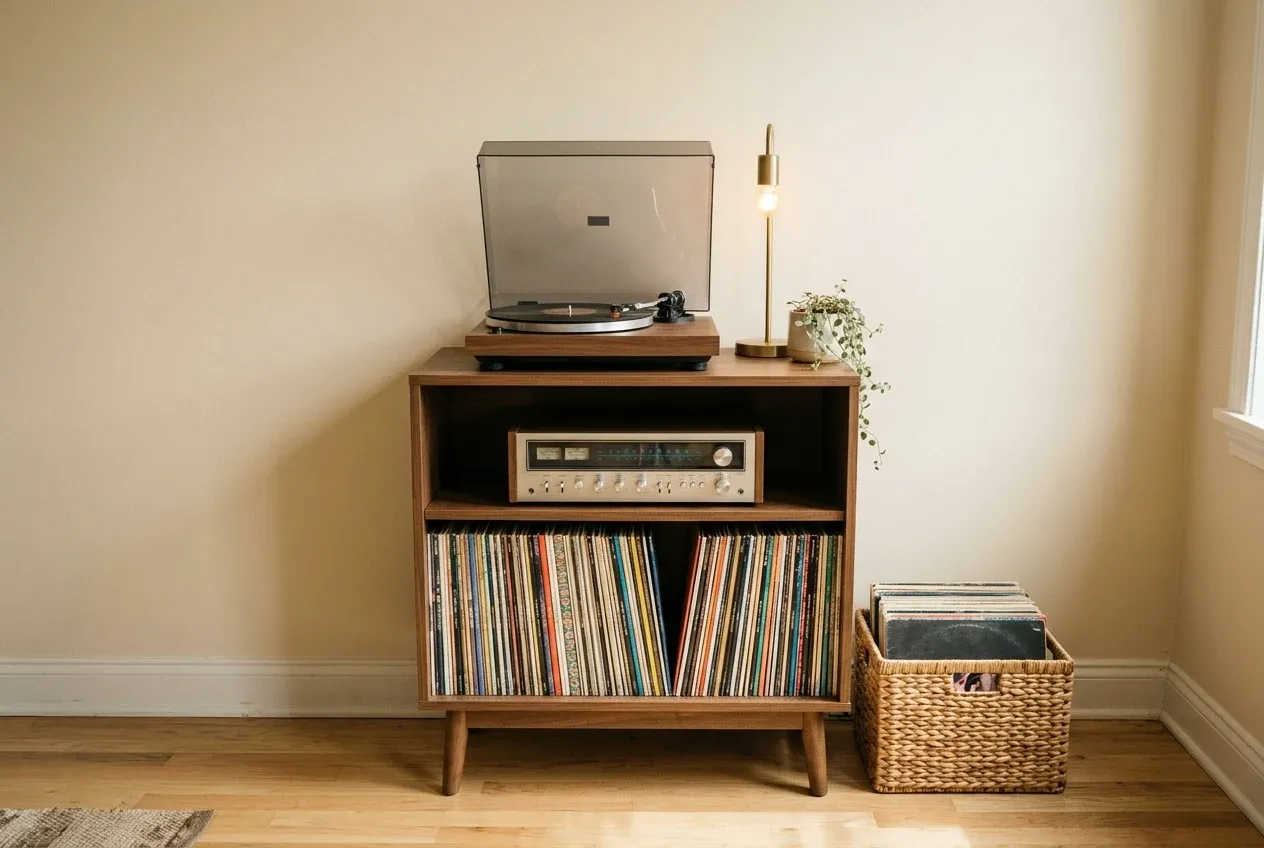
Room specifications
- Room ScaleSmall living room (about 11 x 13 ft) with one solid wall for a media cabinet
- Design StyleWarm Vintage / Vinyl Listening Lounge
- Budget TierMid-Range ($$)
- Palette Swatches4 colors
The best record player cabinet for a small living room is about 28 to 32 inches wide, puts the turntable deck near 30 inches high, and leaves at least 2 inches behind the receiver for heat to escape. That size fits between a window and a doorway and still holds a turntable, an amplifier or receiver, and a good run of records.
A turntable on a wobbly shelf or a shallow dining sideboard is where most problems start: skipped tracks, a dust cover that hangs over the edge, and an amplifier with no airflow. A cabinet built for audio solves those in one footprint.
What the cabinet needs to do
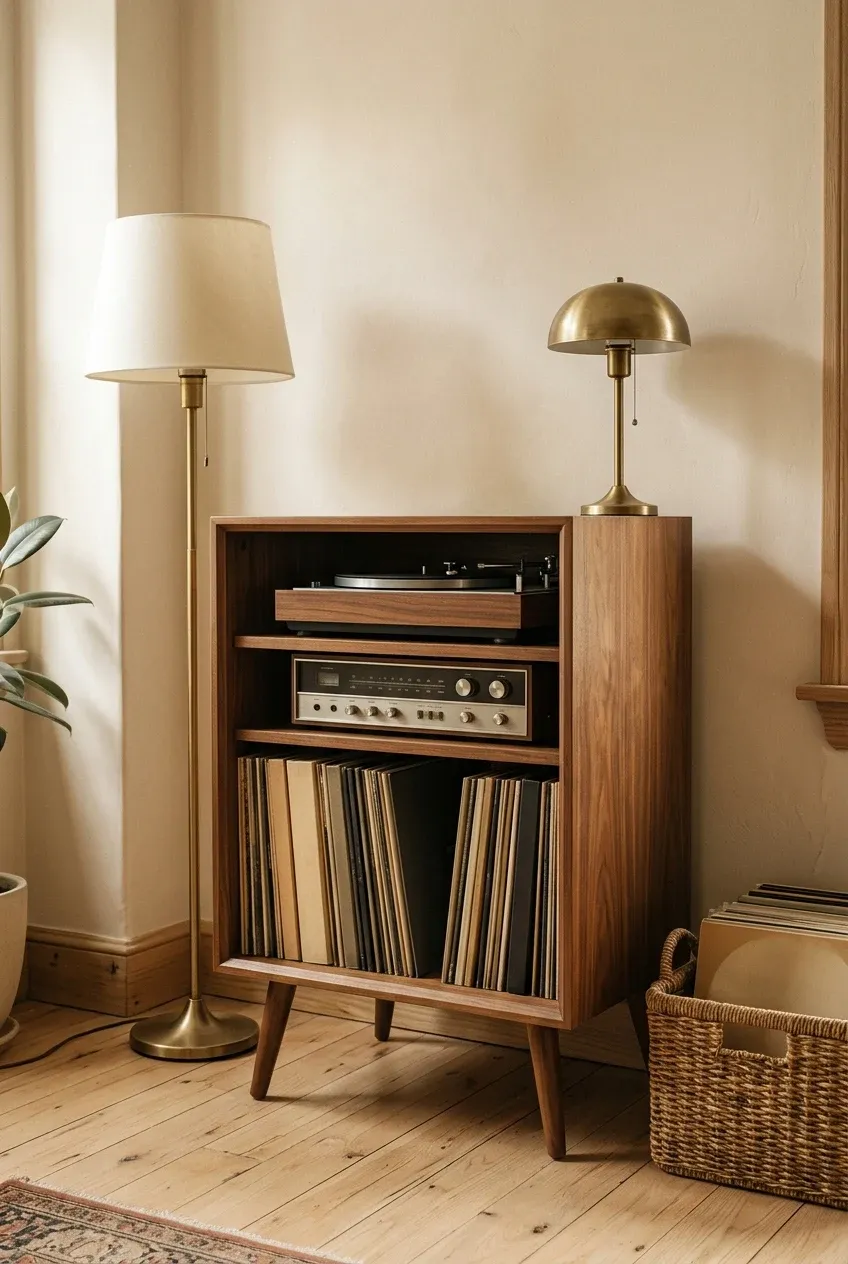
A listening cabinet carries a turntable on top, a receiver or pre-amp on an open shelf, and vertical storage for 12-inch records below. Compared with a generic sideboard, it should have deeper shelves, a stiffer top and an open or vented back. Put the turntable over a solid vertical divider rather than the middle of an unsupported span. Footsteps on a rental’s hardwood then reach the tonearm less.
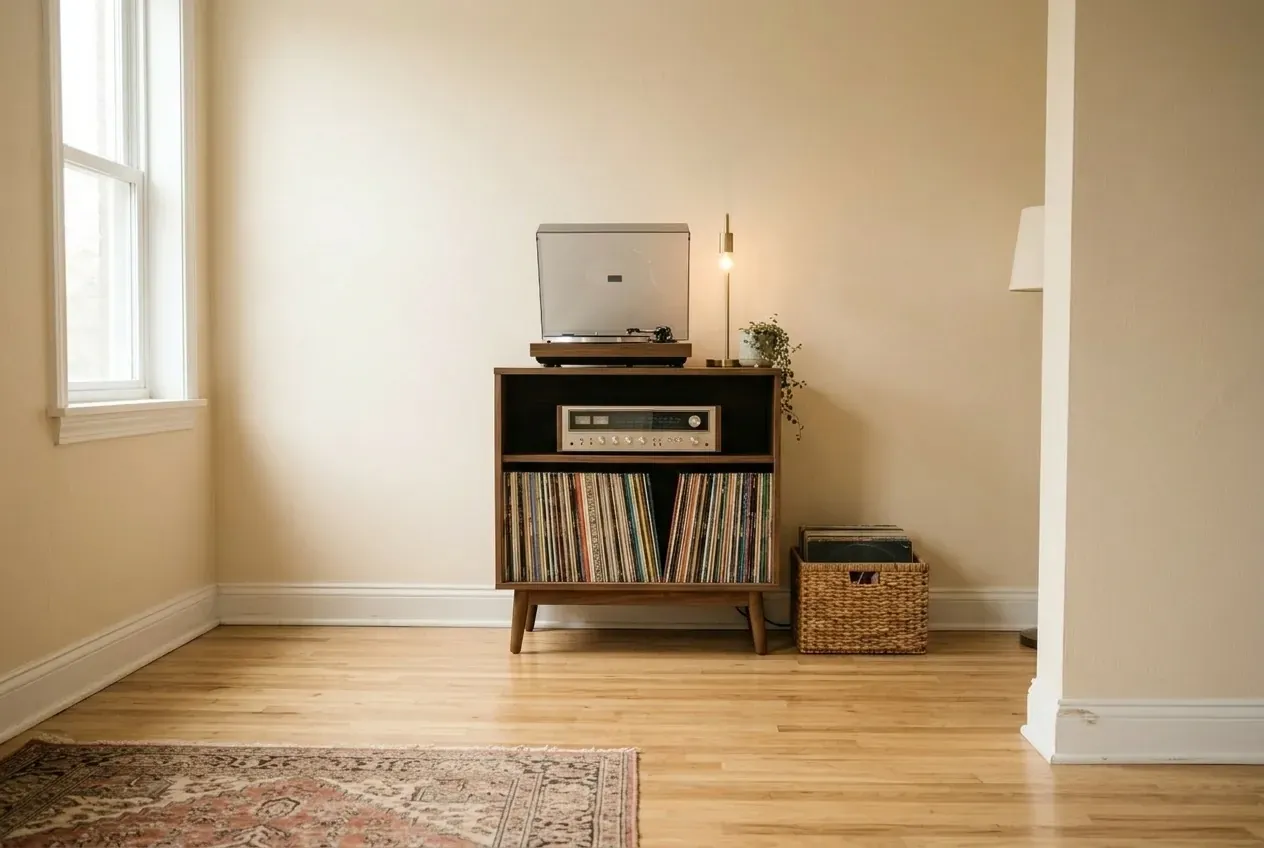 The same room seen from the opposite end, so you can judge the layout from the far side.
Measurements to check before you order
- Width, 28 to 32 inches: narrow enough for a small wall, wide enough for a full-size turntable.
- Deck height, around 30 inches: you can cue a record while standing without stooping.
- Top depth, 15 to 17 inches: the turntable and its dust cover sit fully on the top.
- Cubby height, about 13.5 inches: standard 12.5-inch jackets slide in upright.
- Rear gap, at least 2 inches: or choose an open back, so the receiver’s heat does not build up.
| Item | Guideline | Reason |
|---|---|---|
| Width | 28 to 32 in | Fits a small wall |
| Deck height | about 30 in | Standing reach |
| Top depth | 15 to 17 in | Covers the dust cover |
| Rear gap | 2 in minimum | Receiver ventilation |
If a front-loading record shelf is not an option, a media console may do the job; compare the corner media console and the sofa console table as alternatives.
Where to put it
Place the cabinet on a solid interior wall, away from direct afternoon sun and radiators. Heat can warp vinyl over time, so a sunny south window is a bad spot. If the cabinet faces the sofa, two bookshelf-size speakers can sit on either side, a few feet apart, forming a listening triangle with your seat.
Keep speakers off the same surface as the turntable, or rest them on small foam pads, so bass vibration does not travel into the needle.
Tape the cabinet outline 2 inches off the baseboard before you buy. Check that the doors still swing and that a 30-inch walkway remains.
If you have no spare wall at all, a turntable shelf combined with a multifunctional coffee table can hold a smaller setup, though you lose the room for storage.
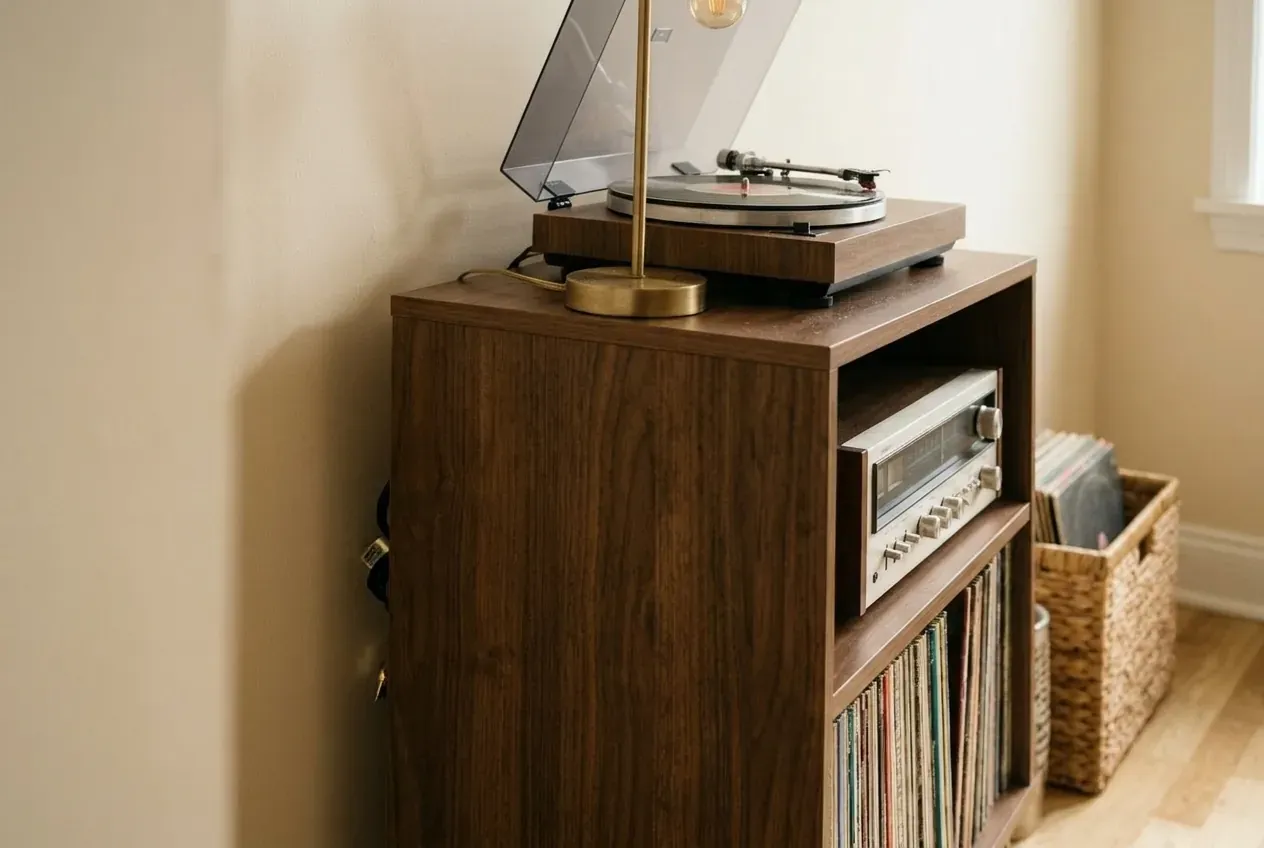 Close up: Keep a record player cabinet 28 to 32 in (71 to 81 cm) wide with the turntable deck at 30 in (76 cm) high and at least 2 in (5 cm) of rear vent clearance.
Storing records in a rental
- Store records upright, never in flat stacks, which can cause warping.
- Weight adds up fast. A full shelf of records is heavy, so use a cabinet with a solid frame and check its rated load with the maker.
- Line cubbies with thin cork or felt to protect sleeves.
- Put felt pads under the legs to protect rental floors.
- Run speaker wire behind the baseboard or in paint-safe adhesive clips.
A walnut-toned cabinet against a warm cream wall suits the look. A single brass-toned table lamp and a basket for overflow sleeves finish the corner without adding clutter. If shelves are also part of your plan, the white bookshelf styling and space-saving bookcase guides cover books and decor.
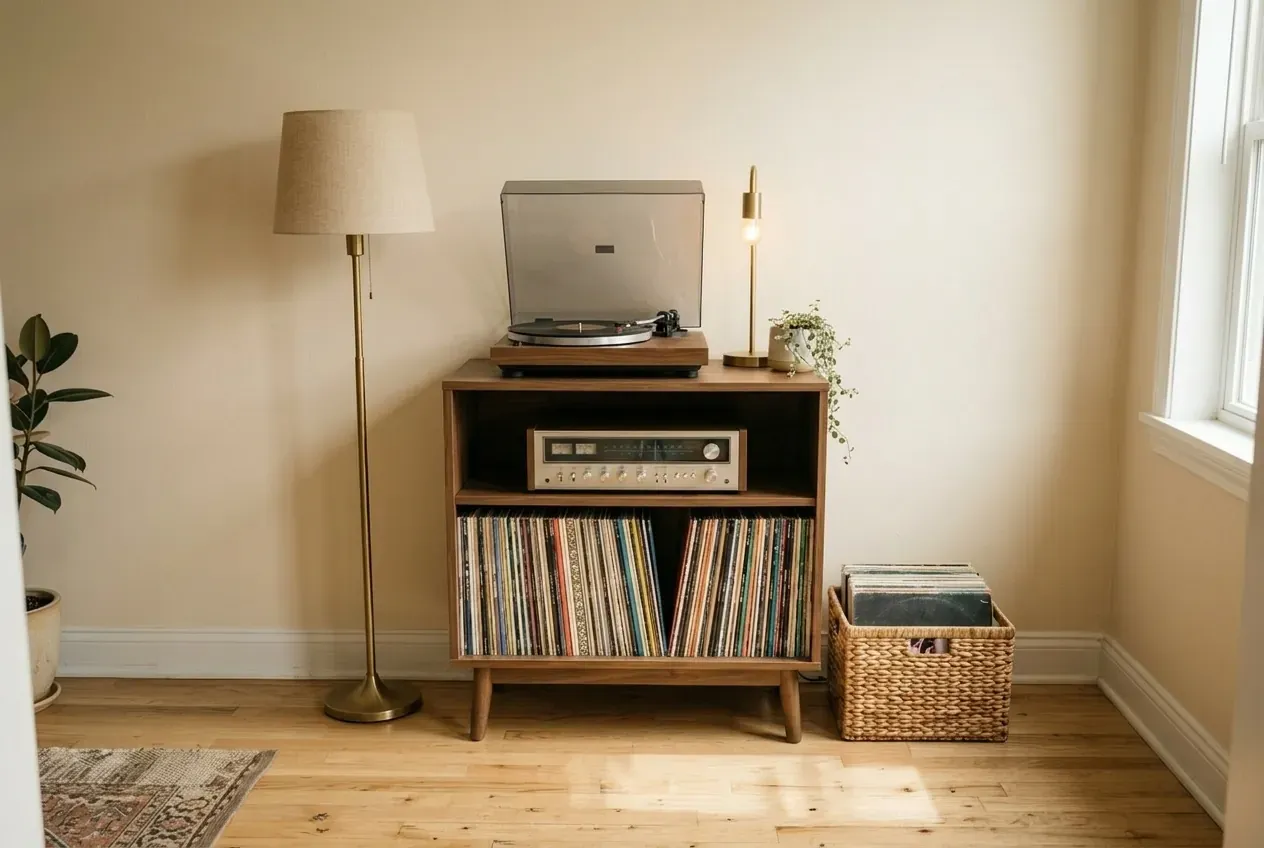 From above and to one side, the full footprint and the walkway read at a glance.
Common mistakes
- Buying for the turntable only. The receiver, a pair of speakers and the cables need space too, so add up the whole setup first.
- Closing the back panel. A solid back traps heat behind an amplifier. An open-back unit, or one with a cut-out, avoids that.
- Placing it beside the door. Slamming a door sends shock through the cabinet and into the needle. Choose a wall that does not share a corner with the entry.
- Ignoring the cables. Leave a few inches behind the cabinet for the power cord and the signal cables, or the unit will not sit flush.
Before you buy
- Measure the wall between the window and door.
- Check turntable and receiver dimensions against the top and middle shelf.
- Confirm 2 inches of rear ventilation.
- Check that jackets fit the cubbies upright.
- Keep the cabinet out of sun and away from heat sources.
- Plan where the power strip and speaker wire will run.
Curated Color Palette & Key Textures
- Warm Parchment #F1ECE1
- Walnut Timber #8A5E3B
- Espresso Ink #3A2A20
- Aged Brass #C6A15B
General references
Dimensions in these guides are typical planning ranges, not legal minimums, and they can differ by jurisdiction. Use the references below as starting points, then confirm local code and your lease before making changes.
FAQ
How wide should a record player cabinet be?
A 28 to 32 in (71 to 81 cm) wide cabinet fits most small living room walls while holding a full-size turntable, receiver, and 150 to 200 records.
What height should a turntable sit at?
Aim for a 30 in (76 cm) deck height so you can cue records comfortably while standing without bending over.
How many records fit in a cabinet shelf?
Expect roughly 50 to 60 LPs per 12 in (30 cm) of shelf width, stored strictly upright to prevent warping.
Save this idea

Keep reading
Related rooms
Standard Window Sizes: 24 x 36 to 48 x 72 in Chart
Standard window sizes in inches and cm: most run 24 to 48 in wide by 30 to 72 in high, and a bedroom window needs a 5.7 sq ft clear opening for egress.
TV Dimensions by Screen Size: 65 in Is 56.7 x 31.9 in
TV dimensions by screen size in inches and cm: a 65 in TV is 56.7 x 31.9 in, a 55 in is 47.9 x 27.0 in, plus the viewing distance and stand width for each.
How High to Hang Pictures: 57 in (145 cm) Center
Hang pictures with the center 57 in (145 cm) up, the frame bottom 7 to 10 in (18 to 25 cm) above a sofa, and frames 2 to 3 in (5 to 8 cm) apart.