Floating TV Console Height: 10-12 in Off the Floor
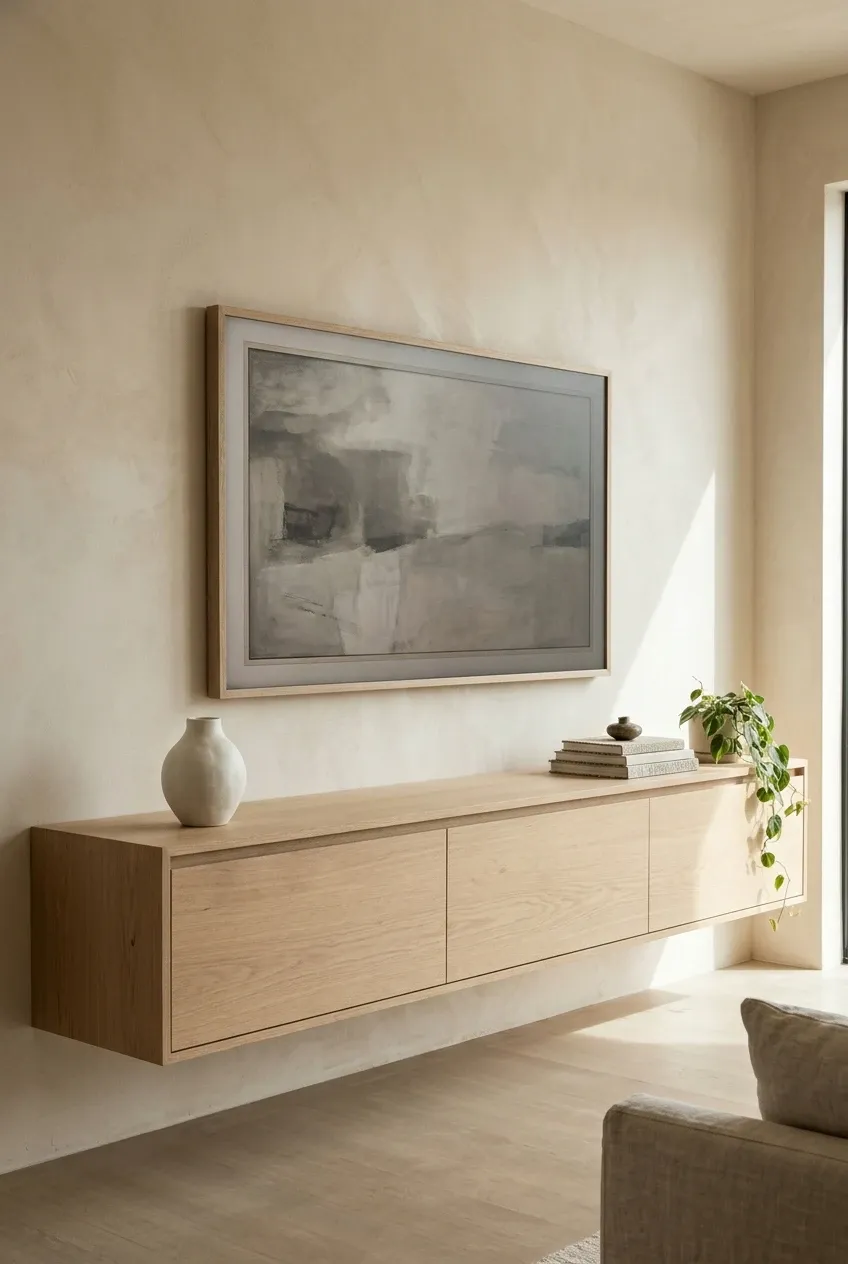
Mount a floating TV console 10-12 in (25-30 cm) off the floor, top at 24-28 in, screen centre at 42 in (107 cm), 9-11 in deep, stud-mounted.
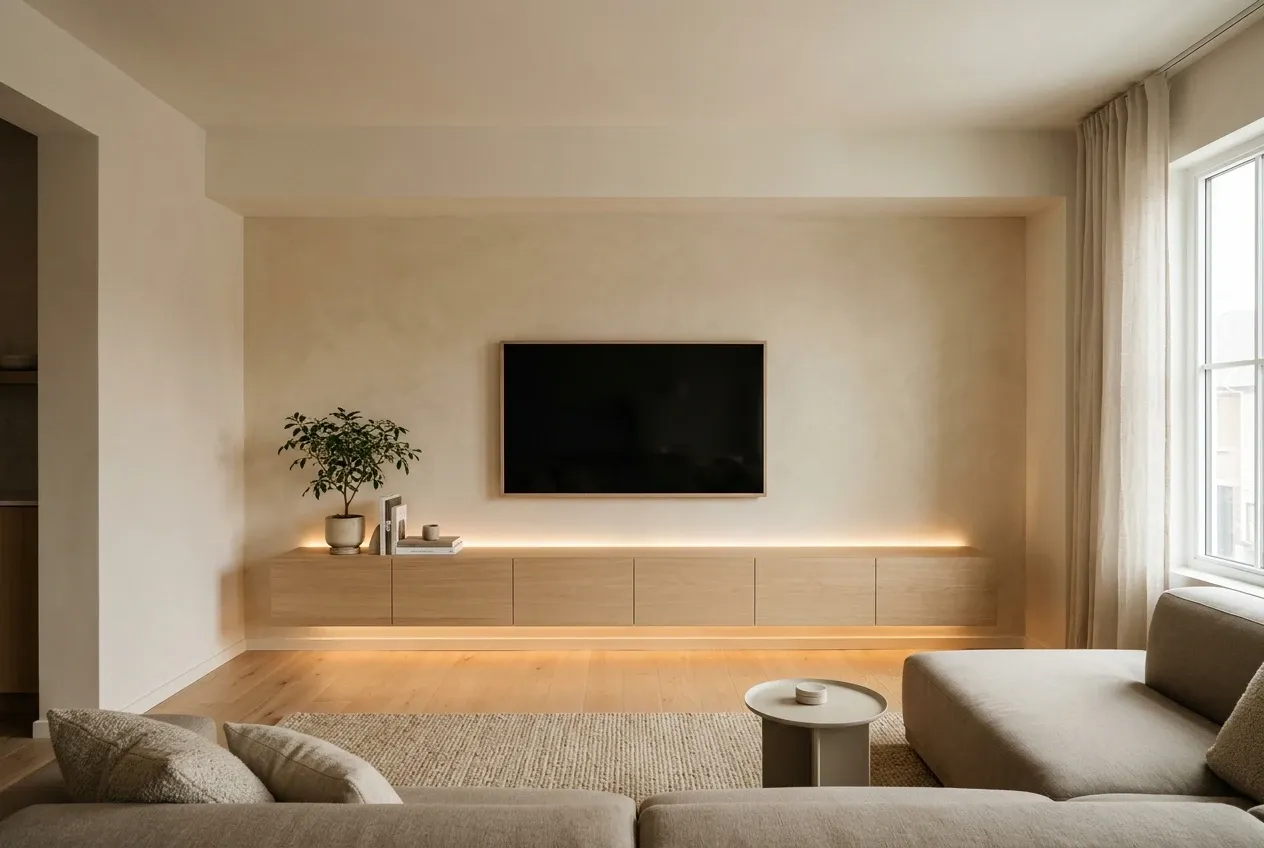
Room specifications
- Room ScaleCompact media alcove (about 9 x 12 ft)
- Design StyleWarm Minimalist / Modern Nordic
- Budget TierMid-Range ($$)
- Palette Swatches4 colors
Mount a floating TV console with its bottom edge about 10 to 12 inches off the floor, so the top lands around 24 to 28 inches high, and put the centre of the screen near 42 inches, which is roughly seated eye level. Fasten the cabinet into studs, not just drywall anchors.
Bulky floor-standing credenzas eat floor and make cleaning awkward in a compact apartment. A wall-hung console frees the floor, keeps the baseboard line visible and makes the room read larger. Without measuring first, though, people end up with a screen that sits too high or a gap between screen and cabinet that looks accidental.
Heights and distances to measure first
| What | Minimum | Small-room target | Why |
|---|---|---|---|
| Floor to console bottom | 8 in (20 cm) | 10 to 12 in (25 to 30 cm) | Shows floor and lets a robot vacuum pass |
| Console top surface | 22 in (56 cm) | 24 to 28 in (61 to 71 cm) | Stays below the seated sightline |
| Console top to TV bottom | 6 in (15 cm) | 8 to 10 in (20 to 25 cm) | Room for a soundbar or small objects |
| Centre of the screen | 38 in (97 cm) | About 42 in (107 cm) | Roughly seated eye height |
| Console depth | 8 in (20 cm) | 9 to 11 in (23 to 28 cm) | Avoids hip bumps in narrow paths |
A useful proportion: make the console at least about 1.5 times as wide as the TV. A 50 inch TV is roughly 44 inches wide, so a console of about 66 inches or more looks balanced. For the wider seating plan, see the furniture scale guide.
To check seated eye height, sit on your sofa, relax, and have someone measure from the floor to your eyes. Most standard apartment sofas put it in the low 40s of inches. Aim the screen centre there.
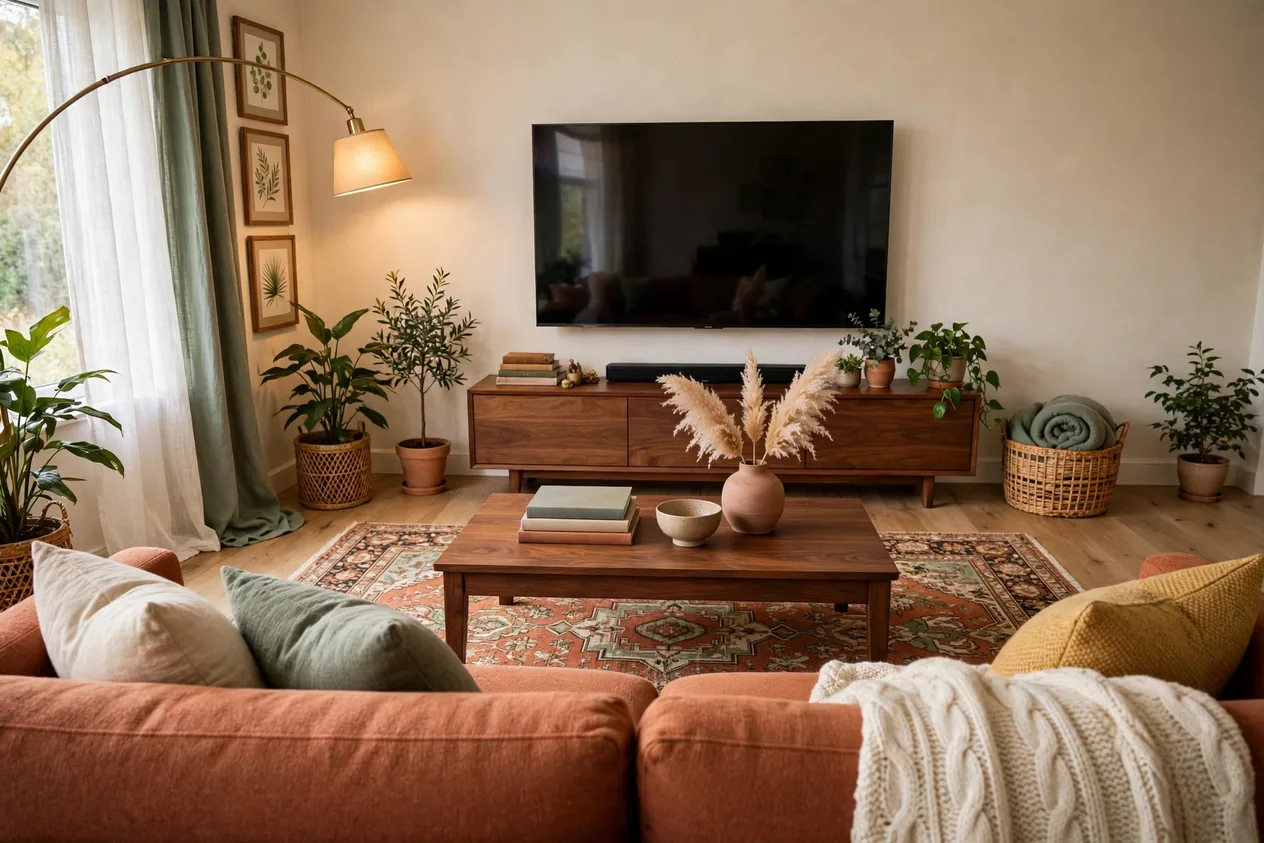
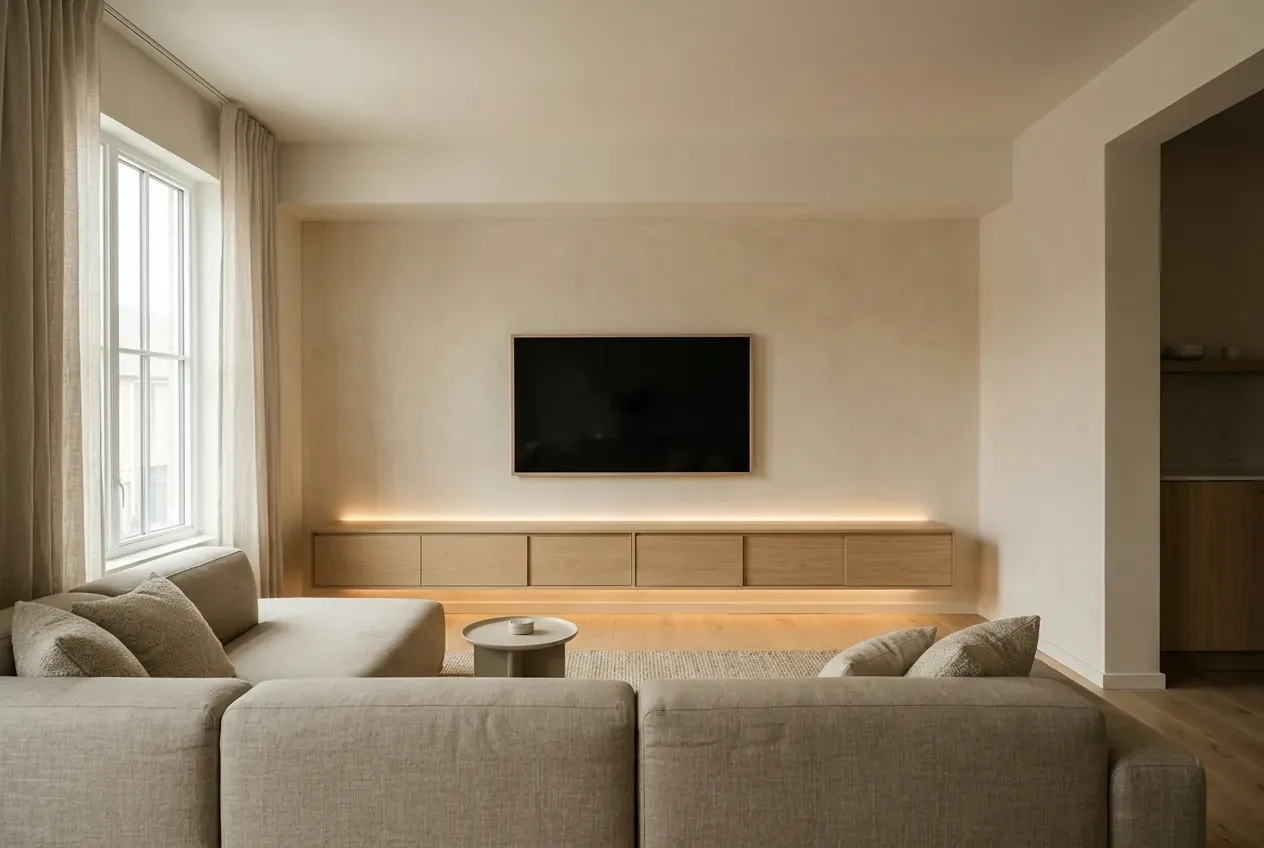 The same room seen from the opposite end, so you can judge the layout from the far side.
How high to hang a TV
Hang the TV so the centre of the screen sits at about 42 in (107 cm), roughly seated eye level on a standard apartment sofa; the working range in the table above runs from 38 in (97 cm) up to that 42 in (107 cm) target. Work backwards from the console: with the console top at 24 to 28 in (61 to 71 cm), leave 8 to 10 in (20 to 25 cm) between the console top and the bottom of the screen, which lands the centre where it should be for most sofas. A companion guide to TV dimensions by screen size is planned for this site, so you can pair the right screen width with these heights before you buy.
Layouts that work
A long slatted run on an 11 ft wall. A white oak credenza about 70 in wide and 10 in deep, with sliding tambour doors, hung with its bottom about 11 in above the baseboard. Centre a 50 inch screen roughly 8 in above the top. Sliding doors need no swing space, so the walkway in front stays free.
Offset in a studio. If the sofa cannot sit opposite the middle of the wall, shift the console to one side and balance it with a few vertical floating art ledges on the other half. The open floor beneath keeps the studio from feeling stuffed. See floating shelves for renters if you cannot drill for the ledges.
A shallow soundbar shelf. Where the walkway is under about 32 inches, skip deep storage. A solid timber ledge about 8 inches deep on a hidden steel bracket, with a low soundbar, makes the smallest possible media footprint. If you want to tuck the TV into a corner instead, read the corner media console guide.
Mounting it safely
- Use studs. Do not hang a loaded console on hollow-wall anchors alone. Fix the cabinet’s cleat into at least two studs with screws sized for the loaded weight. There is no single universal rating: the screws, the stud and the cabinet each have their own limit, so follow the figures on the console’s spec sheet and the fastener maker’s guidance.
- Find the studs and level the cleat before you drill, then check it again once the cabinet is on.
- Load it in stages and look for sag.
- Ask the landlord if the lease prohibits wall holes. A freestanding low console may be the safer route in a rental.
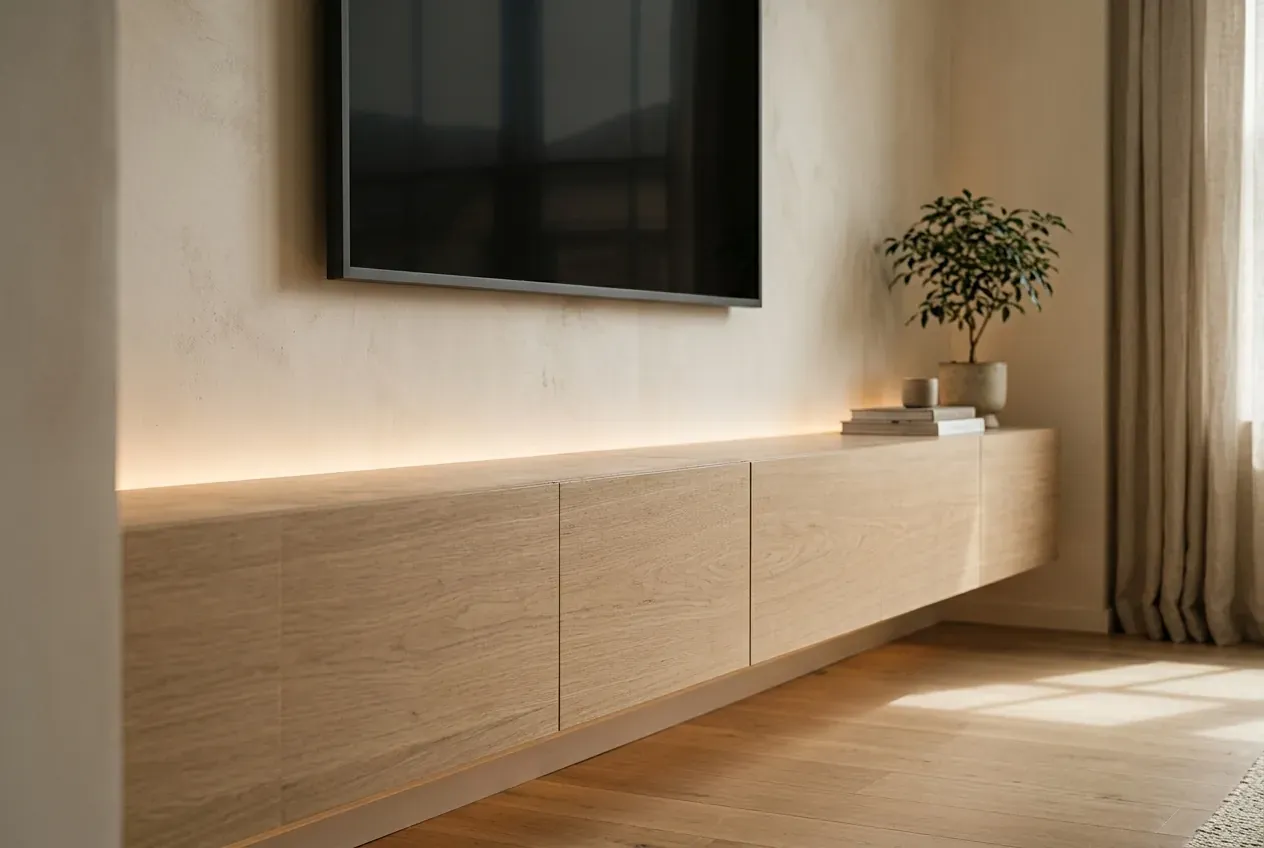 Close up: Mount the floating console top at 24 to 28 inches (61 to 71 cm) AFF and the screen center at 42 inches (107 cm) AFF.
Cables
- In-wall pass-through. A recessed cable box behind the TV and cabinet hides power and HDMI lines, if the wall can be cut and local rules allow.
- Surface raceway. In a rental, a low-profile cord channel painted the wall colour is easier to remove and nearly invisible.
- Under-cabinet LED strip. A warm, dimmable strip under the console makes it appear to float and gives a soft wash on the wall.
Heat and airflow
Streaming boxes, game consoles and receivers give off heat, and enclosed shelves trap it. Choose a console with open or vented sections, keep gaps around each device, and follow each device’s manual for clearances. Fabric front panels, open backs and bottom slots all help, but check the maker’s guidance rather than drilling your own holes into a cabinet.
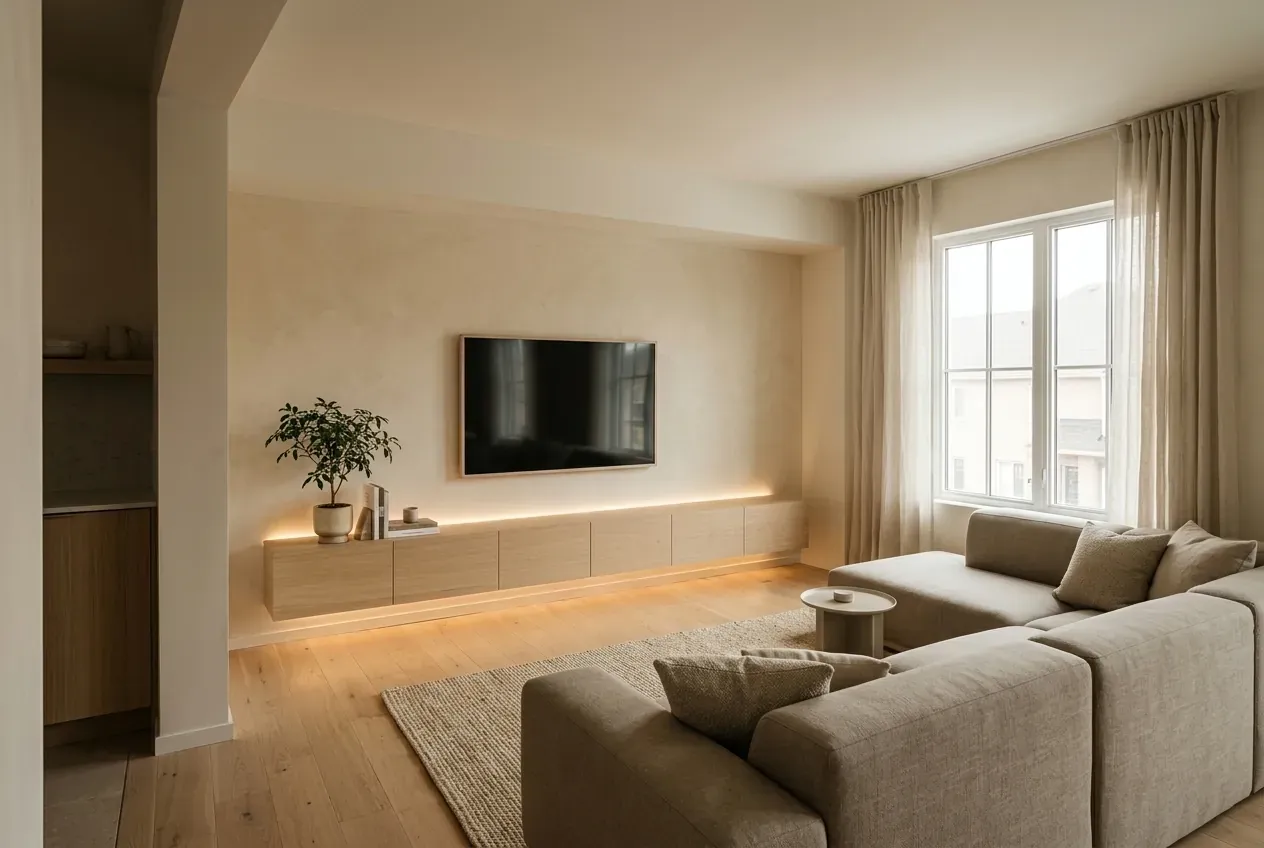 From above and to one side, the full footprint and the walkway read at a glance.
Colour and finish
Warm plaster or off-white walls reduce the glare behind a lit screen. Light oak on the console and oat linen on the sofa look soft, and charcoal pulls on the doors give a small anchor. A matte finish shows fewer reflections near a screen.
Common mistakes
- Setting the screen so high you tilt your neck.
- Choosing a console narrower than the TV.
- Mounting too low so the floor strip disappears.
- Relying on drywall anchors for a heavy cabinet.
- Sealing hot devices in a closed cavity.
Before you mount it
- Measure your seated eye height.
- Mark the screen centre at about 42 inches.
- Set the console bottom 10 to 12 inches up.
- Keep the console 1.5 times the TV width.
- Find at least two studs.
- Plan cables and ventilation before you load it.
Curated Color Palette & Key Textures
- Warm Plaster #EDE8DE
- Rift Oak #D1B898
- Soft Charcoal #2C2C2A
- Linen #E5DEC9
General references
Dimensions in these guides are typical planning ranges, not legal minimums, and they can differ by jurisdiction. Use the references below as starting points, then confirm local code and your lease before making changes.
FAQ
How high should a floating TV console be off the floor?
A floating TV console should sit with its bottom edge 8 to 12 inches above finished floor, placing its upper surface between 24 and 28 inches high.
What is the correct viewing height for a wall-mounted TV?
The center of your television screen should align with seated eye level, typically 40 to 42 inches above finished floor for standard apartment sofas.
How deep should a floating console be in a narrow apartment?
Limit cabinet depth to 9 to 11 inches to maintain open floor sightlines and allow 30 inches of walkway clearance past coffee tables.
Save this idea

Keep reading
Related rooms
Standard Window Sizes: 24 x 36 to 48 x 72 in Chart
Standard window sizes in inches and cm: most run 24 to 48 in wide by 30 to 72 in high, and a bedroom window needs a 5.7 sq ft clear opening for egress.
TV Dimensions by Screen Size: 65 in Is 56.7 x 31.9 in
TV dimensions by screen size in inches and cm: a 65 in TV is 56.7 x 31.9 in, a 55 in is 47.9 x 27.0 in, plus the viewing distance and stand width for each.
How High to Hang Pictures: 57 in (145 cm) Center
Hang pictures with the center 57 in (145 cm) up, the frame bottom 7 to 10 in (18 to 25 cm) above a sofa, and frames 2 to 3 in (5 to 8 cm) apart.