Small Room Dehumidifiers: Bedroom Moisture Guide
Dehumidifier size for a bedroom: match the pint rating to the room, hold 30–50% RH, and pick a 35 dBA quiet model for sleep in small apartments.
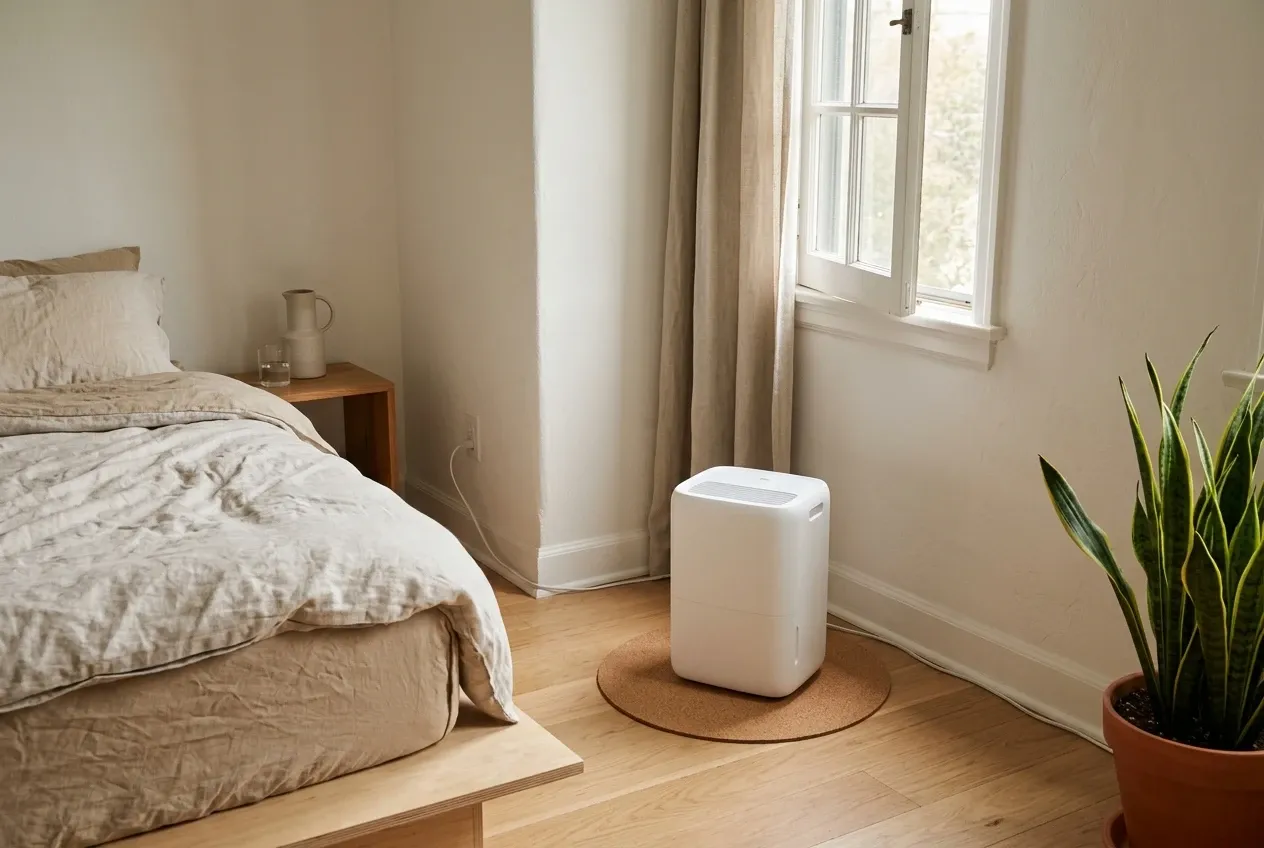
Room specifications
- Room ScaleSmall apartment bedroom (about 10 x 12 ft)
- Design StyleWarm Minimalist / Clean Wellness
- Budget TierMid-Range ($$)
- Palette Swatches4 colors
Waking up to foggy window glass, musty closet odors, and clammy bed sheets in a compact 10x12 foot (3.0x3.7 m) apartment bedroom signals dangerously high humidity levels exceeding 65 percent. In tight rental units with limited exterior ventilation, trapped human respiration and shower steam foster toxic black mold spores within drywall seams and behind headboards.
Deploying a compact, whisper-quiet dehumidifier engineered for residential bedrooms maintains air between 30 and 50 percent relative humidity, protecting health and decor. By coordinating air quality management with 10x10 bedroom layouts and bedroom blackout window treatments, you secure a healthy sleep sanctuary.
1. Sizing and Specs for a Small Bedroom Dehumidifier
Follow these performance and spatial metrics when selecting dehumidifiers for sleeping spaces.
| Appliance Metric | Standard Room Spec | Recommended Target | Health & Acoustic Impact |
|---|---|---|---|
| Moisture Extraction Rate | 15–20 Pints / 24 Hours | 22–30 Pints / Day | Rapidly extracts dampness from 100 to 200 sq ft bedrooms. |
| Operating Noise Level (Low) | 42–48 dBA commercial | Under 36 dBA whisper | Permits deep sleep without annoying compressor vibration hum. |
| Airflow Perimeter Margin | 8.0 in (20.3 cm) minimum | 12.0 in (30.5 cm) clear | Ensures continuous air circulation across cooling condenser coils. |
| Target Relative Humidity | 30–50% RH safe range | 45% RH optimal | Inhibits dust mite breeding and halts mold mildew colonization. |
| Condensate Tank Capacity | 0.5–0.8 Gallons (1.9–3.0 L) | 1.0 Gallon (3.8 L) | Requires emptying only once every 24 hours under normal moisture load. |
Health alert: Relative humidity exceeding 55 percent creates prime breeding conditions for dust mites and airborne fungal spores. Keep digital hygrometers at headboard level to ensure humidity stays strictly below 50 percent year-round.
Sizing by apartment footprint
If the unit has to serve more than the bedroom, size by total floor area. These pint ratings follow Department of Energy (DOE) testing metrics.
| Space | Pint rating (per 24 h) | Tank volume | Noise ceiling |
|---|---|---|---|
| Studio under 350 sq ft (32.5 sq m) | 15-20 pints | 0.6-0.8 gal (2.3-3.0 L) | 36 dBA on low |
| 1-bedroom, 350-600 sq ft (32.5-55.7 sq m) | 20-30 pints | 0.8-1.2 gal (3.0-4.5 L) | 40 dBA on medium |
| Windowless bathroom only | 10-15 pints | 0.5 gal (1.9 L) | 38 dBA |
| Basement or garden flat | 30-35 pints | 1.5 gal (5.7 L) | 44 dBA |
| Peltier thermo-electric | Under 2 pints | 0.2 gal (0.8 L) | Under 28 dBA |
Avoid cheap 1-pint Peltier desktop units for whole rooms. The chip lacks the refrigeration power to pull moisture from anything larger than a small wardrobe closet, so a whole apartment needs a true mechanical compressor.
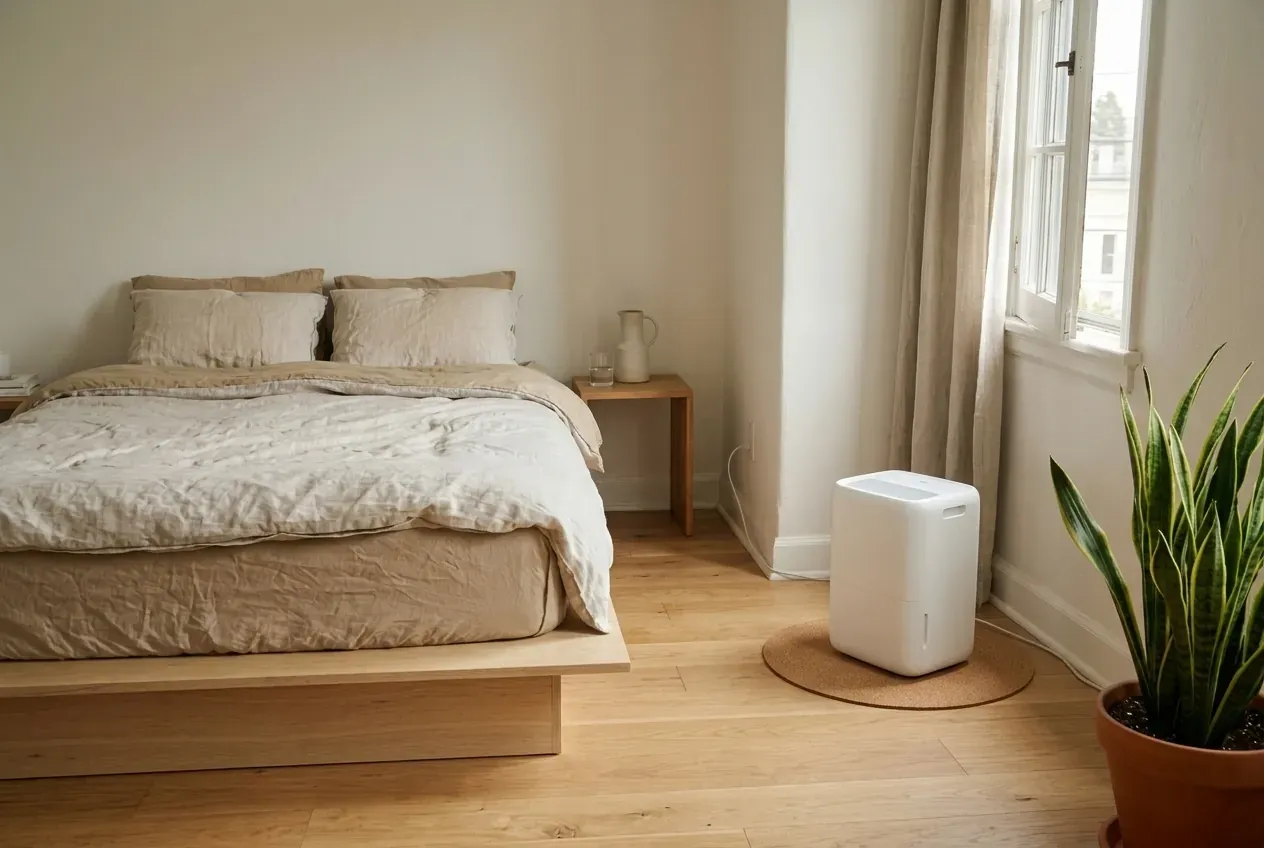 The same room seen from the opposite end, so you can judge the layout from the far side.
2. Placement Setups for Bedrooms, Hallways and Bathrooms
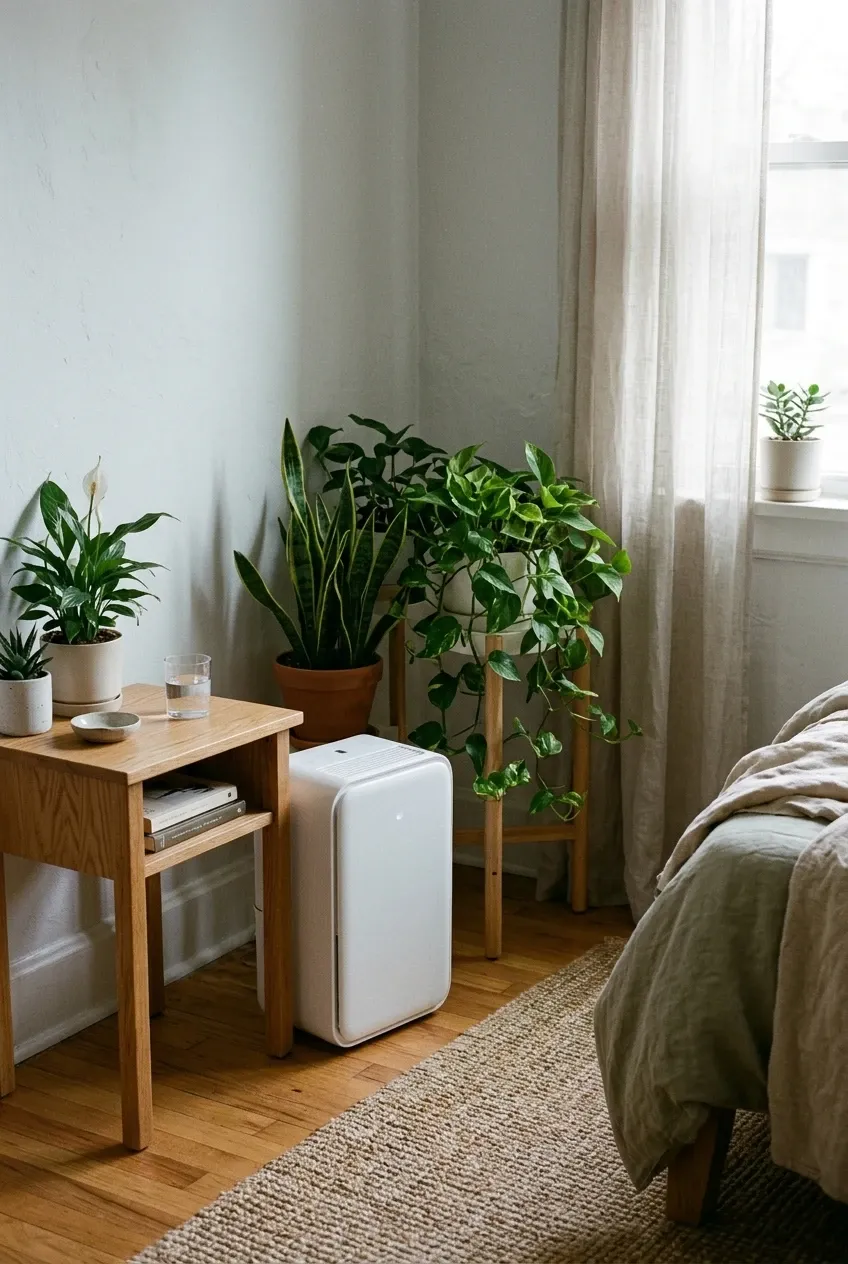
Window corner, low decibel. For a 10x12 foot primary bedroom with winter window condensation, use a compact 25-pint compressor unit in Pure Chalk (#F6F4EE) running at 35 dBA on low. Tuck it in the corner 14 inches (35.6 cm) from the window trim on a 1/2-inch thick round cork mat, which keeps compressor vibration out of the floor joists and ends the morning sill puddles and musty smell.
Closet-adjacent. In a windowless bedroom where a reach-in wardrobe shares a wall with a humid bathroom, place the unit next to the open closet doors. It keeps leather shoes and wool coats dry and prevents garment spoilage.
Thermo-electric for micro-studios. Under 250 square feet, a solid-state Peltier unit with no compressor runs in near silence on a nightstand surface.
Central hallway. In a 500 sq ft one-bedroom with an interior bathroom, a 22-pint Energy Star compressor unit at 38 dBA in the hallway between bathroom and bedroom draws air from both damp zones. Keep it 14 inches from the corridor walls for 360-degree intake and empty the 0.8-gallon (3.0 L) tank once daily in winter.
Bathroom with gravity drain. For chronic moisture in older rentals, place the unit in the bathroom with a 4-foot clear vinyl hose running into the shower drain, so it runs around the clock with no bucket emptying. Run it for 30 minutes after showers; bathrooms with no exterior window and humidity above 65 percent can see latex paint peel within about a year.
Kitchen steam. In a galley kitchen without a range hood, roll a compact portable unit beside the prep counter while boiling or simmering.
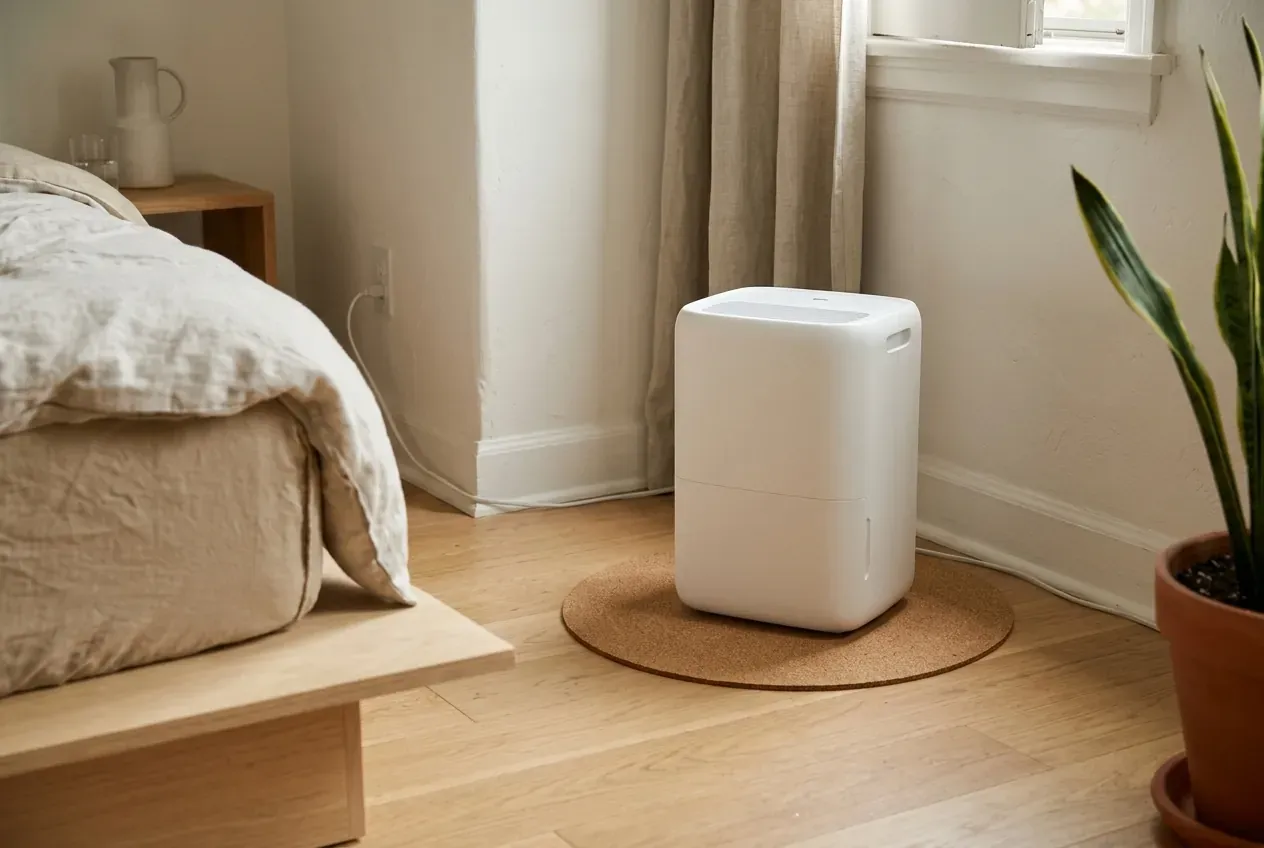 Close up: Maintain a minimum 12-inch (30.5 cm) perimeter air intake clearance around small room dehumidifiers and regulate bedroom relative humidity between 30% and 50%.
3. Floor Protection & Maintenance Protocols
- Vibration-Damping Cork Trivet: Compressors create micro-vibrations that can turn hardwood floors into sounding boards for lower-floor neighbors. Always place a 1/2-inch thick dense natural cork mat beneath dehumidifier wheels to deaden sound and catch stray water droplets during tank emptying.
- Weekly Filter Cleaning: Wash the removable nylon dust pre-filter weekly under warm running tap water. Accumulated pet dander and lint choke airflow, forcing the compressor to run hotter and increasing electricity consumption.
- Drain Hose Pitch: On continuous drain, the hose must slope down at least 1/4 inch per foot (about 2 cm per metre). An upward loop stops gravity drainage and sends water back into the reservoir.
- Auto-Defrost Sensor Verification: In winter, cooling coils can ice over when bedroom temperatures drop below 65°F (18°C). Ensure your unit includes automatic defrost cycle logic, which shuts off the compressor while running the fan to melt frost automatically.
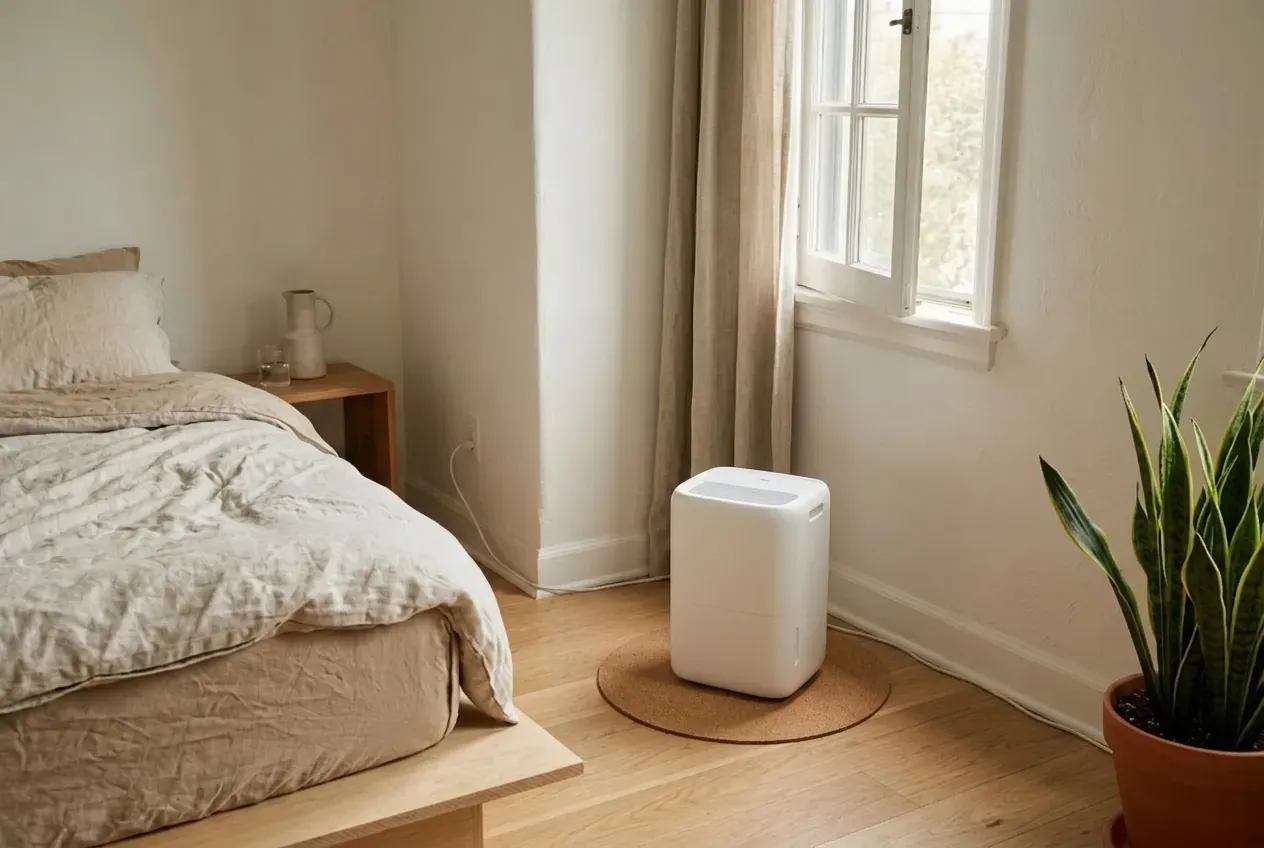 From above and to one side, the full footprint and the walkway read at a glance.
4. Color and Finish Choices That Hide the Appliance
Keep the unit visually quiet. A Pure Chalk (#F6F4EE, LRV 86) housing against matching walls disappears into the corner. Natural White Oak (#C8A882, LRV 48) platform framing and nightstands add warmth, and Earthy Cork (#B88E5E) mats with Muted Slate (#424647, LRV 22) curtains ground the setting.
Complete your dehumidifier installation by running the unit until your hygrometer reads 45% before turning on quiet sleep mode.
Curated Color Palette & Key Textures
- Pure Chalk #F6F4EE
- Natural White Oak #C8A882
- Earthy Cork #B88E5E
- Muted Slate #424647
General references
Dimensions in these guides are typical planning ranges, not legal minimums, and they can differ by jurisdiction. Use the references below as starting points, then confirm local code and your lease before making changes.
FAQ
What size dehumidifier is needed for a 120 square foot bedroom?
A compact 20 to 30-pint compressor dehumidifier or high-capacity Peltier unit efficiently controls moisture in rooms up to 150 square feet.
How quiet should a bedroom dehumidifier be for sleeping?
Look for units operating below 38 dBA (decibels) on low speed, which equates to a gentle background whisper that will not disrupt sleep.
Can dehumidifiers prevent black mold on bedroom window frames?
Yes, maintaining bedroom relative humidity below 50% eliminates window condensation that feeds toxic black mold (Stachybotrys) growth.
What size dehumidifier do I need for a 500 square foot apartment?
A 20 to 30-pint (new DOE standard) compressor dehumidifier regulates humidity across a 500 sq ft (46.5 sq m) apartment. Studios under 350 sq ft (32.5 sq m) can use 15 to 20 pints.
How much electricity does a small dehumidifier use?
Energy Star-certified compact units draw roughly 200 to 300 watts, costing about $0.15 to $0.30 per day when set to 45% RH.
Save this idea

Keep reading
Related rooms
Bunk Bed Dimensions: 5 Sizes, Clearances & Safety Gaps
A twin bunk is 77 x 41 in (196 x 104 cm) and about 62 in tall: all 5 standard sizes, the 5 in guardrail rule, deck spacing and the ceiling check.
Standard Bed Sizes: Queen 60 x 80 in (152 x 203 cm)
Standard bed sizes in inches and cm: a double (full) is 54 x 75 in, a queen 60 x 80, a king 76 x 80, a California king 72 x 84, plus the room each needs.
Rug Size for a King Bed: 8x10 Shows 22 in Each Side
Rug size for a king bed: an 8x10 ft rug shows 22 in (56 cm) each side and 43 in past the foot; a 9x12 shows 34 in. See the maths, a chart and a calculator.