Floating Book Shelves for Small Spaces: Studs & Styling
Maximize small living room walls with floating book shelves. Stud anchoring rules, 12-inch vertical spacing, weight ratings, and modern styling rules.
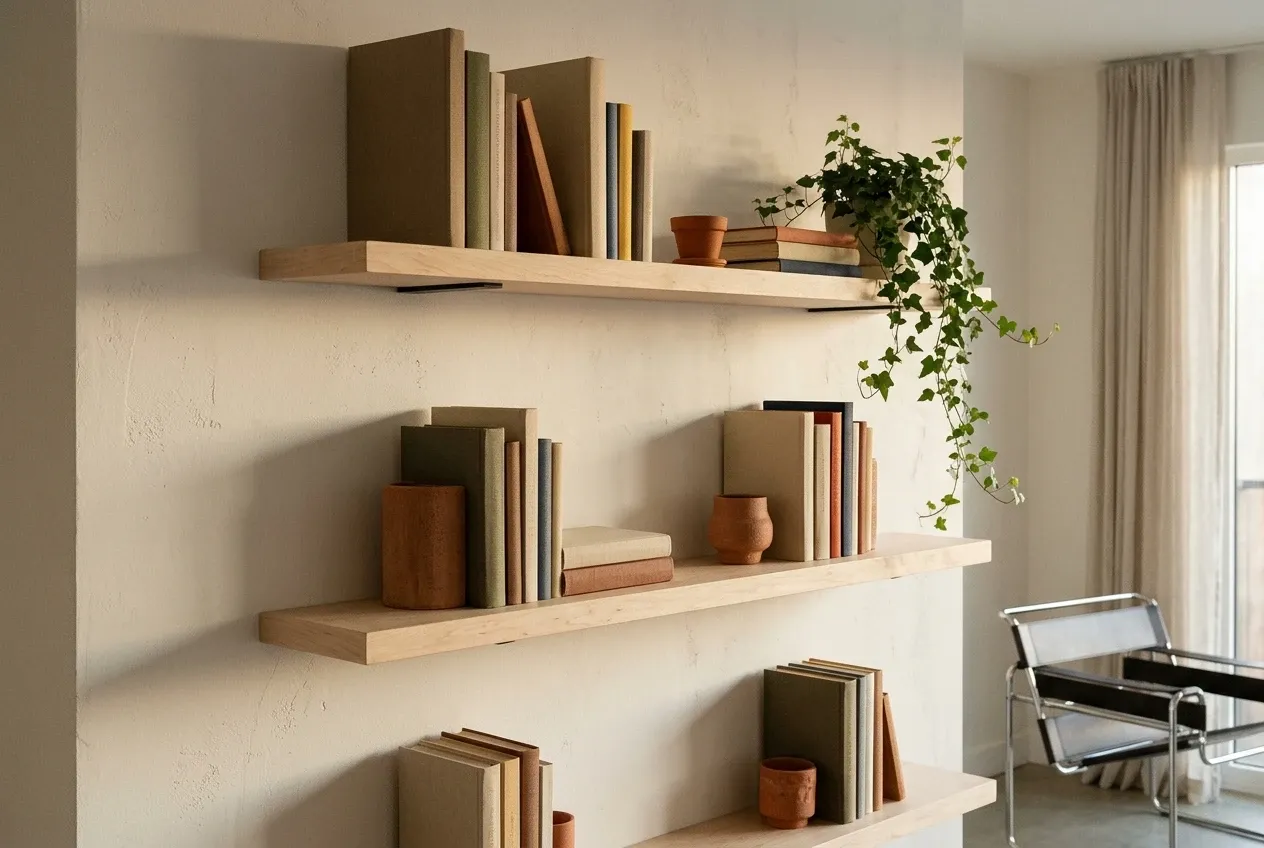
Room specifications
- Room ScaleSmall apartment living room (about 11 x 12 ft)
- Design StyleBauhaus / Modern Minimalist
- Budget TierBudget ($)
- Palette Swatches4 colors
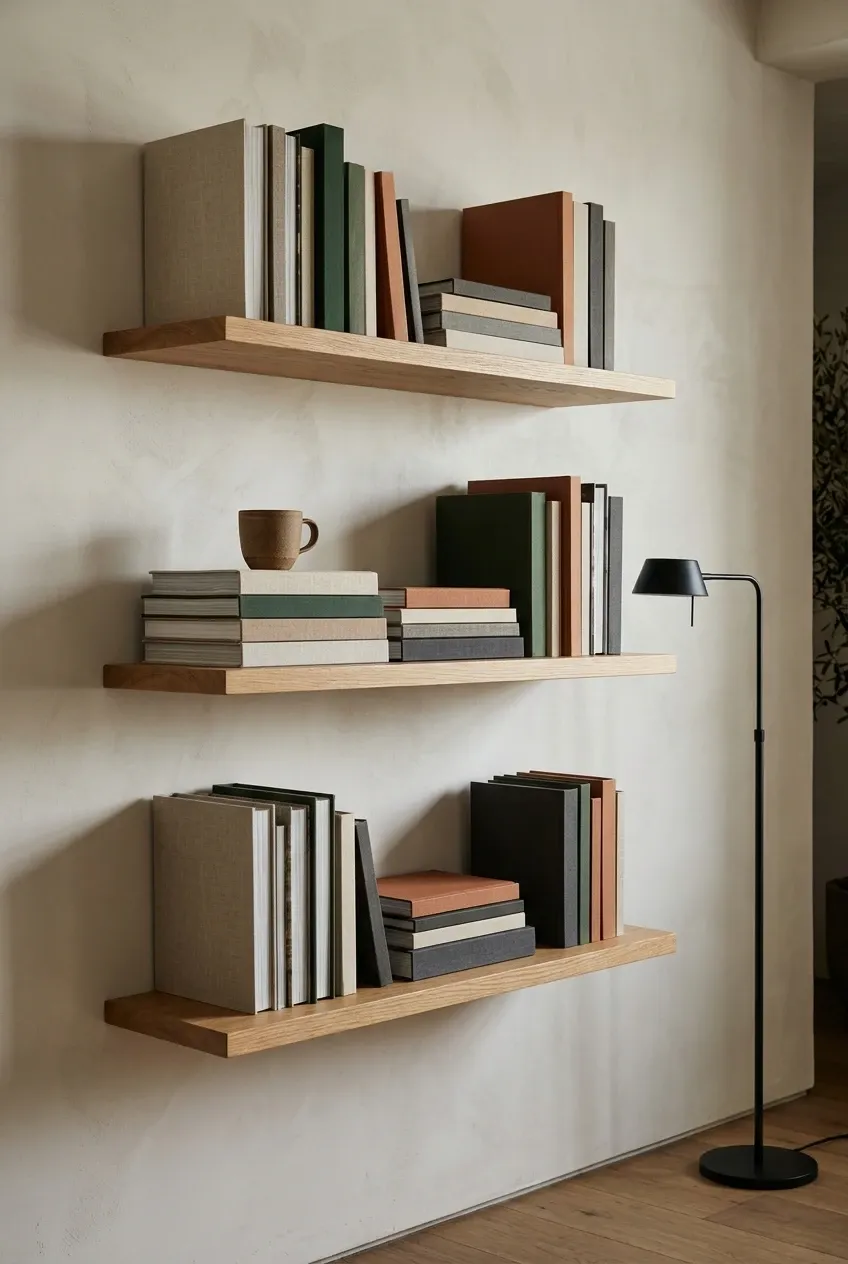
Floating bookshelves hold books safely only if the load is carried by studs or by anchors rated for the weight, so plan the mounting first and the styling second. Space the tiers about 12 to 14 inches apart for standard hardcovers, and leave one tier mostly open so the wall does not feel heavy.
In an apartment where floor space is tight, a tall freestanding bookcase can choke a walkway. Wall-hung shelves use the vertical space instead and keep the baseboard area clear. They also pair well with how to style a bookshelf and with small corner shelf ideas for awkward spots. For general heights and distances, see the companion shelf spacing and height guide.
Match the mounting to the load
Books are heavy, and a cantilevered shelf pulls outward on its upper fasteners as well as down. Hollow-wall fixings are weakest at exactly that kind of load.
| Mounting method | How strong, relatively | Typical depth | Best for |
|---|---|---|---|
| Screws into studs | Strongest of these methods | 8 to 10 in (20 to 25 cm) | Hardcovers and ceramics |
| Heavy-duty toggle bolts | Moderate, depends on the product | 6 to 8 in (15 to 20 cm) | Paperbacks, small plants, framed art |
| Concealed rod (cantilever) bracket | Moderate to high | 8 to 9 in (20 to 23 cm) | Mixed collections |
| Light plastic anchors | Lowest of these methods | 4 to 6 in (10 to 15 cm) | Postcards, a candle |
Catch at least one wall stud wherever you can, and make sure the printed capacity of every anchor is above the loaded weight of the shelf. If the shelf cannot reach a stud, keep it light.
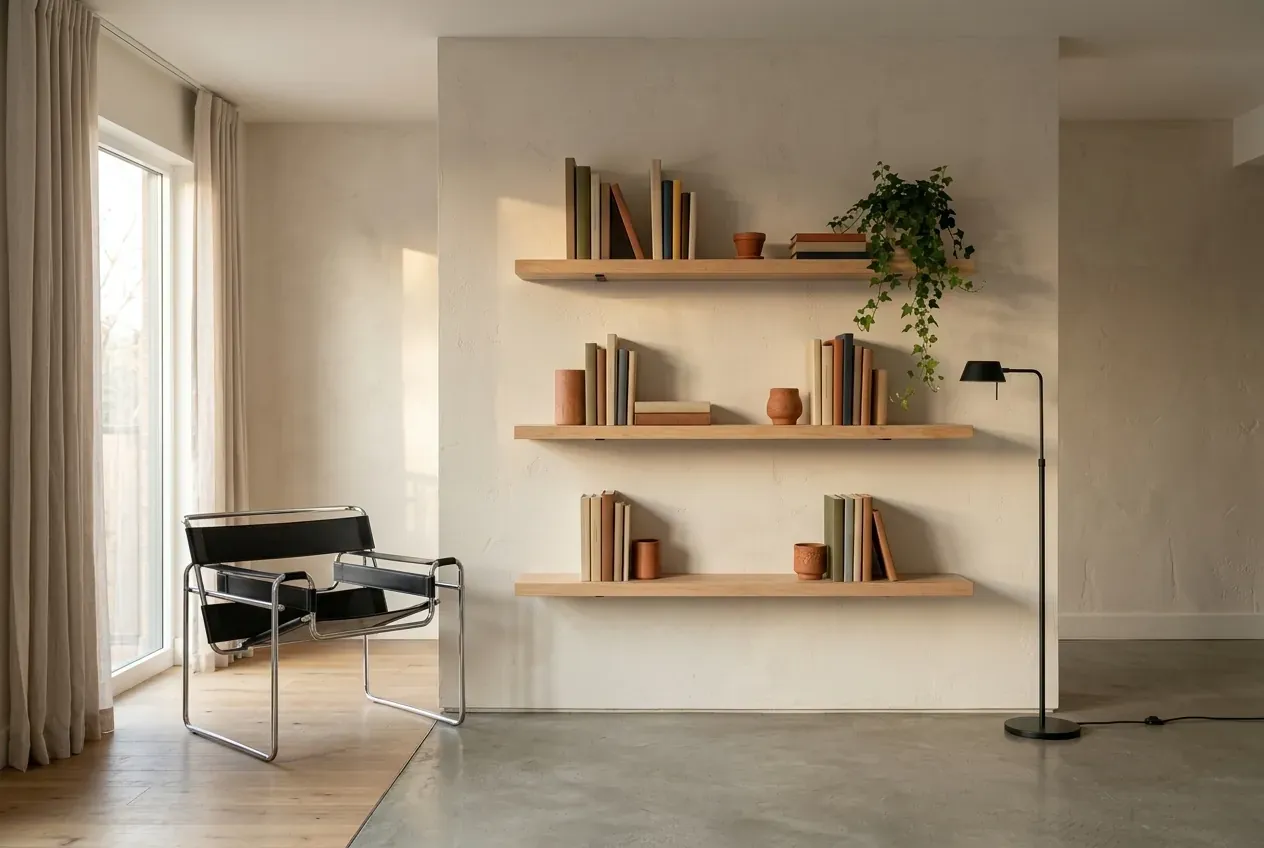 The same room seen from the opposite end, so you can judge the layout from the far side.
How to install one
- Find the studs. Use a stud finder and confirm with a small nail in a spot the shelf will cover. Mark the centres with masking tape.
- Choose the shelf length to fit. A shelf that spans two studs is much more reliable than one that lands between them.
- Level first. Hold the bracket or shelf against the wall, level it, and mark the screw holes. Drill pilot holes so the wood does not split.
- Fasten and slide on. Screw the bracket into the studs, slide the shelf over the prongs, and tighten the set screws.
- Load gradually. Put light items on first, and check for sag or a gap along the wall after a day before adding heavy books.
Layouts that suit small rooms
A three-tier stack on a narrow pier. A 3 ft wall between two doorways suits three shelves, each around 32 in wide and 8 in deep. Put the first shelf near 44 in off the floor, about 13 in between tiers, with the top shelf not much above 70 in. Dark steel brackets can echo window frames.
A ledge over the sofa. A long, shallow picture ledge, about 4 in deep, hung roughly 12 in above the sofa back lets you lean framed photos without anything protruding into head space. If you want deeper shelves above seating, read the above-bed shelf safety guide for a sense of what to avoid overhead.
A corner wrap. In a dead corner beside the TV, two staggered shelves can wrap the corner and use it. Keep about 36 in of clearance from nearby armchairs.
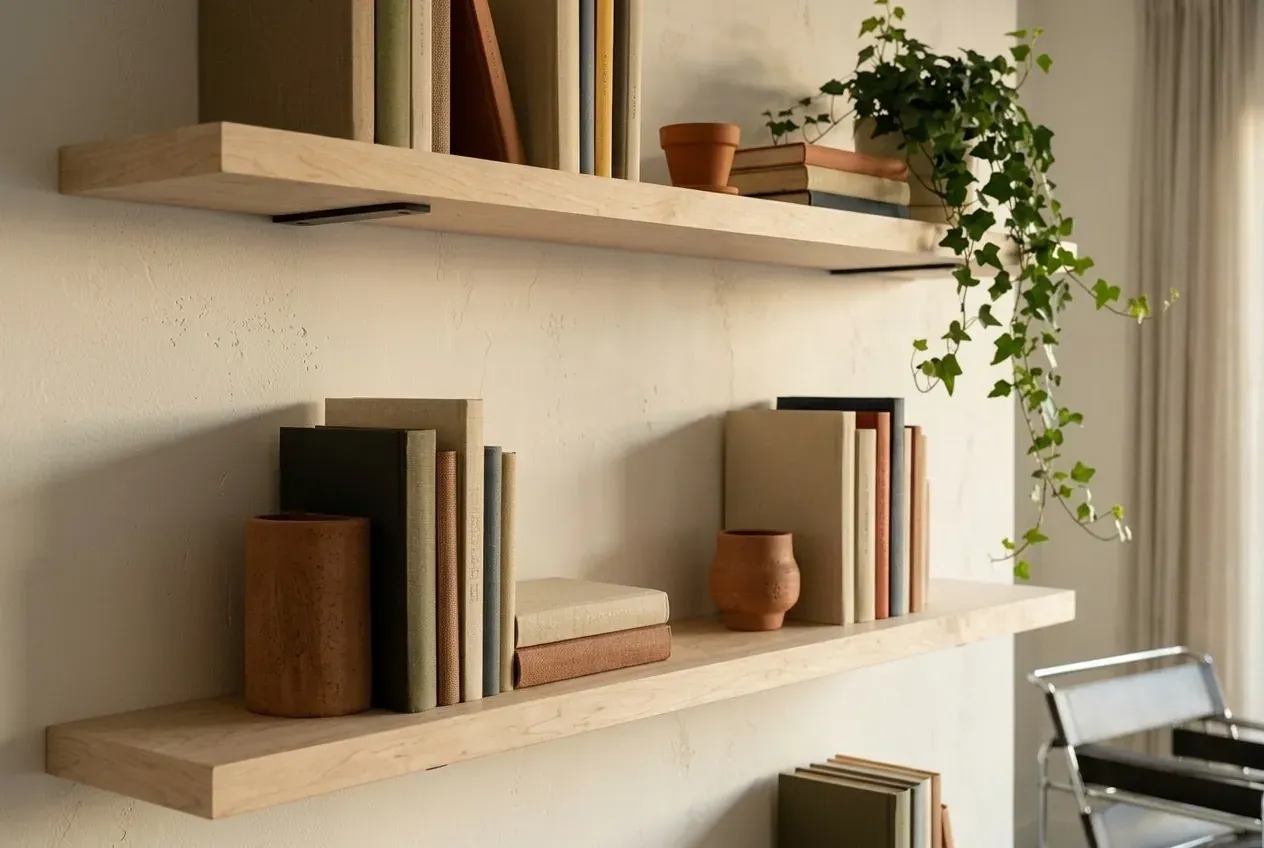 Close up: Maintain 12 to 14 inches (30.5-35.6 cm) of vertical clearance between shelf tiers to accommodate standard hardcover books.
Styling so the wall still breathes
- Mix vertical stacks, held by sculptural bookends, with a few horizontal piles that act as pedestals for small objects.
- Leave roughly a fifth of each tier open, as resting space for the eye.
- Add one or two terracotta or ceramic vessels and a trailing plant, or a piece of amber glass that catches afternoon light.
- Repeat one material, such as the birch of the shelves, in a nearby frame or bowl so the wall looks planned.
- Put heavy, dark objects on the lowest tier and lighter ones higher.
- Keep sofa-back ledges shallow so someone sitting up does not hit a leaning frame.
A pale matte wall colour with light timber shelves and dark brackets is a safe combination that keeps the shelves from looking heavy.
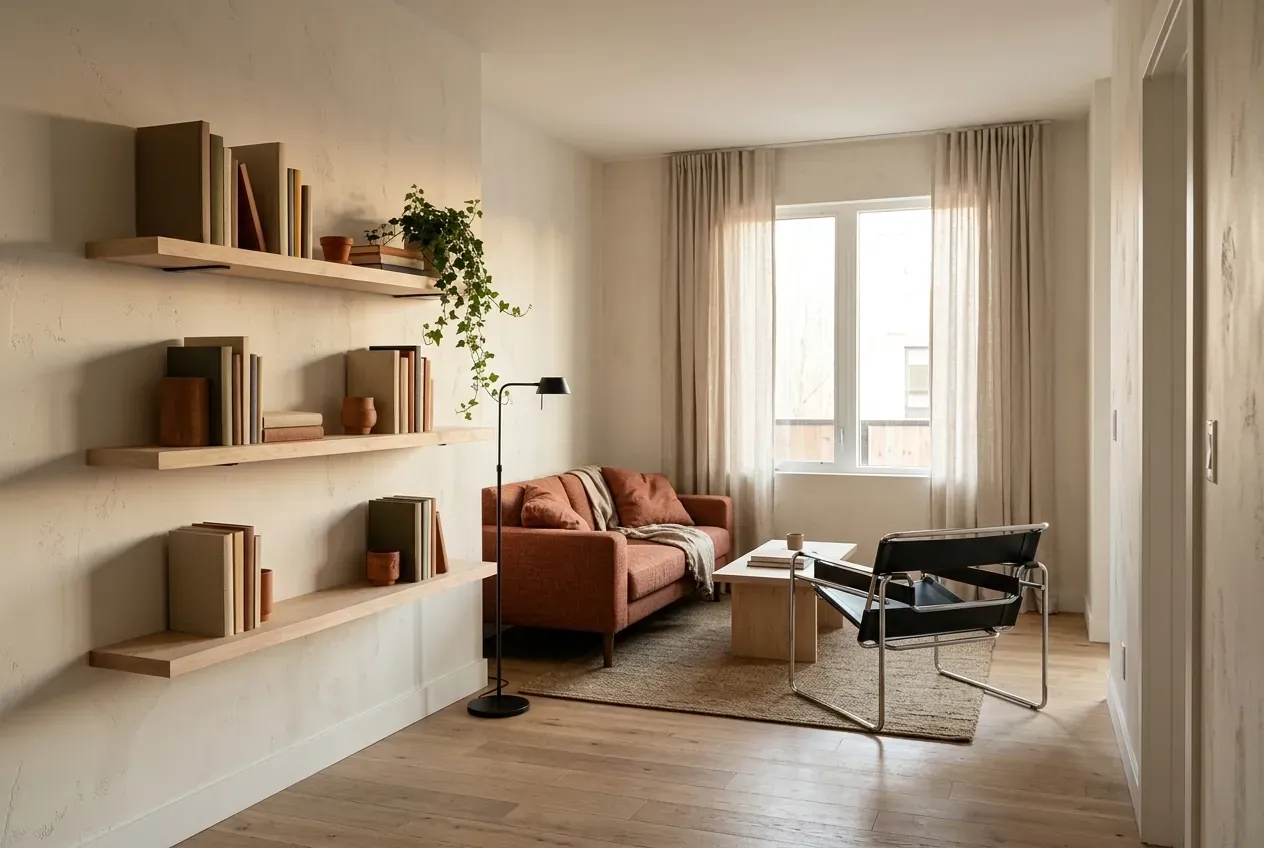 From above and to one side, the full footprint and the walkway read at a glance.
Common mistakes
- Trusting the maximum weight on a plastic anchor without checking the wall.
- Mounting a long shelf on one stud and expecting it to stay level.
- Filling every tier with books so the wall looks heavy and the fixings are strained.
- Hanging the lowest shelf where a seated person can hit it.
- Choosing a shelf deeper than the books need.
If you rent and cannot drill into studs at all, the no-drill floating shelves guide covers lighter options.
Before you hang them
- Locate and mark the studs.
- Pick shelf lengths that reach them.
- Check the anchor and bracket weight ratings against your books.
- Plan 12 to 14 inches between tiers.
- Keep the lowest shelf clear of seated heads.
- Leave one tier open.
- Load the shelf a bit at a time.
Curated Color Palette & Key Textures
- Cast Iron Black #2A2A2A
- Bleached Birch #E6DFD3
- Terracotta Brick #B85D43
- Raw Steel #707372
General references
Dimensions in these guides are typical planning ranges, not legal minimums, and they can differ by jurisdiction. Use the references below as starting points, then confirm local code and your lease before making changes.
FAQ
How much weight can floating shelves hold on apartment drywall?
It depends on the anchor and the wall, not the shelf. Stud-mounted brackets hold far more than hollow-drywall fixings, but the safe figure is whatever the bracket and anchor manufacturers publish for your wall type, so check both spec sheets.
How far apart should floating bookshelves be spaced vertically?
Space shelves 12 to 14 inches (30.5 to 35.6 cm) apart for novels and decorative objects, or 16 inches (40.6 cm) for oversized art monographs.
How high above a living room sofa should floating shelves be hung?
Hang the lowest shelf 10 to 12 inches (25.4 to 30.5 cm) above the sofa backrest to prevent seated guests from bumping their heads.
Save this idea

Keep reading
Related rooms
Standard Window Sizes: 24 x 36 to 48 x 72 in Chart
Standard window sizes in inches and cm: most run 24 to 48 in wide by 30 to 72 in high, and a bedroom window needs a 5.7 sq ft clear opening for egress.
TV Dimensions by Screen Size: 65 in Is 56.7 x 31.9 in
TV dimensions by screen size in inches and cm: a 65 in TV is 56.7 x 31.9 in, a 55 in is 47.9 x 27.0 in, plus the viewing distance and stand width for each.
How High to Hang Pictures: 57 in (145 cm) Center
Hang pictures with the center 57 in (145 cm) up, the frame bottom 7 to 10 in (18 to 25 cm) above a sofa, and frames 2 to 3 in (5 to 8 cm) apart.