How to Choose a Paint Color for a Small Room
A four-step swatch process for small rooms: sample board size, viewing distance, the 24-hour check, and why the second-light test beats the chip.
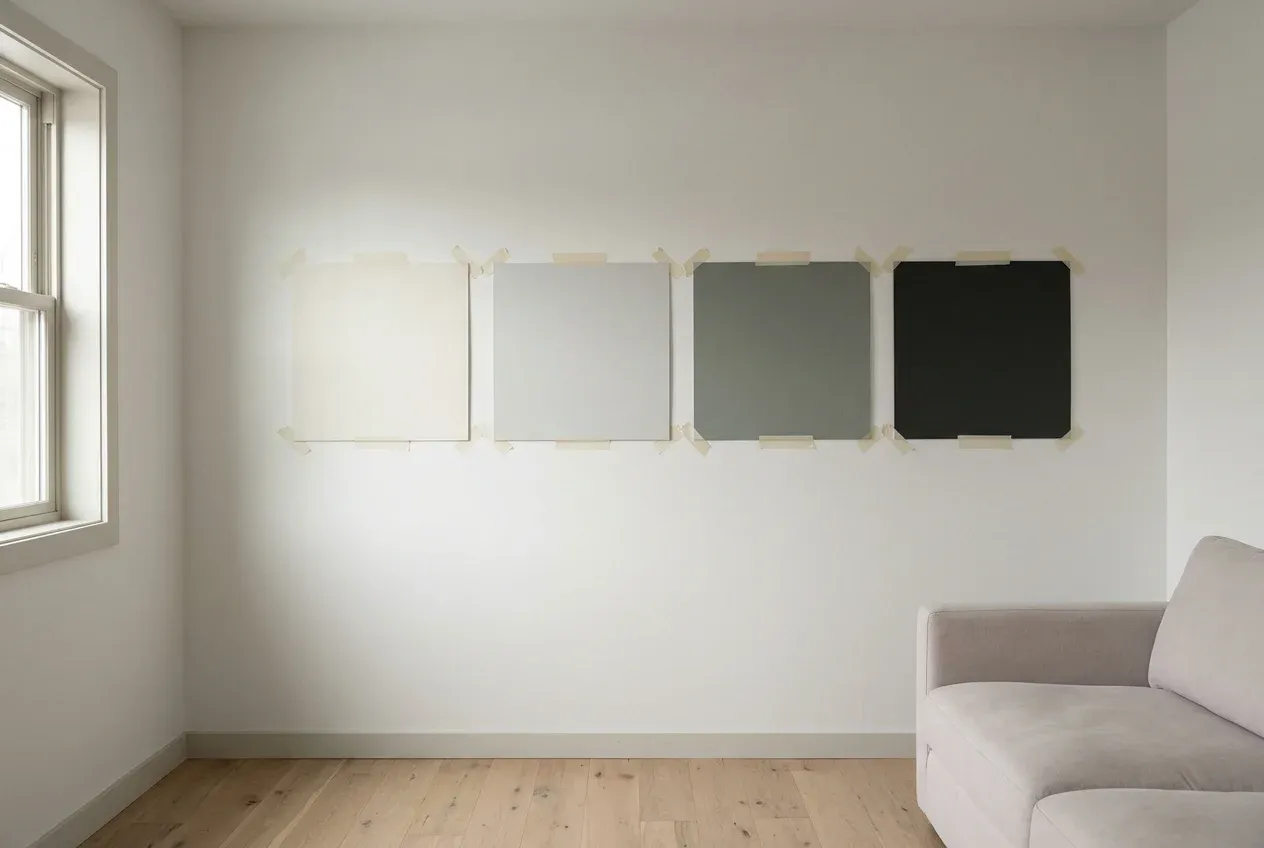
Room specifications
- Room ScaleSmall living room (about 10 x 12 ft) with two windows on different walls
- Design StyleQuiet Contemporary Neutral
- Budget TierBudget ($)
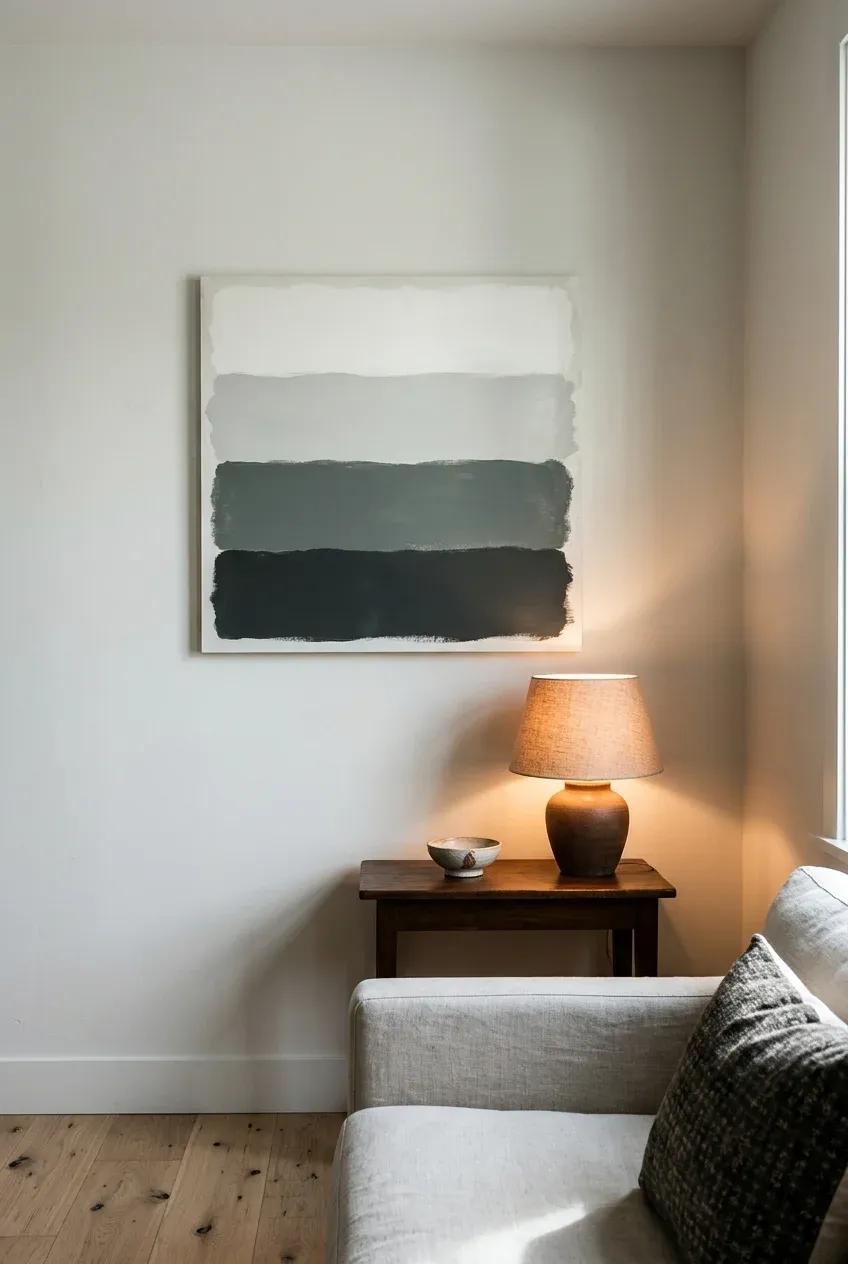
- Palette Swatches4 colors
The most reliable way to choose a paint color for a small room is to test your top three candidates on 24 in (61 cm) sample boards and watch them across a full day of light. A 2 x 3 in chip is seen against bright white card, so undertones look cleaner and lighter than they will across 100 sq ft (9.3 sq m) of drywall.
Use boards, not chips or patches
Painting samples straight onto the wall causes problems: the old colour biases your eye, and roller edges leave ridges you must sand before the final coat. Instead, roll each colour in two coats onto a 24 x 24 in (61 x 61 cm) primed foam board or poster board, and leave a 1 in (2.5 cm) white border. The border resets your eye each time you glance at it.
Boards also move from room to room. If you are weighing paint against renter-friendly wallpaper, they leave the drywall unmarked.
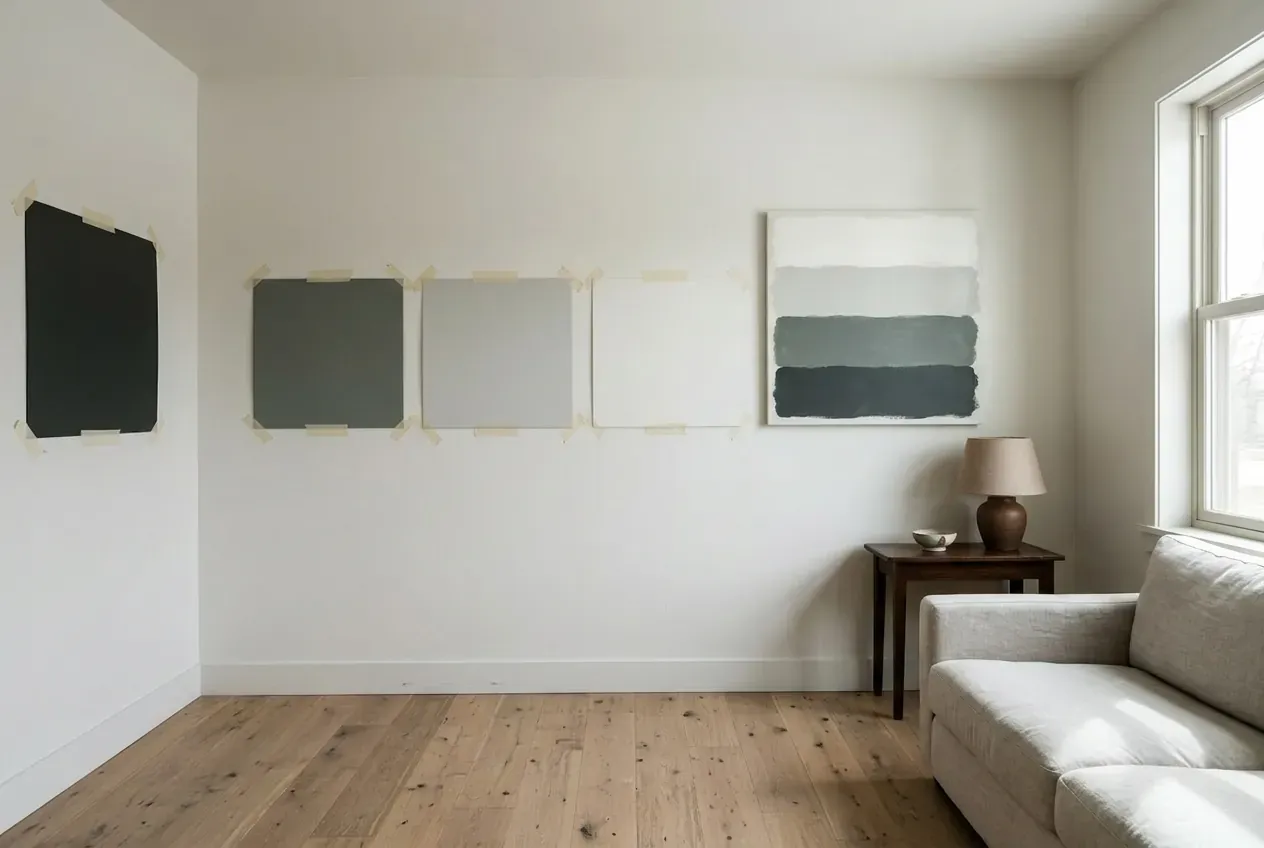 The same room seen from the opposite end, so you can judge the layout from the far side.
Look at it in the worst light
A small room rarely has balanced light all day, so run a second-light test. Tape your boards to two surfaces: the wall perpendicular to your main window, and the darkest corner beside a doorway. Look in daylight, then again in the evening with only your normal lamps on.
| Time | What it shows | What to do |
|---|---|---|
| 10 a.m., indirect daylight | The true undertone (grey, green, pink or yellow) | Drop any board that flashes an unwanted cast |
| 2 p.m., direct sun | Whether a very light colour washes out | Step down a shade if it glares |
| 8 p.m., warm lamplight | Whether the colour turns flat or muddy | Reject colours that go dull or greenish |
A colour earns the gallon only if it stays pleasant at the room’s worst hour, usually late afternoon in winter or evening lamplight.
Distance and what sits next to the wall
Do not judge a sample from 12 in away. Stand about 6 ft (1.8 m) back, so the floor, baseboards and sofa are in your peripheral vision. In a 10 x 12 ft (3.0 x 3.7 m) room, surfaces within a few feet of the wall bounce their colour onto it. Honey-oak floors push amber warmth upward, and a dark rug absorbs light and makes a light grey read a step deeper.
Hang the boards at eye level, not down by the skirting board, and keep no more than three, a few inches apart. With four or more, the eye starts comparing instead of judging.
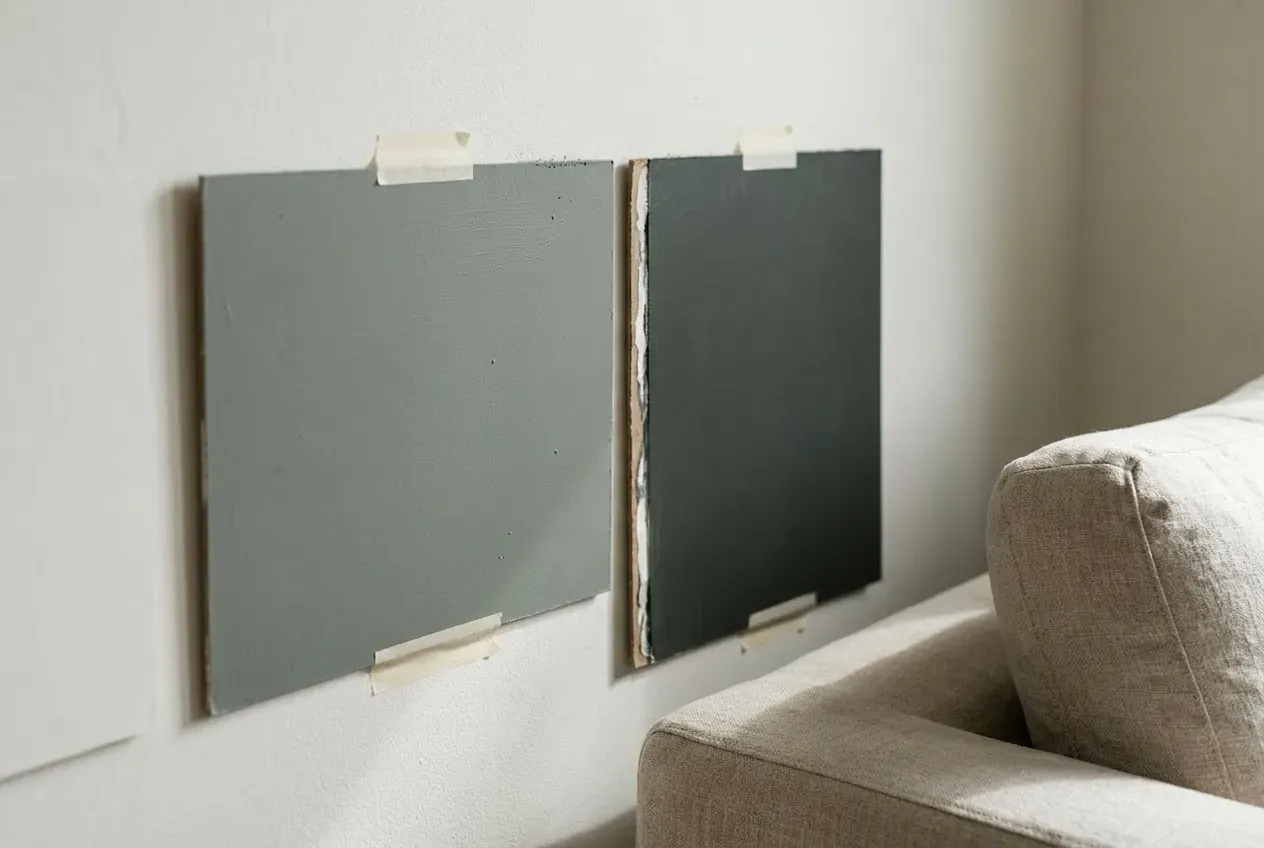 Close up: Paint a 24 in (61 cm) sample board rather than dabbing the wall, because a chip smaller than that reads as a colour while a board reads as a wall.
Four steps before you buy
- Shortlist three shades with different undertones. Five near-identical whites will not tell you anything.
- Board them in two coats with a white margin.
- Live with them for 24 hours on two walls, in daylight and under lamps.
- Decide sheen and trim last. Matte or eggshell suits walls and satin suits trim. Then check the choice against your bedroom paint colour guide and the rental wall repair steps.
Common sampling mistakes
- Overlapping patches. Two sample pots side by side on an old wall creates false contrast. Keep each colour on its own board.
- Ignoring floor bounce. Warm wood floors reflect amber onto the lower wall and push cool greys warmer.
- Judging sheen from the sample pot. A matte sample looks softer and deeper than a satin finish in the same formula. Confirm the sheen separately.
- Testing only in daylight. A colour that looks right at noon can look dull at night.
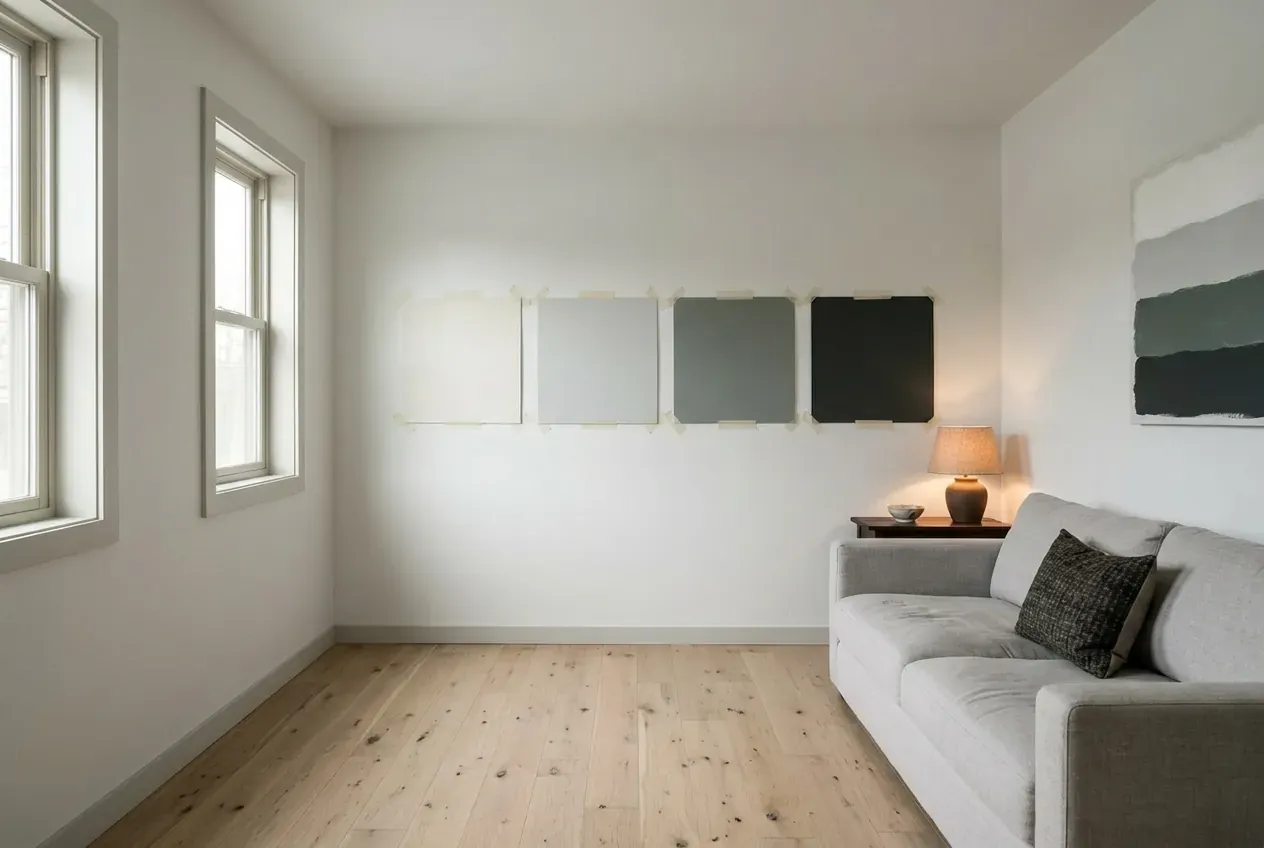 From above and to one side, the full footprint and the walkway read at a glance.
Related ideas
If you want the same colour on the walls, ceiling and trim, see colour drenching a small room. For a bedroom scheme, the Japandi palettes for renters show how to keep a small space calm, and the north-facing light guide helps if the room gets little sun. For a smaller room such as a bathroom, see the small bathroom paint and tile guide.
Checklist
- Choose three candidates with different undertones.
- Paint two coats on 24 in boards with a white border.
- Tape them to two walls at eye level.
- Check at 10 a.m., 2 p.m. and 8 p.m.
- Stand 6 ft back before eliminating one.
- Confirm the finish and order only after 24 hours.
Curated Color Palette & Key Textures
- Gallery White #F4F5F3
- Studio Grey #D3D6D1
- Moss Slate #7C8580
- Charcoal Ink #333A38
General references
Dimensions in these guides are typical planning ranges, not legal minimums, and they can differ by jurisdiction. Use the references below as starting points, then confirm local code and your lease before making changes.
FAQ
How do I choose a paint colour for a small room?
Test the three strongest candidates as 24 in (61 cm) boards on two walls, then view them at the room's real light hours before committing.
How many colours should I sample at once?
Three. A fourth and the eye start comparing instead of judging, and every extra board makes the greige look greyer.
Do paint samples look different on the wall than on the chip?
Yes. A chip is an isolated colour on white; the same colour on a wall picks up reflected floor and furniture tone and reads darker and warmer.
Save this idea

Keep reading
Related rooms
Bunk Bed Dimensions: 5 Sizes, Clearances & Safety Gaps
A twin bunk is 77 x 41 in (196 x 104 cm) and about 62 in tall: all 5 standard sizes, the 5 in guardrail rule, deck spacing and the ceiling check.
Standard Bed Sizes: Queen 60 x 80 in (152 x 203 cm)
Standard bed sizes in inches and cm: a double (full) is 54 x 75 in, a queen 60 x 80, a king 76 x 80, a California king 72 x 84, plus the room each needs.
Rug Size for a King Bed: 8x10 Shows 22 in Each Side
Rug size for a king bed: an 8x10 ft rug shows 22 in (56 cm) each side and 43 in past the foot; a 9x12 shows 34 in. See the maths, a chart and a calculator.