Entryway Shoe Storage That Fits a Real Hallway
Entryway shoe storage for small spaces: how many pairs a 36 in (91 cm) run holds, the 18 in aisle to keep clear, and layering a rack, shelf and hooks.
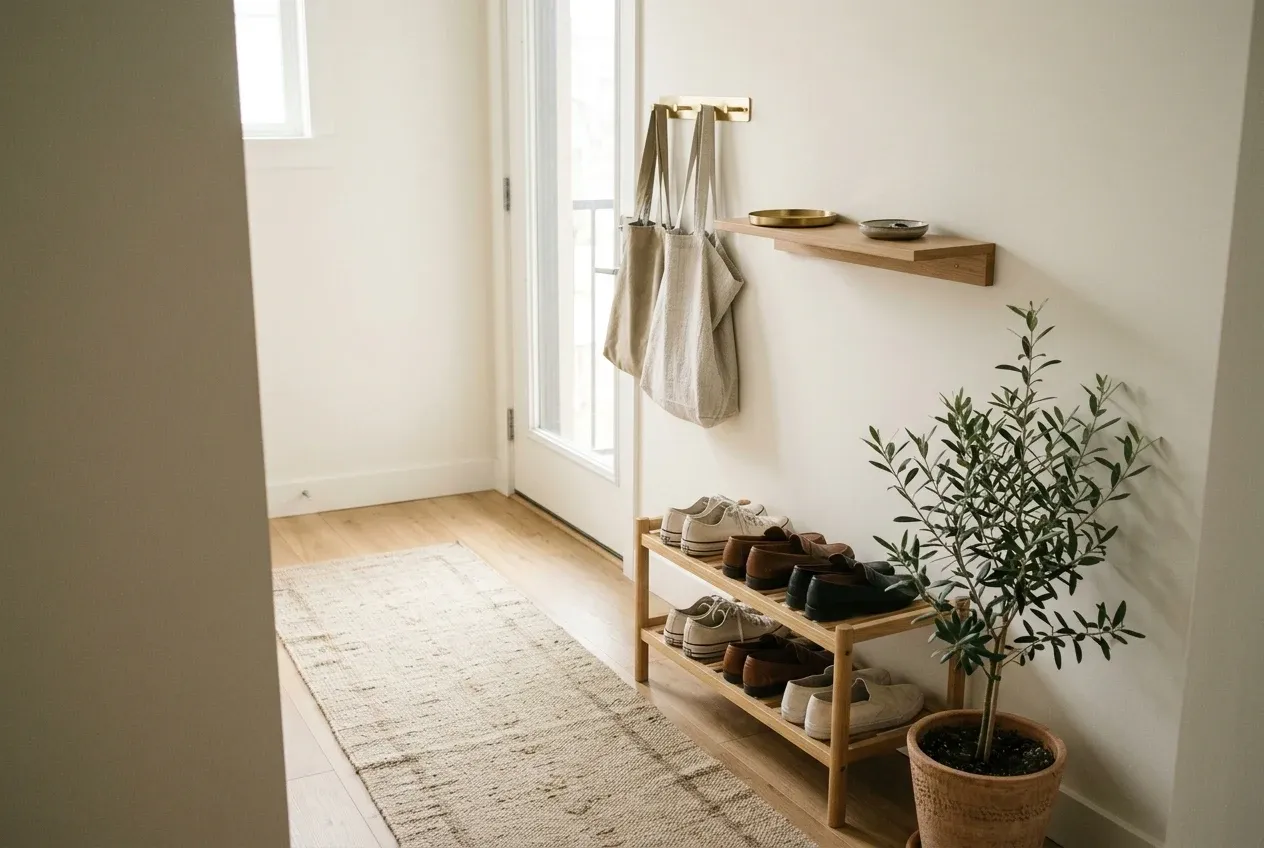
Room specifications
- Room ScaleNarrow entryway (about 3 x 6 ft)
- Design StyleWarm Minimalist / Japandi
- Budget TierBudget ($)
- Palette Swatches4 colors
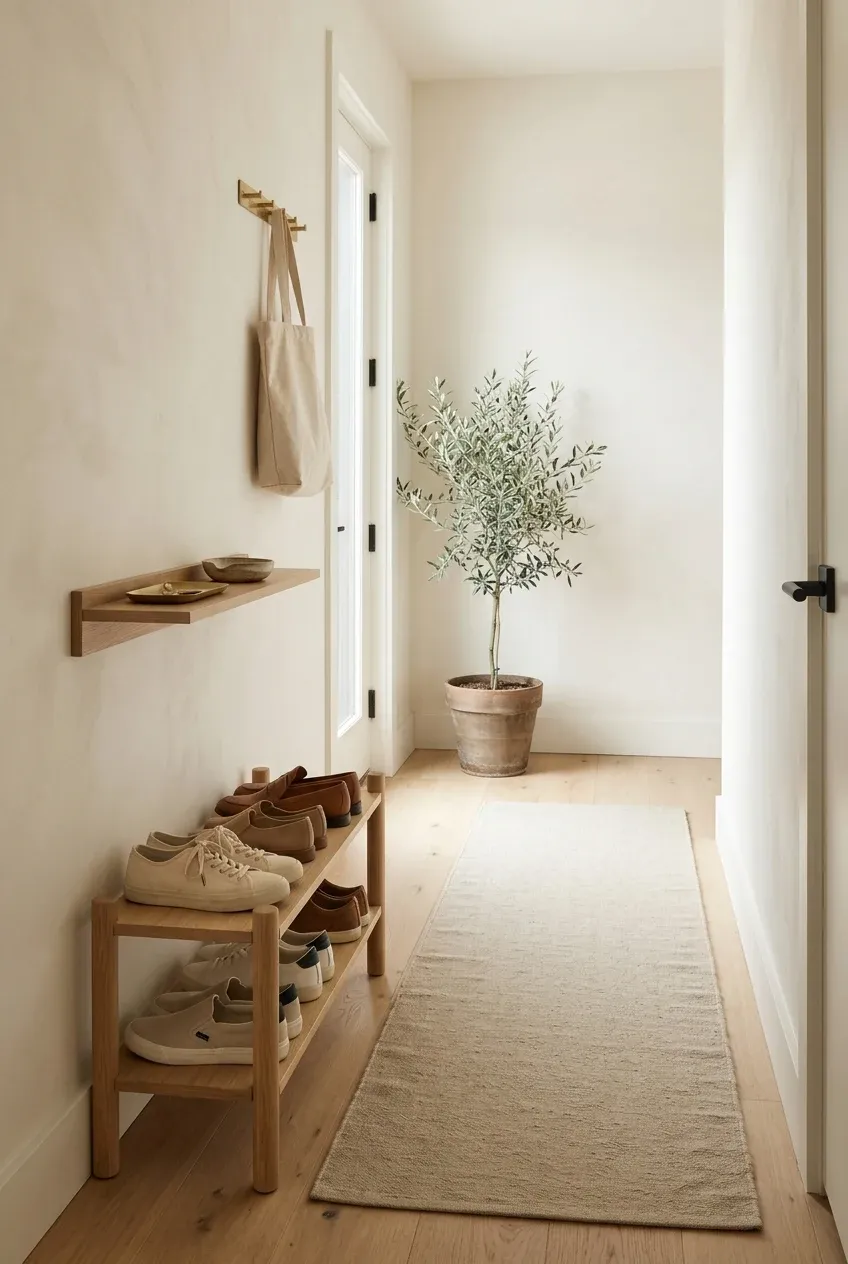
In a 36 in (91 cm) wide hallway, the best shoe storage is a shallow unit, 7 to 12 in (18 to 30 cm) deep, that leaves at least 18 in (46 cm) of clear floor in front of it, and ideally 24 in (61 cm) where the front door swings inward. A two-tier flat rack holds roughly 6 to 8 pairs along a 36 in run. A tilt-out cabinet of the same width holds more, and it hides them.
Many apartments open straight into a narrow corridor or the living room with no foyer. Without a drop zone, wet sneakers, boots and delivery boxes pile up behind the door and grit tracks onto the rugs. The answer is to plan the wall in three layers (floor, waist height and shoulder height) and to cap how much each person keeps at the door. For the other rooms, see the best storage solutions for small apartments and how to organize a small apartment room by room.
How many pairs will fit?
Work out the capacity of the wall run, then check what it does to the walkway.
| Storage type | Depth | Pairs on a 36 in run | Aisle left in a 36 in hall |
|---|---|---|---|
| Flat two-tier rack | 11 to 12 in (28 to 30 cm) | 6 to 8 | about 24 in (61 cm) |
| Single-row tip-out cabinet | 7 to 9 in (18 to 23 cm) | 6 to 9 | about 27 to 29 in (69 to 74 cm) |
| Double-row tip-out cabinet | 11 to 12 in (28 to 30 cm) | 12 to 16 | about 24 in (61 cm) |
| Bench with lower shelf | 14 to 15 in (36 to 38 cm) | 4 to 6 | about 21 to 22 in (53 to 56 cm) |
These capacities depend on shoe size and style. Boots and sneakers with thick soles take more room than flats. Anything deeper than about 12 in belongs in a wider hall, because in a 36 in passage it eats the walkway.
If the rack sits inside the door’s swing arc, even a 10 in unit can stop the door opening fully. Open the door and tape the arc on the floor before buying.
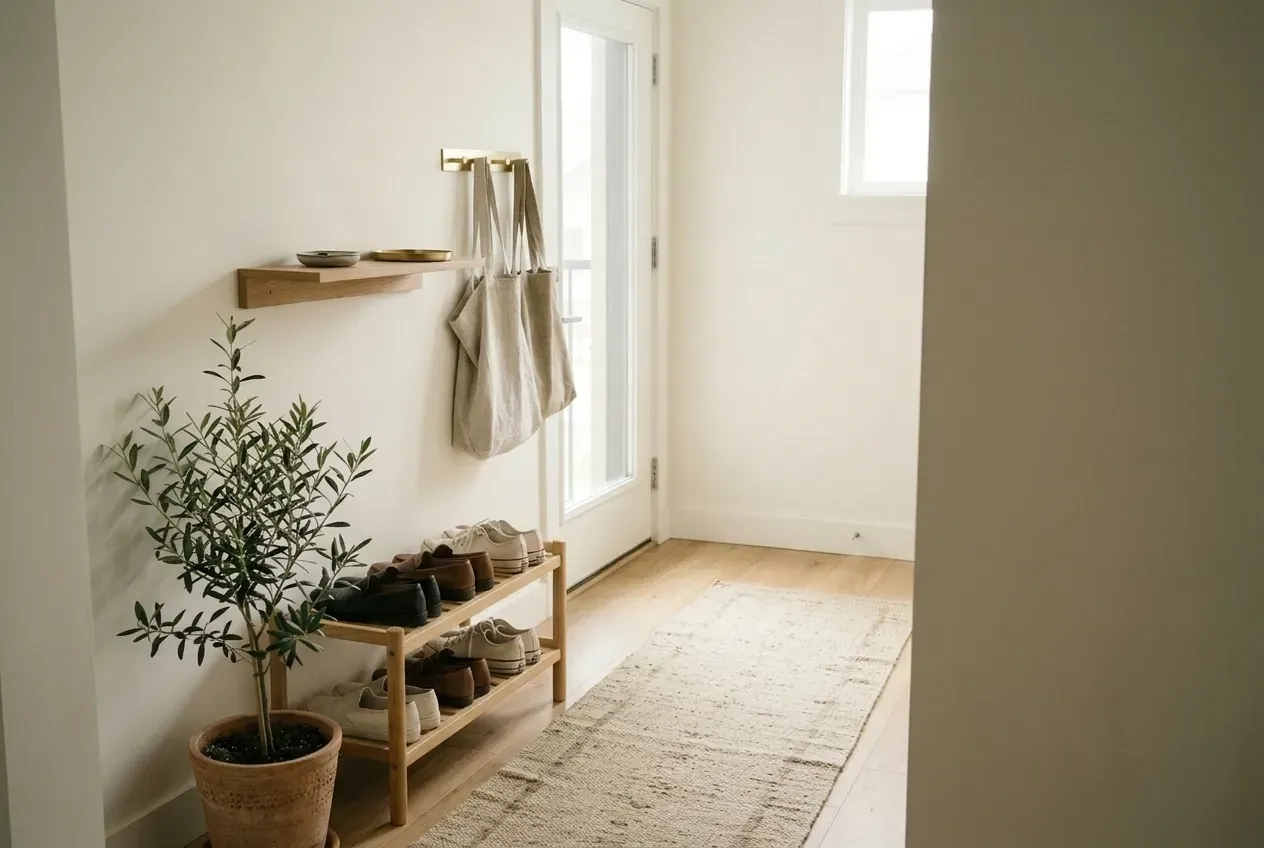 The same room seen from the opposite end, so you can judge the layout from the far side.
The three layers on the wall
- Floor to about 20 in (51 cm): shoes only, below knee height. A slatted rack that lifts them off the floor lets you sweep underneath.
- About 40 to 44 in (102 to 112 cm): a shallow ledge, about 5 in deep, for keys, sunglasses and mail. It is narrow enough that your hip does not catch it as you pass.
- About 64 to 68 in (163 to 173 cm): a hook rail for totes and daily jackets, with bulky sleeves hanging above the ledge rather than over it.
Hooks that fit over a door are an extra option when the wall is full; see the over-the-door hook clearances.
Choosing between rack, cabinet and bench
Open rack. Cheapest, no drilling, and a good fit if you only need your everyday pairs within reach. Put it on a washable runner to catch grit. The disadvantage is that clutter is on view from the sofa.
Tip-out cabinet. A shallow cabinet that tilts out hides shoes behind flat doors, which matters when the entry is visible from the living room. A 7 to 9 in deep model suits the narrowest halls. Anchor it to the wall to stop tipping; follow the maker’s instructions.
Wall rail or recessed niche. For halls of 36 in or less, go shallower than a cabinet. A 3.5 in (9 cm) rail holds shoes flat against the wall behind the entry door. In a non-load-bearing interior wall, a niche between studs can give a recessed cabinet; confirm what is inside the wall and get landlord permission first. The recessed cabinet guide shows how that works.
Bench with a shoe grate. Only if the foyer is closer to 4 ft wide, so you can sit to lace shoes. The entryway bench size guide covers the dimensions.
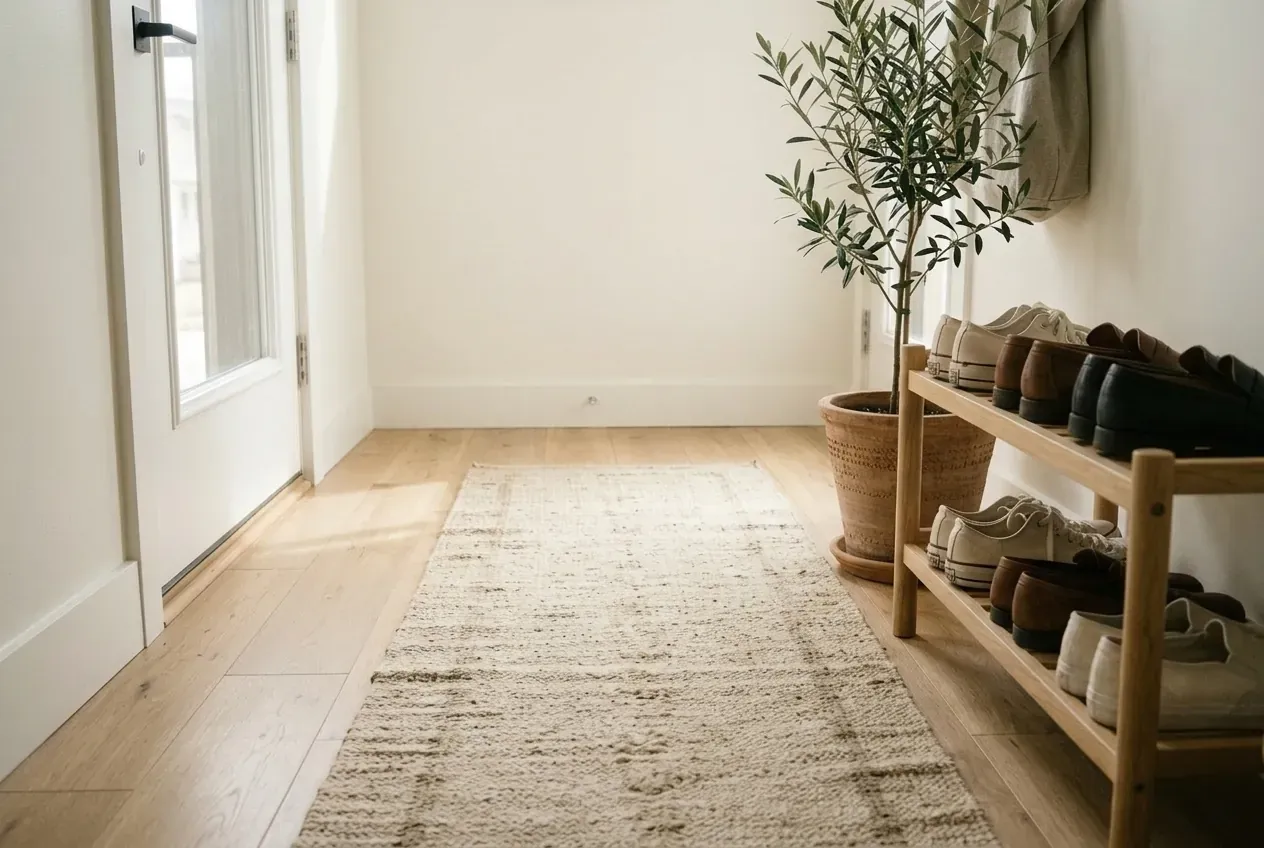 Close up: Keep an 18 in (46 cm) clear aisle in front of entryway shoe storage so a door can open and you can bend down.
Renter-safe fixing
Stud-anchored rails take full loads and leave small holes to patch. Adhesive hook strips are fine for light items such as totes. Freestanding racks and tip-out units need no holes at all. An over-door rack holds a handful of pairs and comes off without a trace. Keep adhesive for light things and use screws for anything you lean on.
To make a narrow hall read wider, raise the unit a few inches off the floor if it is wall-hung and keep its finish close to the wall colour. A mirror opposite the door bounces light; the entryway mirror guide shows where to mount one.
Limit what lives at the door
Keep your three most-worn pairs per person by the door. Store seasonal boots in a bedroom closet and swap them as needed, so the front door never overflows. If the corridor is also a hallway to decorate, see the hallway decorating guide and the slim shoe cabinet guide for tighter sizes.
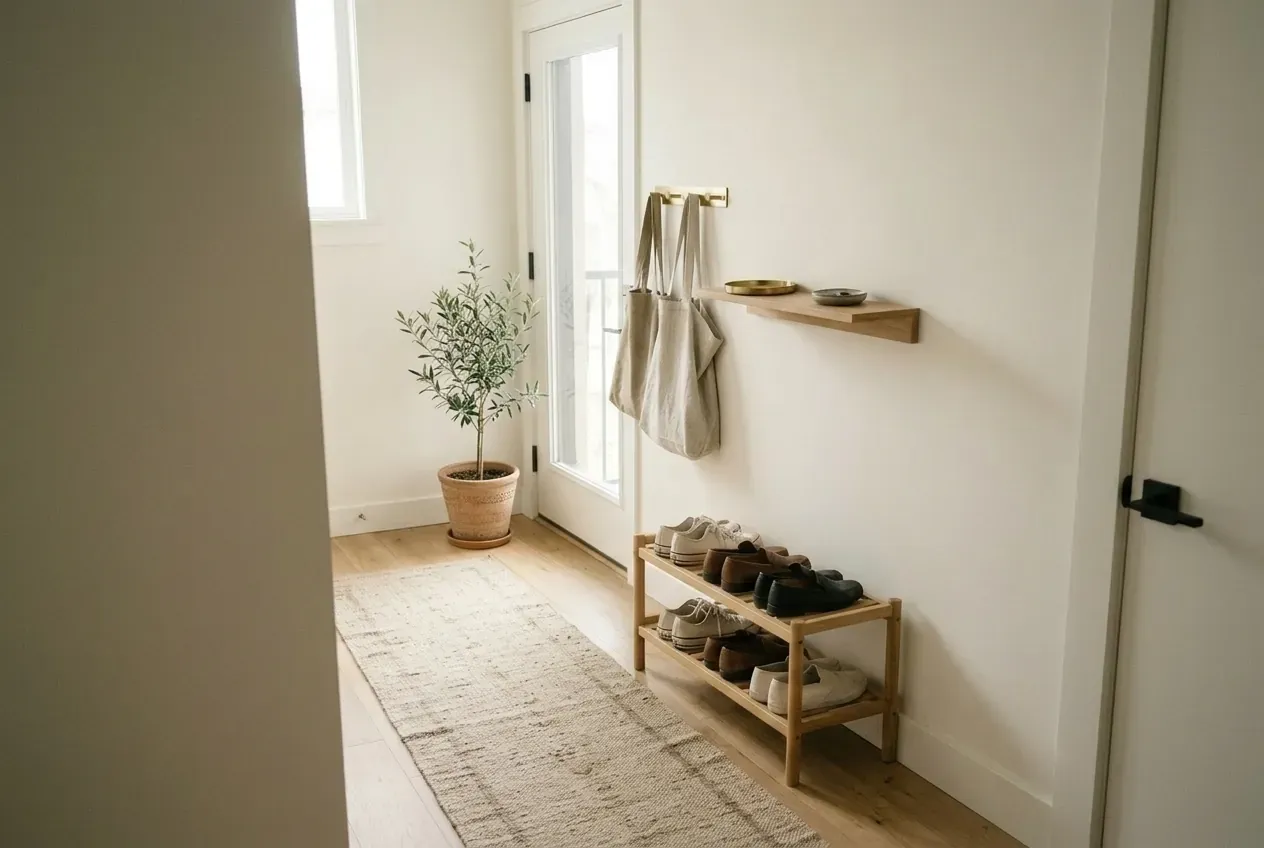 From above and to one side, the full footprint and the walkway read at a glance.
Common mistakes
- Buying a deep cabinet without checking the door swing.
- Letting wet shoes sit on a closed cabinet shelf with no air.
- Putting hooks too low so coats hit the floor.
- Placing the key ledge so deep that it catches hips.
Before you buy
- Measure the hall width and mark the door’s swing arc with tape.
- Leave at least 18 in of floor in front, more if the door opens inward.
- Count how many pairs you actually need at the door.
- Check the depth on the spec sheet, not just the product photos.
- Decide whether the unit gets anchored or stays freestanding.
- Plan the ledge and the hook rail on the same wall.
Curated Color Palette & Key Textures
- Alabaster Chalk #F5F2EB
- Oat Linen #D9CDB8
- Light Oak #C9A97C
- Charcoal Ink #2F3135
General references
Dimensions in these guides are typical planning ranges, not legal minimums, and they can differ by jurisdiction. Use the references below as starting points, then confirm local code and your lease before making changes.
FAQ
How many pairs of shoes fit in a small entryway?
A 36-inch (91 cm) wide two-tier flat rack holds 6 to 8 pairs of adult shoes, while a tilted double-row tip-out shoe cabinet in the same width holds 12 to 16 pairs.
How deep should an entryway shoe rack be?
In narrow 36-inch hallways, cap shoe rack or cabinet depth at 7 to 12 inches (18 to 30 cm) so you preserve at least an 18-to-24 inch walking corridor.
How do I store shoes in a narrow hallway?
Use a wall-mounted tilted shoe cabinet under 9 inches deep, layer a slim key shelf at 42 inches high, and mount coat hooks at 66 inches to keep the floor clear.
How much aisle should you leave in front of entryway shoe storage?
At least 18 in (46 cm), and ideally 24 in (61 cm) where the front door swings inward. A 12 in (30 cm) deep rack in a 36 in (91 cm) hall leaves 24 in.
What is the shallowest entryway shoe storage?
A single-row tip-out cabinet, 7 to 9 in (18 to 23 cm) deep, holds 6 to 9 pairs on a 36 in (91 cm) run and leaves about 27 to 29 in (69 to 74 cm) of aisle.
Save this idea

Keep reading
Related rooms
Standard Shower Head Height: 72 to 80 in (183 to 203 cm)
Standard shower head height: mount a fixed head 72 to 80 in (183 to 203 cm) above the floor, 6 in above the tallest user, valve at 38 to 48 in.
Standard Interior Door Sizes: Widths, Heights, Clearances
Standard interior door sizes: 24 to 36 in (61 to 91 cm) wide and 80 in (203 cm) tall, with clear openings, rough-opening sizes and swing clearance.
What Is a 3/4 Bathroom? Layouts, Sizes & Code Clearances
What is a 3/4 bathroom? A toilet, sink and shower with no tub, in as little as 5 x 7 ft (152 x 213 cm). Compare quarter, half and full baths.