Narrow Storage Cabinet Ideas for Bedroom Walls
Narrow storage cabinets for tight bedroom alcoves: 10 to 12 inch depths, door swing clearance, anchoring tall units, and what to store where.
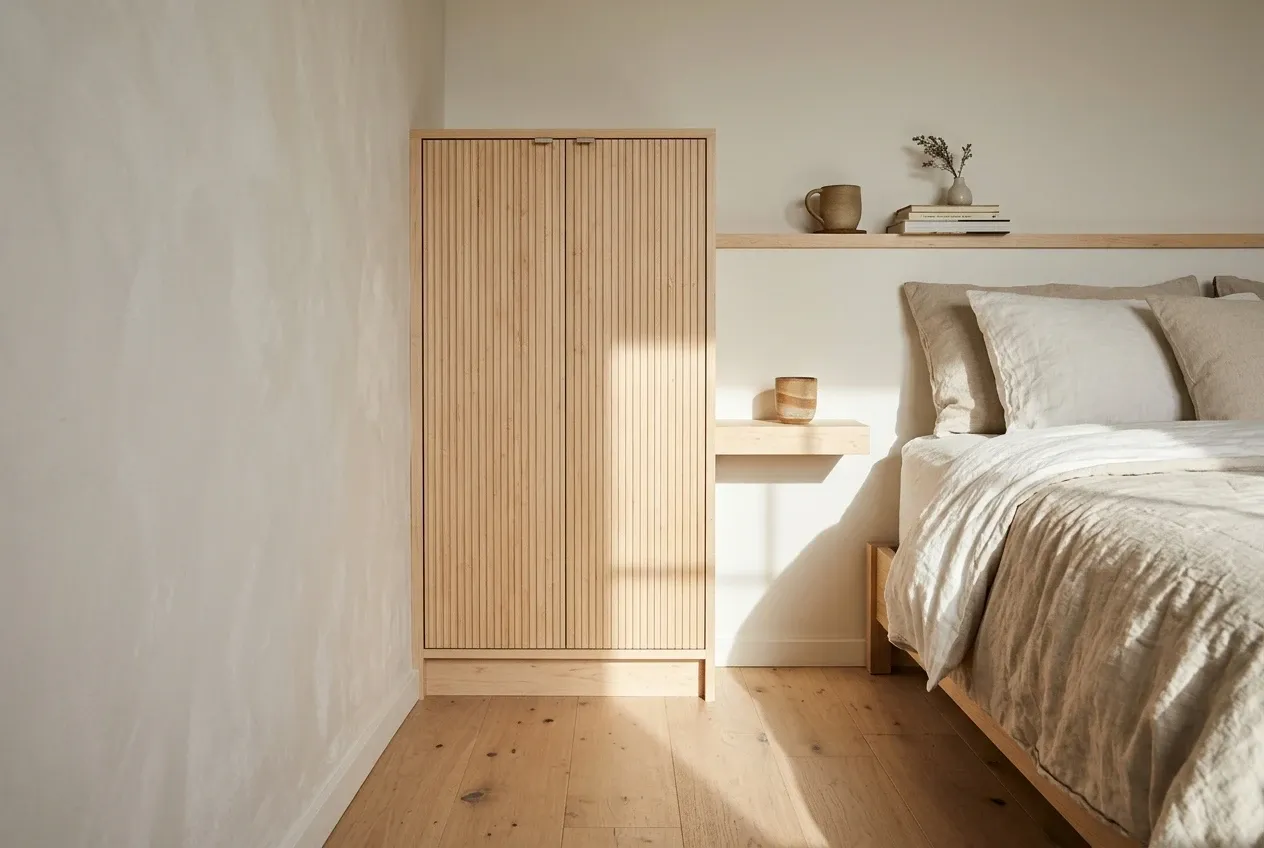
Room specifications
- Room ScaleSmall apartment bedroom alcove (about 3 x 4 ft)
- Design StyleScandinavian Minimalist / Modern Craft
- Budget TierMid-Range ($$)
- Palette Swatches4 colors
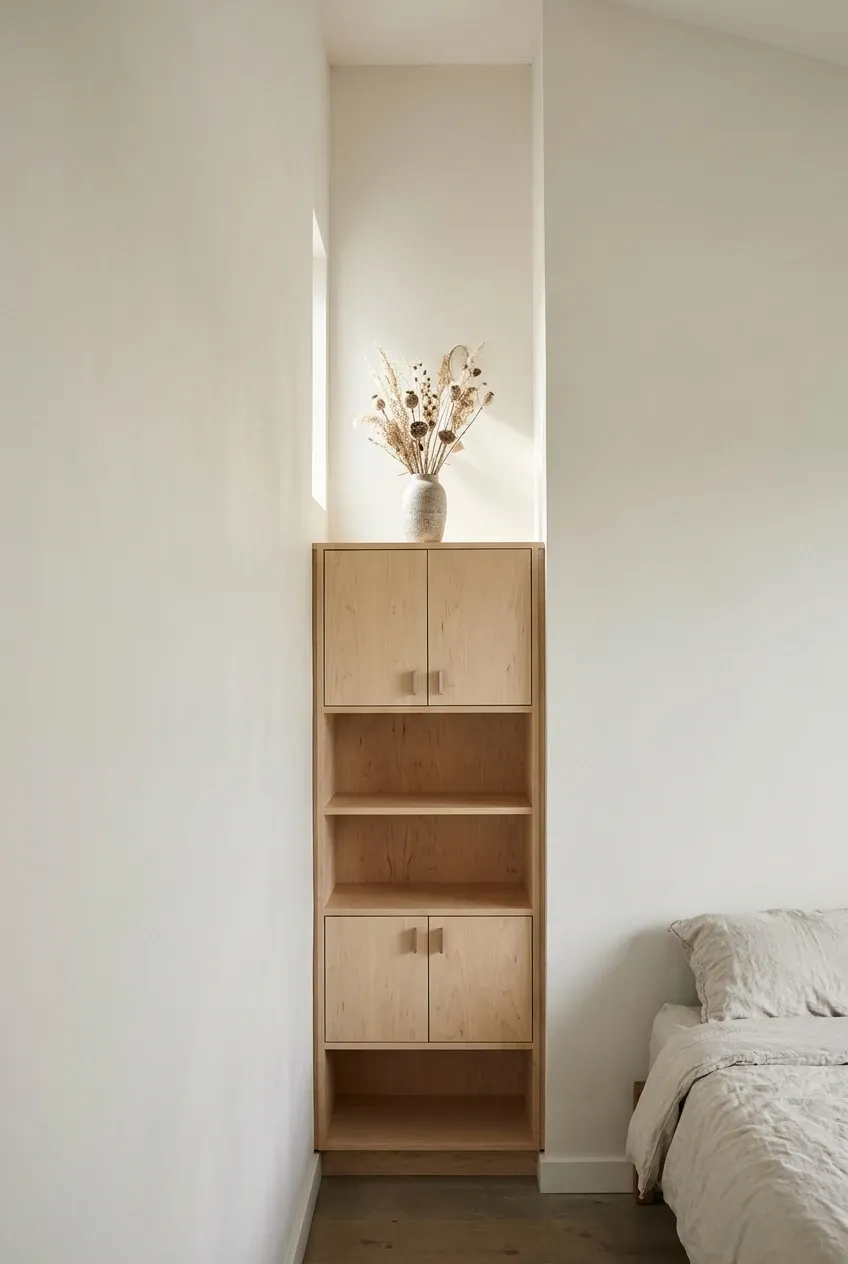
A narrow cabinet 10 to 12 inches deep fits into a bedroom alcove or wall pier and holds folded clothes, linens and bins without eating into the walking lane beside the bed. Keep roughly 28 inches (71 cm) of clear floor between the cabinet and the bed edge, and anchor any tall unit to the wall.
A traditional 22-inch-deep dresser in a small bedroom blocks door swings and bumps into nightstands. A shallow cabinet uses an unused corner or pier instead. The same depth and walkway logic applies in the small storage cabinets guide, and the no-closet bedroom storage guide shows how a tower can stand in for a wardrobe.
How much room does it really take?
| Element | Minimum | Target |
|---|---|---|
| Cabinet depth | 10 in (25 cm) | 12 in (30 cm) |
| Door swing space in front | 18 in (46 cm) | 24 in (61 cm) |
| Clear path to the bed edge | 24 in (61 cm) | 28 in (71 cm) |
| Shelf spacing for folded clothes | 8 in (20 cm) | 10 to 12 in (25 to 30 cm) |
Measure the alcove width, its depth and the baseboard projection. A cabinet that touches the wall only at the baseboard rocks forward, so you may need a cut-out in the back or feet that lift it clear of the trim.
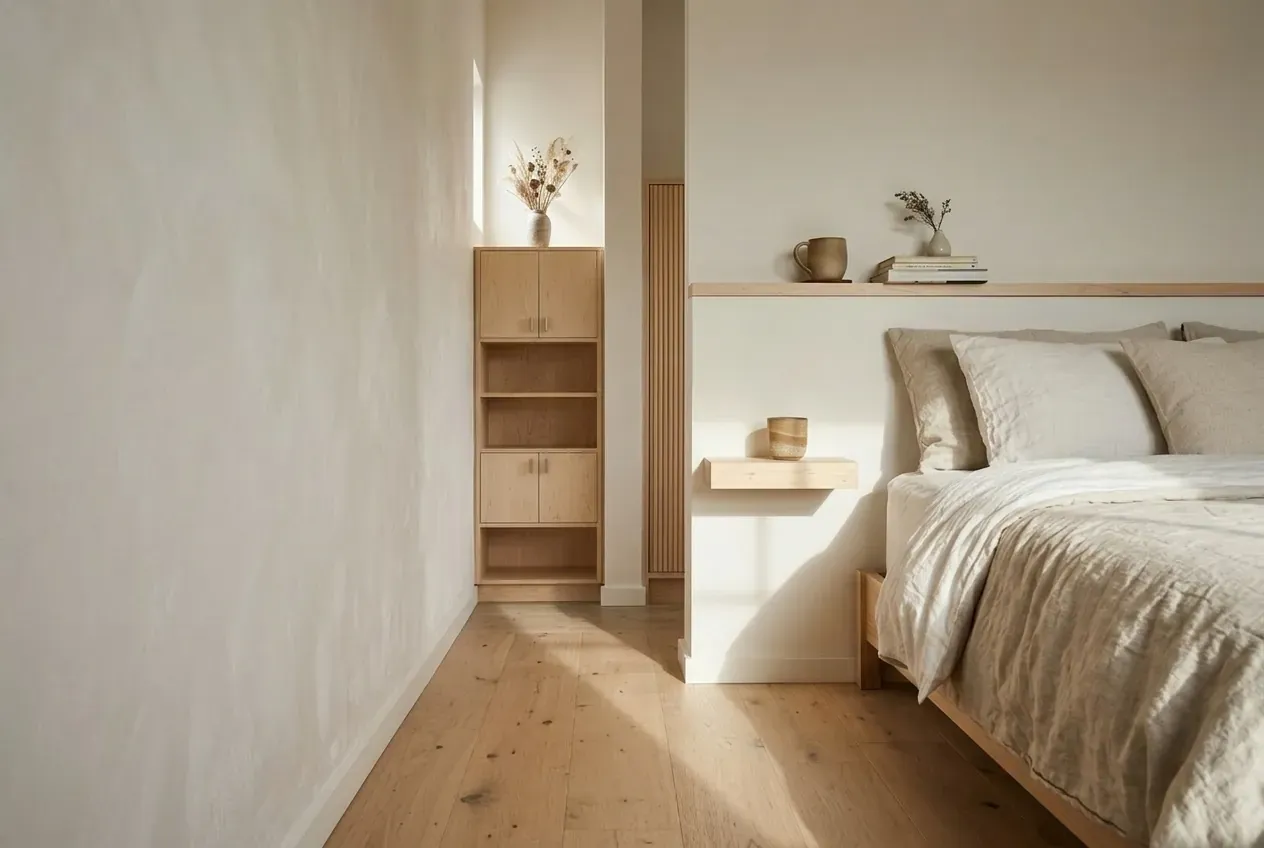 The same room seen from the opposite end, so you can judge the layout from the far side.
Doors that suit tight rooms
Hinged doors need space in front to swing open (at least 20 to 24 inches). If that space falls on the bed side, they clip the mattress. Sliding doors and open cubbies need nothing in front, so they suit narrow walkways. Fluted or louvred doors add texture without making a tall unit feel heavy, and brushed-metal edge pulls keep surfaces flat.
Layouts for different alcoves
A 3 ft recess beside the closet door. A tower about 32 inches wide and 11 inches deep fits in a 36-inch recess. A closed lower section hides clutter, while open shelves above show books or ceramics. Check the closet door still opens fully.
A wall pier facing the foot of the bed. A floating cabinet or console, hung low enough to leave a gap above the floor for shoe baskets, avoids the heavy look. Mount it using a rail or cleat suited to the load, in studs, and confirm your lease allows it. See queen bed layouts for how far a bed foot should sit from a wall.
Next to the bed, instead of a nightstand. A slim tower beside the headboard with an open shelf at mattress height can double as a bedside table. This works in a 9 x 10 ft room where two separate nightstands will not fit.
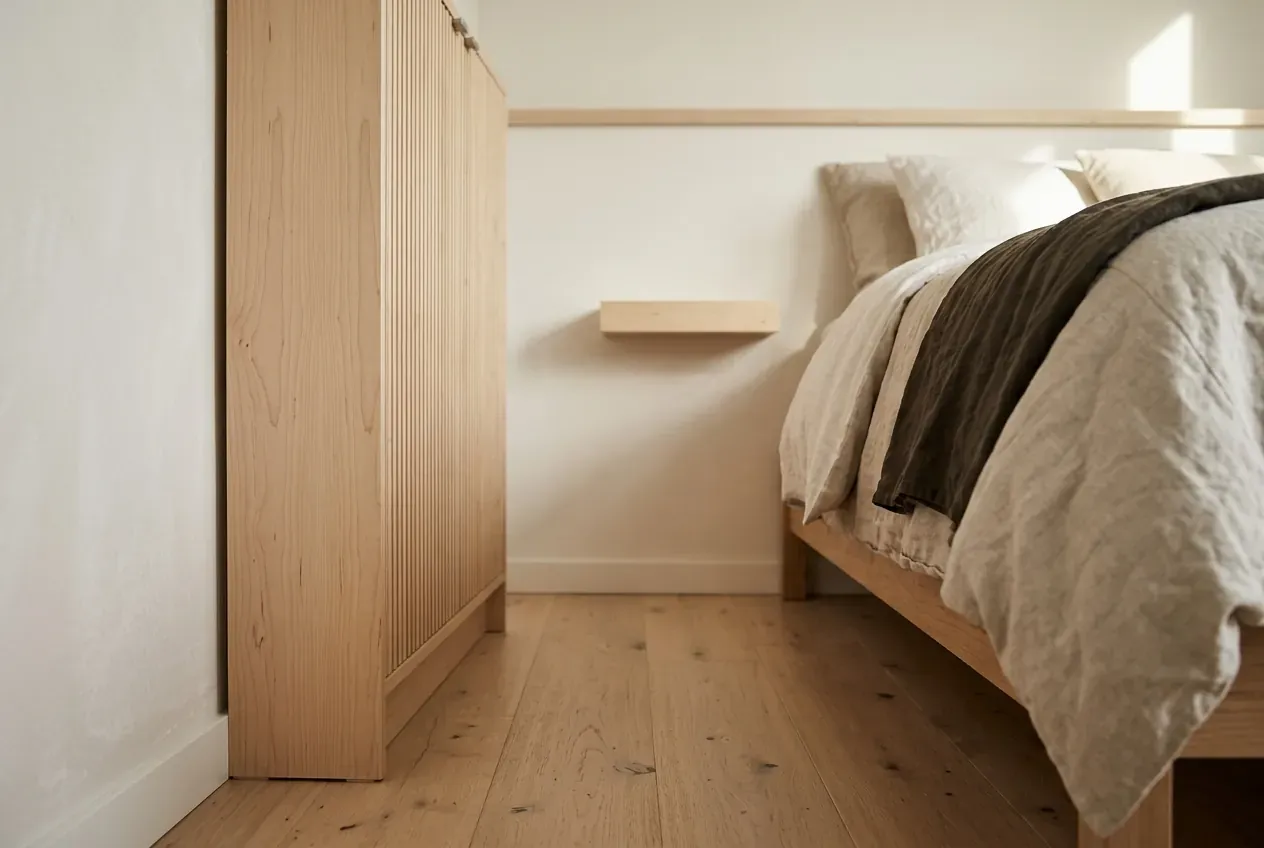 Close up: Maintain a shallow cabinet depth of 10 to 12 inches (25.4-30.5 cm) in bedroom alcoves to preserve a minimum 28-inch walking lane beside the bed.
Anchor it properly
Tall, shallow cabinets tip forward easily, especially when a top drawer or door is loaded. The US Consumer Product Safety Commission recommends anchoring tall furniture to the wall; follow the maker’s hardware and fix it into a stud rather than relying on plastic drywall anchors.
- Locate a stud behind the cabinet and attach the bracket or strap through the upper rail.
- Adjust levelling feet so the cabinet sits straight and tucks fully back against the wall before you tighten the tether.
- Put heavy items such as jeans, blankets and albums low, and light items such as hats and t-shirts high.
- In homes with children or pets, treat anchoring as essential, not optional.
If you rent, ask your landlord whether anchoring into the wall is permitted. Small stud-screw holes are easy to patch, and the patch-and-paint guide covers that.
Colour and finish
Pale mineral walls with a light birch or oak cabinet make a shallow tower look built-in. Matching the cabinet to the wall colour makes it recede, which suits a very narrow room. See the bedroom paint colour guide for wall choices.
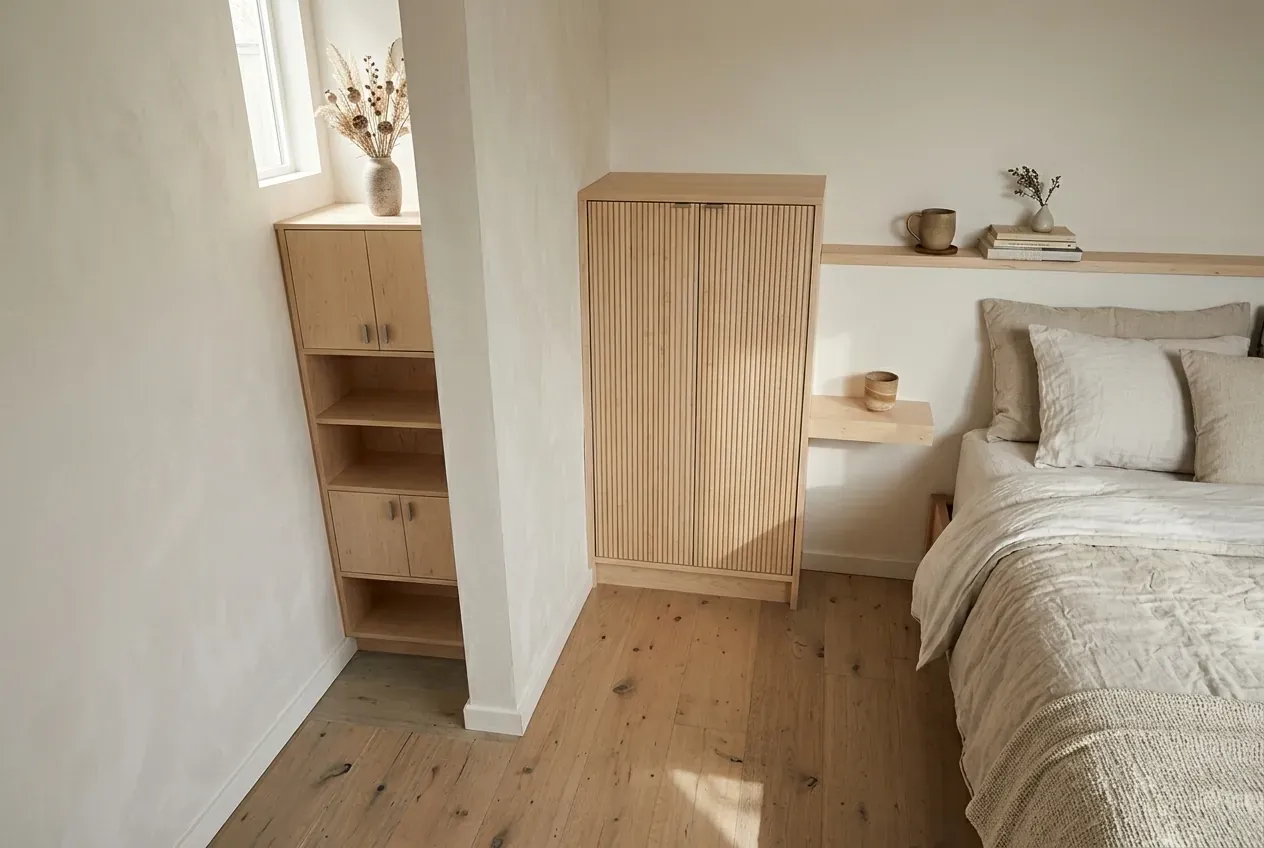 From above and to one side, the full footprint and the walkway read at a glance.
Common mistakes
- Ordering a hinged-door cabinet for an alcove where the door would swing into the bed.
- Choosing a deep unit and ending up with a walkway under 24 inches.
- Skipping the anchor because the cabinet seems stable when empty.
- Setting shelves too far apart, so stacks of sweaters topple.
Before you buy
- Measure the alcove width, depth and baseboard projection.
- Confirm 28 inches of walkway remains, and test door swing.
- Choose sliding doors or open cubbies if front space is short.
- Check for a stud and buy the right anchor hardware.
- Pick shelf heights for what you will actually store. For other ideas, see best storage solutions for small apartments.
Curated Color Palette & Key Textures
- Blonde Birch #D9C3A5
- Chalk Plaster #F3EFE8
- Brushed Nickel #9B9E9F
- Muted Umber #3B332A
General references
Dimensions in these guides are typical planning ranges, not legal minimums, and they can differ by jurisdiction. Use the references below as starting points, then confirm local code and your lease before making changes.
FAQ
What is the shallowest depth for a functional bedroom storage cabinet?
A depth of 10 to 12 inches (25.4 to 30.5 cm) comfortably holds folded jeans, sweaters, and linen storage cubes without encroaching into bedroom walking lanes.
Do tall narrow cabinets require wall anchoring in rental apartments?
Yes, tall cabinets over 60 inches high with narrow bases are top-heavy and must be secured to wall studs using anti-tip drywall anchor brackets.
Are sliding doors or hinged doors better for narrow bedroom cabinets?
Sliding bypass doors or open cubbies are ideal because they require zero clearance in front, whereas hinged doors demand at least 20 to 24 inches of swing space.
Save this idea

Keep reading
Related rooms
Bunk Bed Dimensions: 5 Sizes, Clearances & Safety Gaps
A twin bunk is 77 x 41 in (196 x 104 cm) and about 62 in tall: all 5 standard sizes, the 5 in guardrail rule, deck spacing and the ceiling check.
Standard Bed Sizes: Queen 60 x 80 in (152 x 203 cm)
Standard bed sizes in inches and cm: a double (full) is 54 x 75 in, a queen 60 x 80, a king 76 x 80, a California king 72 x 84, plus the room each needs.
Rug Size for a King Bed: 8x10 Shows 22 in Each Side
Rug size for a king bed: an 8x10 ft rug shows 22 in (56 cm) each side and 43 in past the foot; a 9x12 shows 34 in. See the maths, a chart and a calculator.