Small Dresser for Closet: Depth and Door Rules
A small dresser for closet layouts: depth under 20 to 22 in (51 to 56 cm) including pulls, 38 to 40 in of clear hanging space above, and door-swing rules.
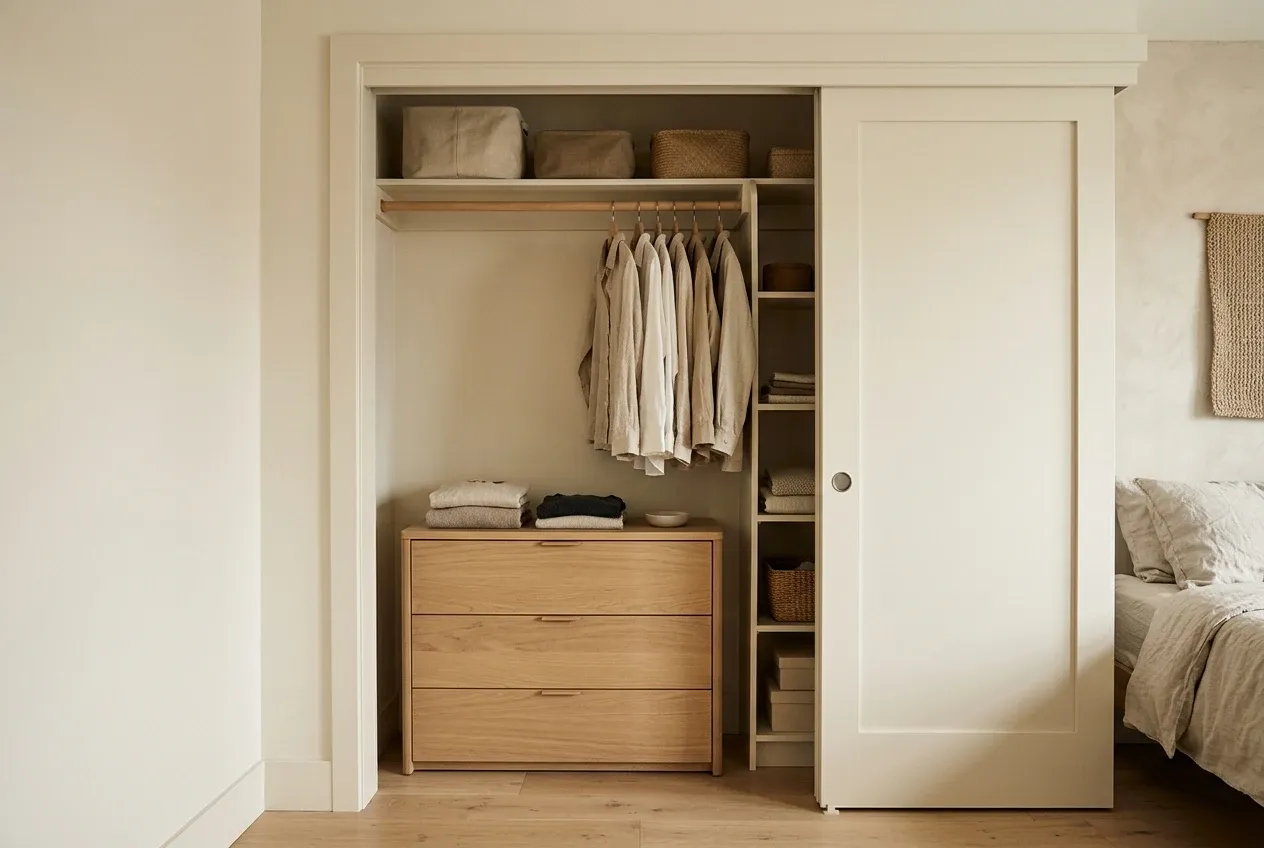
Room specifications
- Room ScaleSmall bedroom reach-in closet (about 5 x 2 ft)
- Design StyleWarm Minimalist / Japandi
- Budget TierBudget ($)
- Palette Swatches4 colors
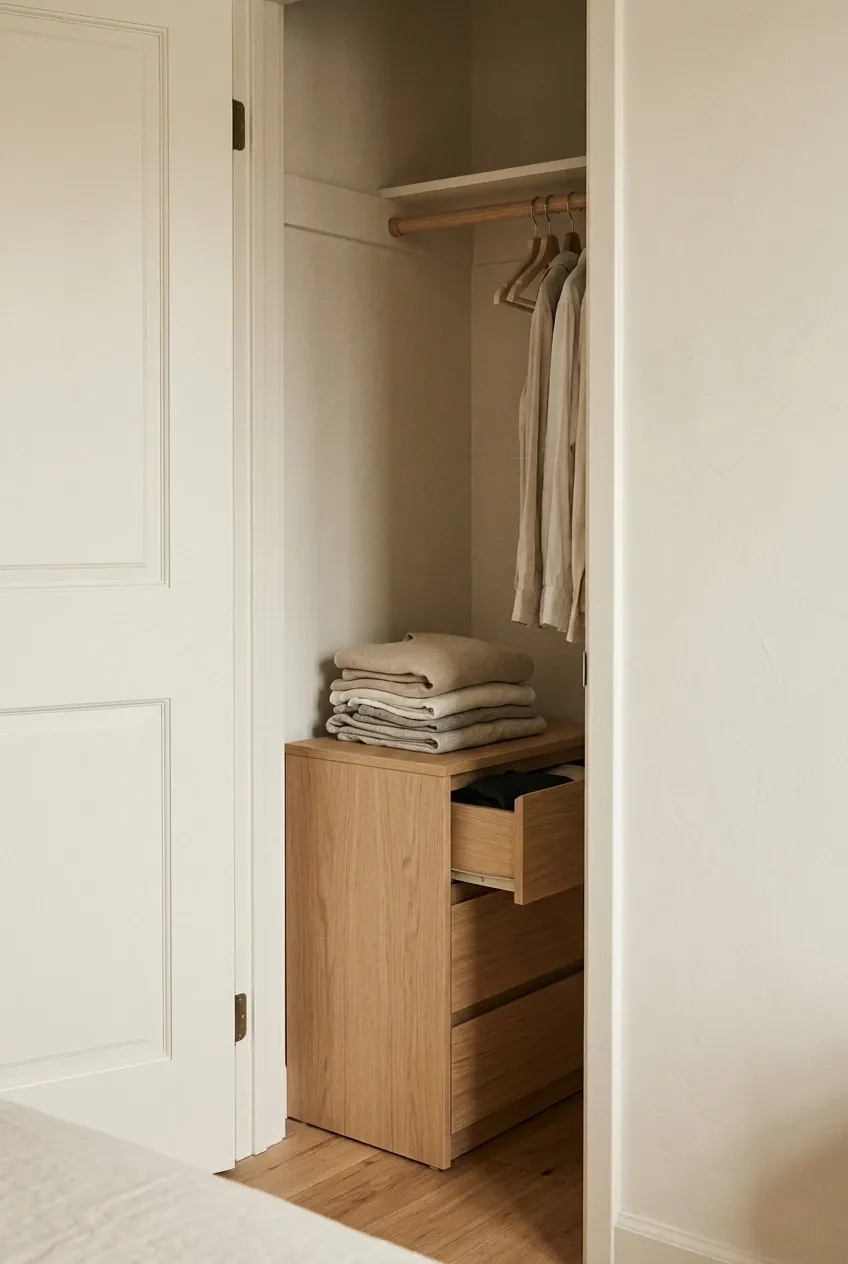
A small dresser for a closet works if its depth, including drawer pulls, stays under about 20 to 22 in (51 to 56 cm) so the door can still close, and if you leave roughly 38 to 40 in of clear hanging space above it. If neither works, take the door off and treat the closet as an open dressing alcove.
In bedrooms under about 120 sq ft (11.1 sq m), floor goes fast to a queen bed and bedside tables. When no wall can take a chest of drawers, the reach-in closet is the obvious place. The no-closet bedroom storage ideas cover the opposite problem, and the best storage solutions for small apartments cover vertical options.
But pushing a dresser into a 5 x 2 ft closet without checking the door swing or rod height creates bottlenecks, so measure first.
What to measure
- Interior depth. Measure from the back wall to the inside of the door frame or sliding track. Note any baseboard heater or other projection. Typical reach-in closets run roughly 24 to 28 in deep; check yours.
- Dresser depth with pulls. Add handle projection to the case depth. Many dressers have a case of 18 to 22 in, and pulls add 1 to 1.5 in. For a snug closet, a case of 16 to 18 in leaves 4 to 6 in of front clearance so drawers do not hit the door frame.
- Opening width. Measure the clear door opening, not the back wall. The short returns on either side of the opening, often 4 to 8 in, can block drawers at the edges if the dresser is wider than the opening.
- Floor in front. You need room to pull drawers fully open, roughly 12 to 14 in beyond the closet threshold or more depending on the drawer.
- Rod height. Count the vertical space from the dresser top to the rod.
The measurements at a glance
| Check | Figure | Why it matters |
|---|---|---|
| Dresser depth including pulls | 20 to 22 in (51 to 56 cm) maximum | Sliding or bifold doors must still close flush |
| Snug-fit case depth | 16 to 18 in (41 to 46 cm) | Leaves 4 to 6 in (10 to 15 cm) of front clearance |
| Pull projection | Adds 1 to 1.5 in (2.5 to 4 cm) | Count it on top of the case depth |
| Drawer pull-out space | 12 to 14 in (30 to 36 cm) beyond the threshold | Room to open drawers fully |
| Hanging drop above the dresser | 38 to 40 in (97 to 102 cm) | Rod height minus dresser height, for shirts and jackets |
| Raised rod height | 74 to 76 in (188 to 193 cm) | Needed when a 34 in dresser sits under the rod |
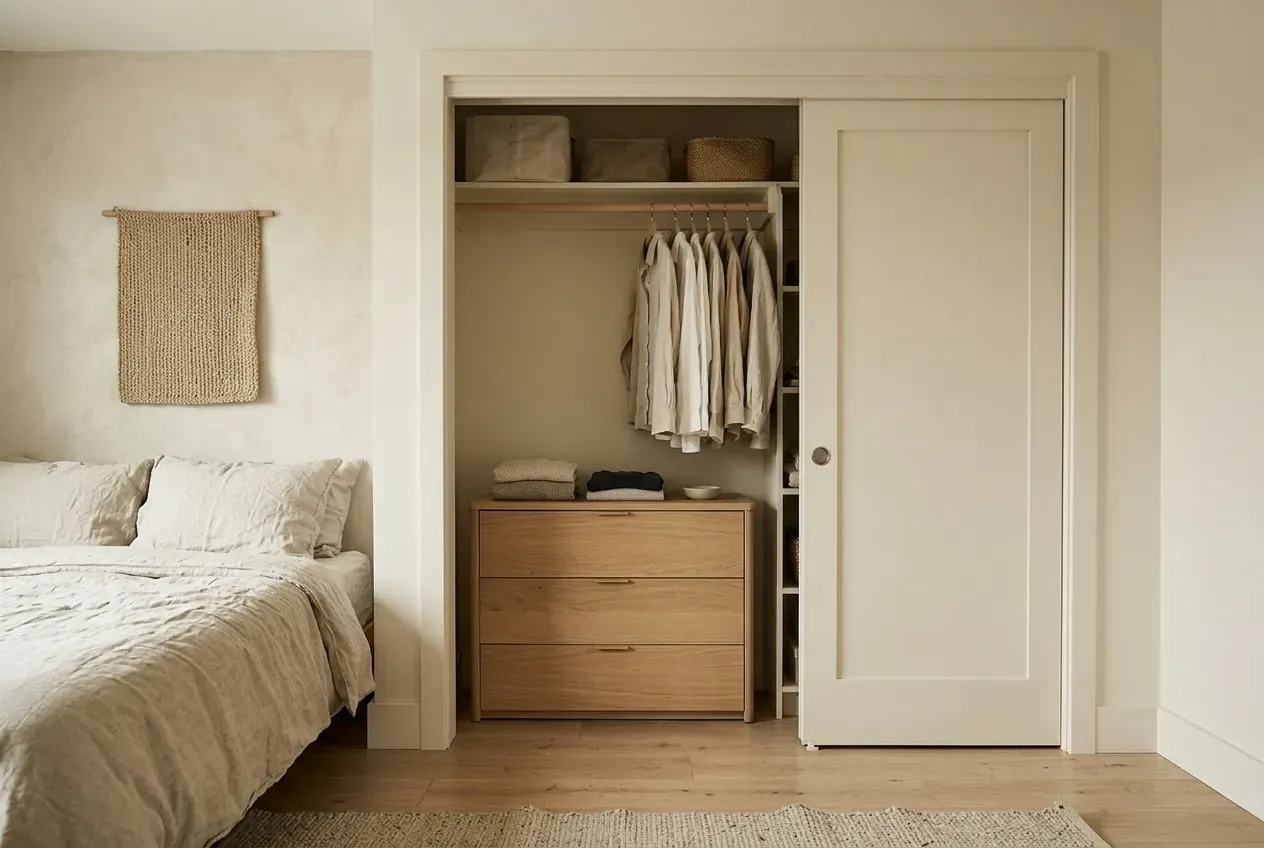 The same room seen from the opposite end, so you can judge the layout from the far side.
The hanging-rod trade
Clothes need drop. A shirt or blazer on a hanger usually needs about 36 to 38 in (91 to 97 cm) from the rod to the hem. If a 34 in tall dresser sits under the rod, you need the rod higher than the standard 66 in, so raise the brackets to about 74 to 76 in (188 to 193 cm), and check you can still reach it.
Do the sum: rod height minus dresser height must be at least 38 to 40 in for full-length hanging. If it is not, hang only short items such as folded or half-length pieces above the dresser, and keep a full-length section on the side without the dresser.
Layouts that work
Low chest under a shortened rod. In a 5 ft closet, a 30 in high, 32 in wide three-drawer chest on one half, and a shortened rod on the other half. You keep full-length coat hanging on one side while shirts hang above the dresser. The top becomes a tray for watches and folded knitwear.
No rod at all. If your wardrobe is mostly folded items such as denim, sweaters and activewear, remove the rod and centre a wider six-drawer dresser against the back wall. Add two 12 in deep floating shelves above, to the ceiling, for boxes and spare bedding.
Door off. In a bedroom where a swinging closet door hits the bedside table, unhinge and store the door, paint the interior in a light colour and treat the closet as a built-in niche. Check your lease for removal rules, and keep the hinges and screws safe for move-out.
For a hanging-heavy wardrobe, see reach-in closet organisation and small closet organizer systems.
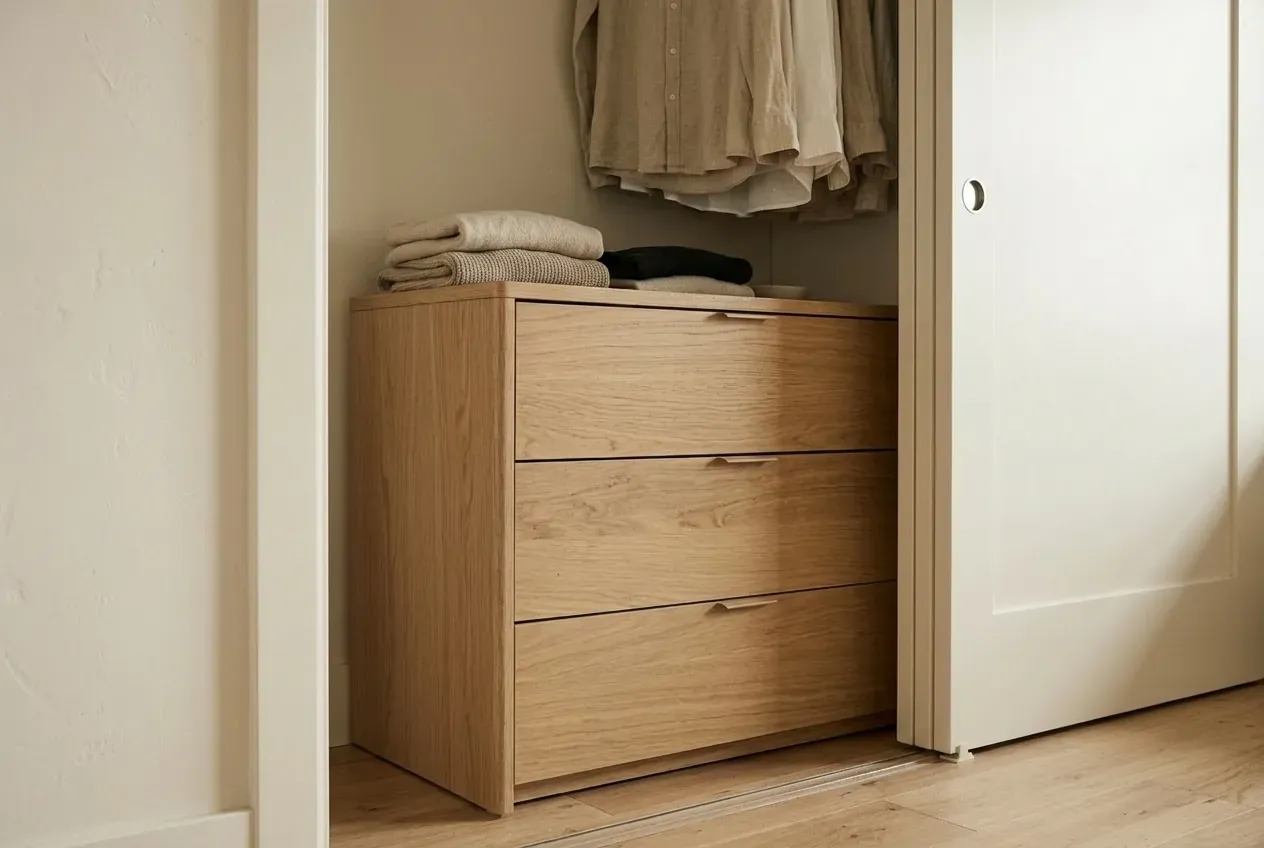 Close up: Keep the dresser 24 in (61 cm) deep or less so the closet door still closes over the drawers.
Safety and finish
- Anti-tip fixing. Anchor the dresser to wall studs with anti-tip straps or brackets. A loaded drawer pulled out can tip a tall case, and a closet is no exception.
- Light colour. A bright interior stops the closet from feeling like a cave. A light wall shell bounces room light into corners, and light wood or pale finishes read well against it.
- Drawer liners. Breathable felt or cotton liners protect garments from raw timber edges.
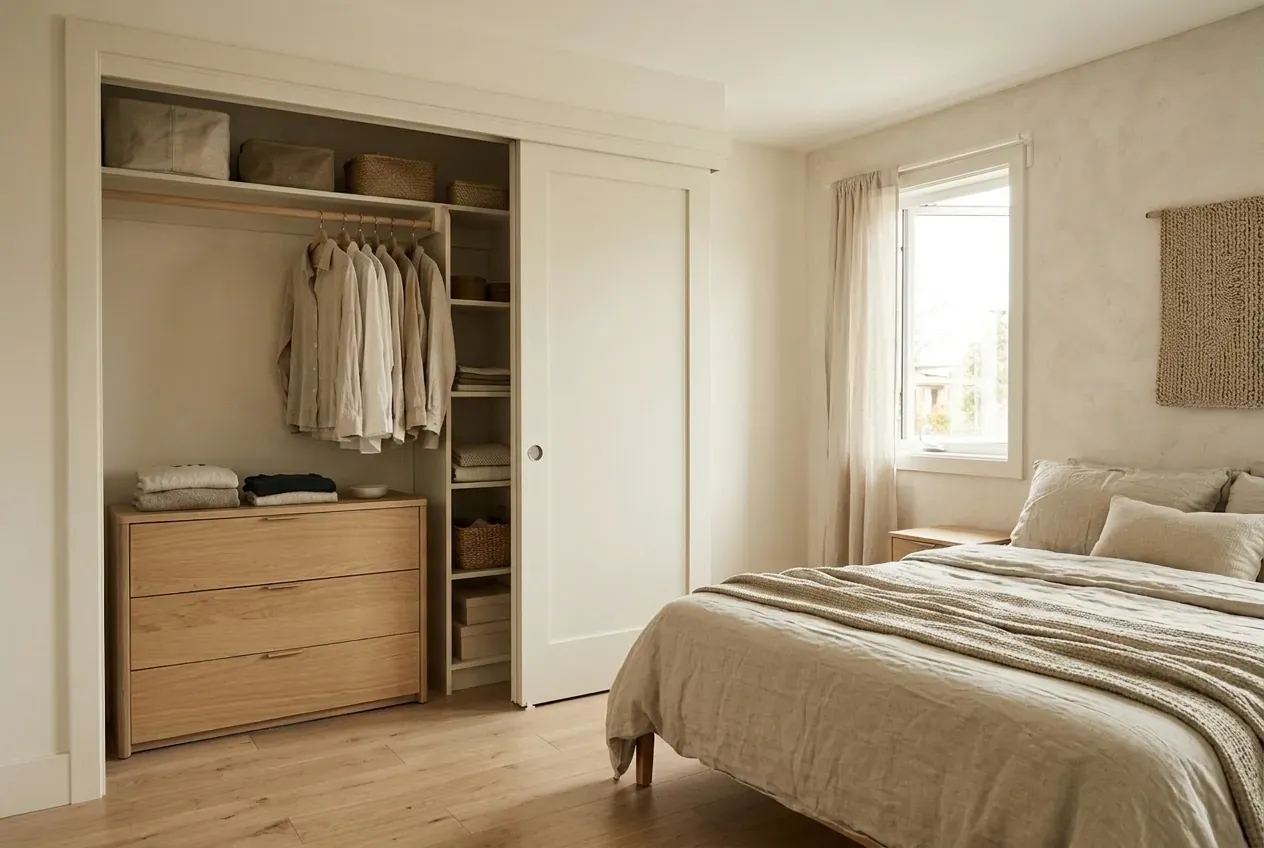 From above and to one side, the full footprint and the walkway read at a glance.
Common mistakes
- Measuring the closet depth at the back wall, not at the door track.
- Forgetting that pulls and drawer fronts stick out beyond the case.
- Leaving too little rod drop, so shirts crumple on top of the dresser.
- Skipping the anti-tip fixing because the dresser is “inside”.
Before you buy
- Measure interior depth, clear opening width and rod height.
- Check the dresser’s total depth including pulls against the door.
- Do the rod-drop arithmetic.
- Decide between shortened rod, no rod or door-off.
- Plan floor space in front for the drawers.
- Buy anti-tip hardware and anchor into studs.
Curated Color Palette & Key Textures
- Alabaster Chalk #F5F2EB
- Oat Linen #D9CDB8
- Light Oak #C9A97C
- Charcoal Ink #2F3135
General references
Dimensions in these guides are typical planning ranges, not legal minimums, and they can differ by jurisdiction. Use the references below as starting points, then confirm local code and your lease before making changes.
FAQ
How deep can a dresser be in a closet?
A dresser must not exceed 20 to 22 inches (51 to 56 cm) in overall depth with drawer hardware included, allowing standard 24-inch closet sliding or bifold doors to close flush.
Can I put a dresser under a closet rod?
Yes, provided the dresser top stands 32 to 34 inches (81 to 86 cm) high or lower, leaving at least 38 to 40 inches of vertical hanging space below the rod for shirts and jackets.
Should I remove my closet door for a dresser?
Removing standard swinging or bifold doors frees up the entire 30-inch entry threshold, turning the closet into an open dressing alcove and accommodating standard 24-inch dressers.
Save this idea

Keep reading
Related rooms
Bunk Bed Dimensions: 5 Sizes, Clearances & Safety Gaps
A twin bunk is 77 x 41 in (196 x 104 cm) and about 62 in tall: all 5 standard sizes, the 5 in guardrail rule, deck spacing and the ceiling check.
Standard Bed Sizes: Queen 60 x 80 in (152 x 203 cm)
Standard bed sizes in inches and cm: a double (full) is 54 x 75 in, a queen 60 x 80, a king 76 x 80, a California king 72 x 84, plus the room each needs.
Rug Size for a King Bed: 8x10 Shows 22 in Each Side
Rug size for a king bed: an 8x10 ft rug shows 22 in (56 cm) each side and 43 in past the foot; a 9x12 shows 34 in. See the maths, a chart and a calculator.