Closet Lighting No Wiring for Small Closets
Closet lighting no wiring for a small closet: rechargeable motion LED bars giving 300 to 500 lumens, mounted 72 in (183 cm) high, no electrician needed.
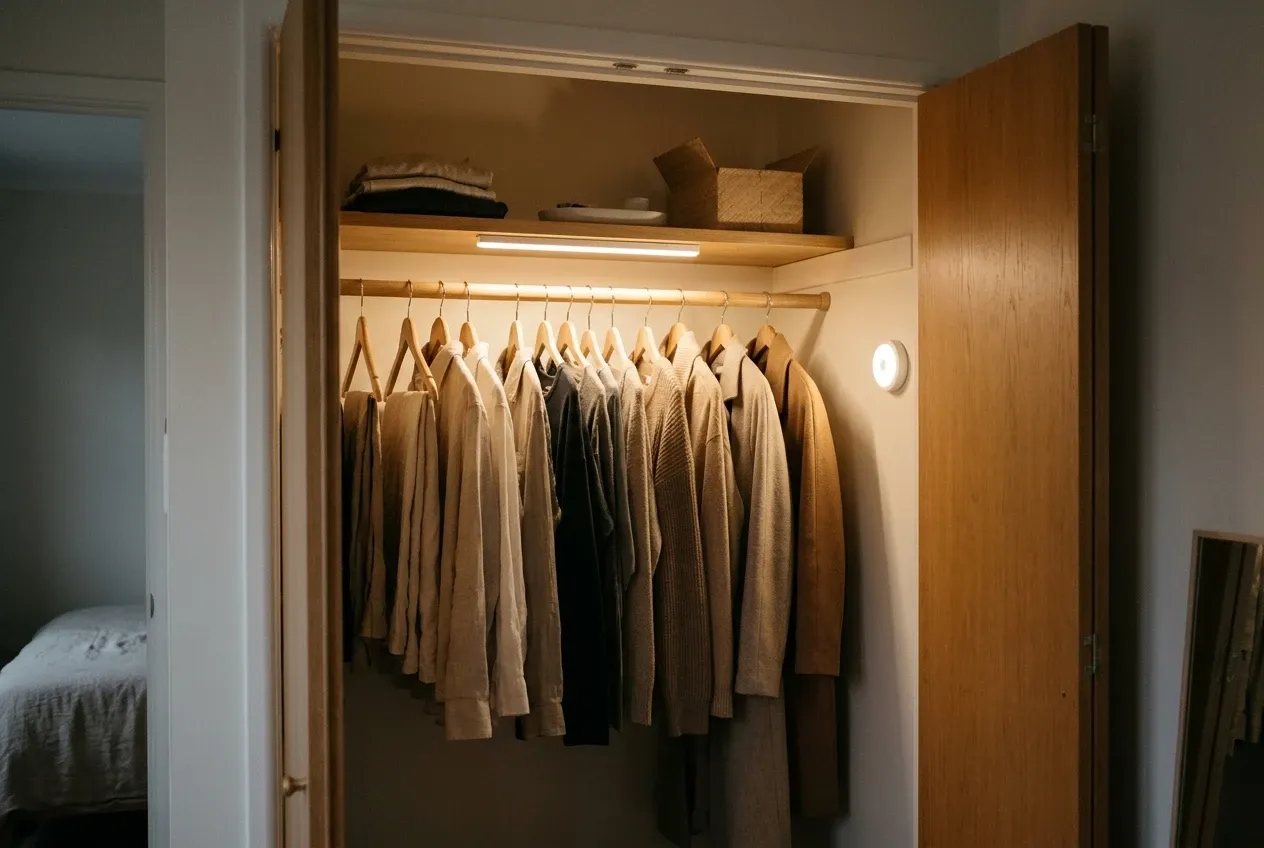
Room specifications
- Room ScaleSmall bedroom closet (about 6 x 2 ft)
- Design StyleWarm Minimalist / Japandi
- Budget TierBudget ($)
- Palette Swatches4 colors
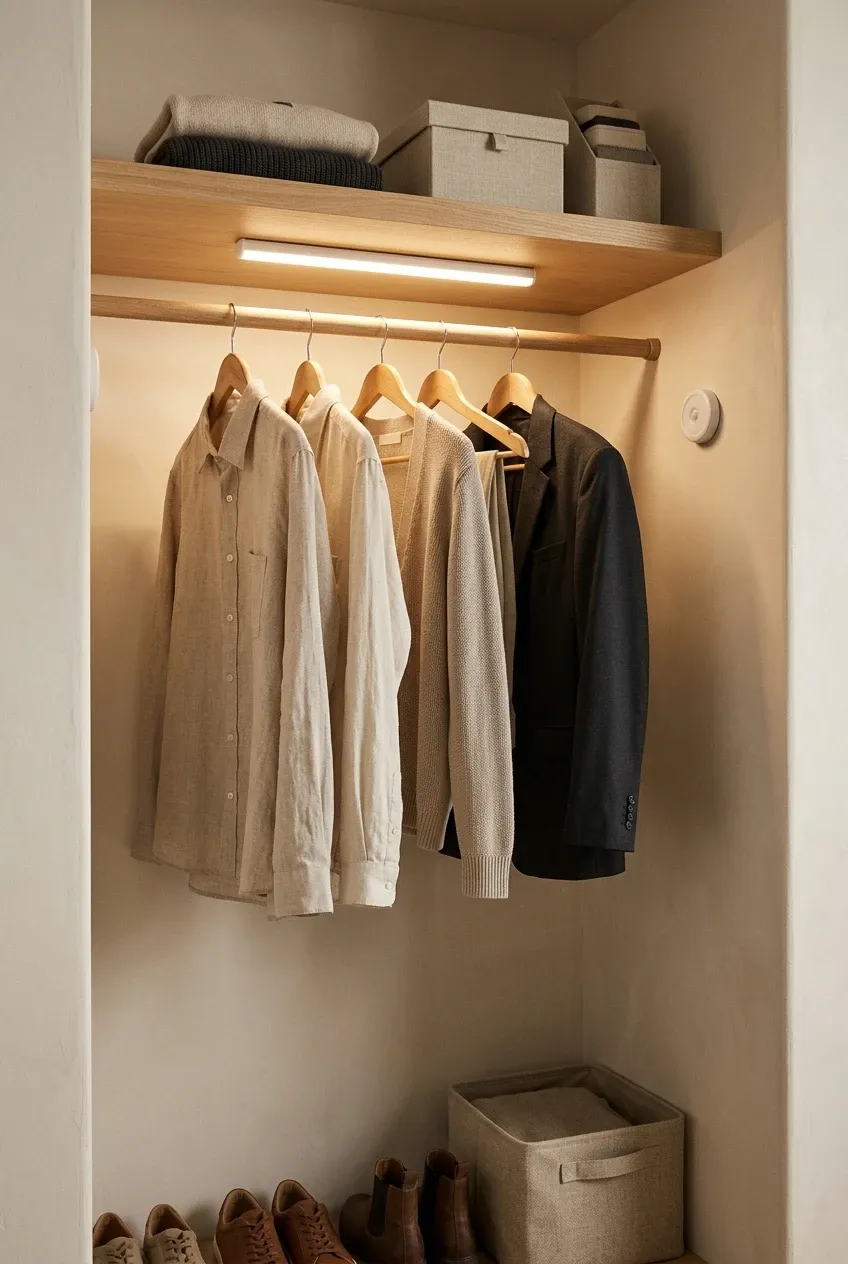
Closet lighting no wiring starts with a rechargeable, motion-sensing LED bar mounted on a magnetic plate 12 in (30 cm) forward of the back wall and about 72 in (183 cm) high. Battery pucks and under-shelf LED strips cover the corners the bar misses. None of them need an electrician or a hole in the wall.
Many rental and older-home reach-ins have no junction box at all, so choosing between navy and black trousers means guessing in dim room light. Hard-wiring a fixture needs a licensed electrician and the landlord’s consent, which most renters cannot get. Battery and USB-C rechargeable lights skip both. For general principles on wireless fixtures, see the wireless sconces guide.
Closet Lighting No Wiring: Choose the Light Type
| Type | Suggested output | Where to mount | Best for |
|---|---|---|---|
| Magnetic LED bar | Roughly 350 to 500 lumens | Door header or ceiling, high and forward | Lighting a whole hanging rail |
| Motion-sensor puck | Roughly 150 to 250 lumens | Side wall, about 60 to 66 in high | Dark corners, shoe racks |
| Battery LED strip | Check the product’s lumens per foot | Under the front lip of a shelf | Folded knitwear and shelf contents |
These are typical product ranges, not requirements; check the lumens on the package. For a 4 to 6 foot closet, a total of a few hundred lumens in a warm white (2700K to 3000K) is usually enough, and a high colour rendering index helps fabrics look true. The Department of Energy guidance in the sources recommends comparing LEDs by lumens, not watts.
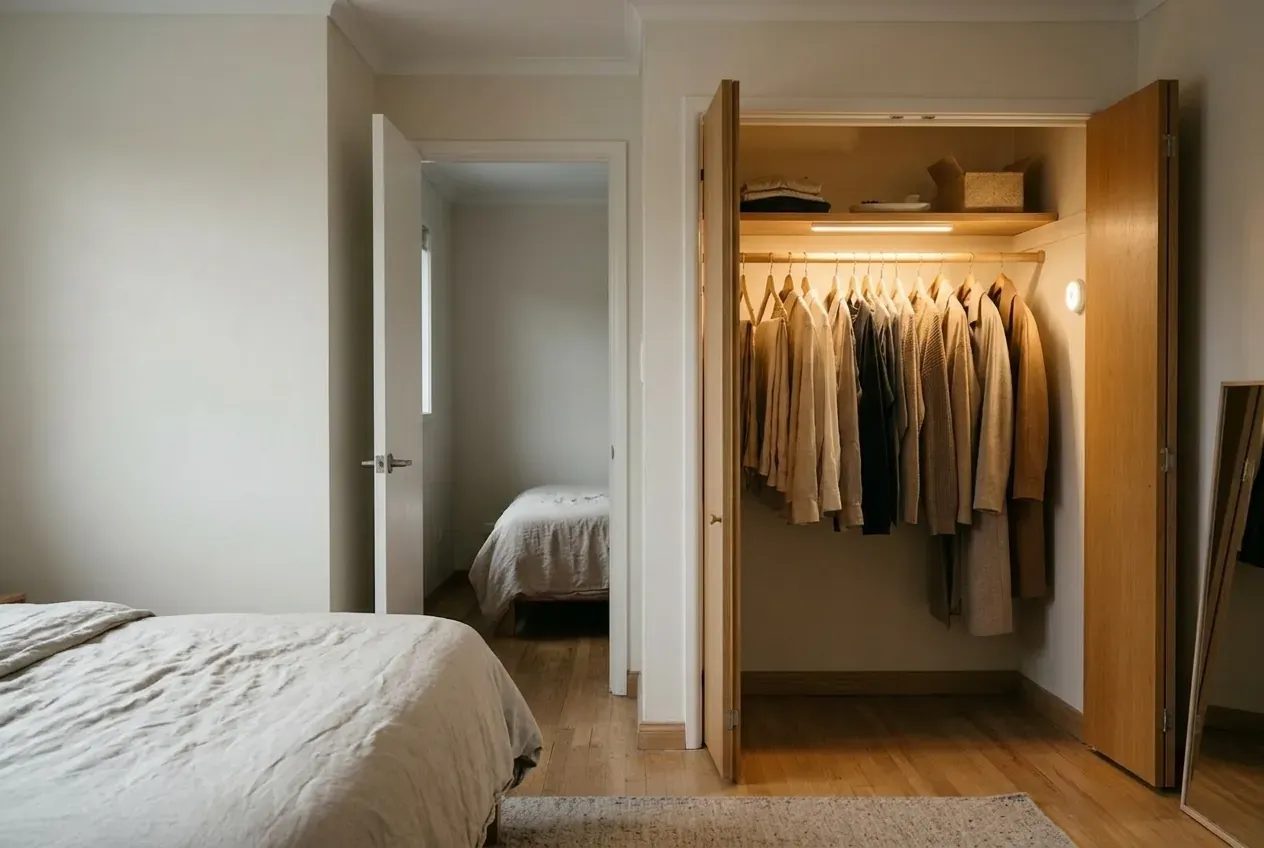 The same room seen from the opposite end, so you can judge the layout from the far side.
Where to put it
The biggest mistake is putting a light on the back wall behind the clothes. Hanging garments then act as a screen and block much of the light. Mount lights forward of the clothes instead:
- on the inside of the door header or the ceiling, 12 in (30 cm) or more forward of the back wall and high enough (around 72 in) to clear the hanging clothes;
- on the underside of the front lip of any upper shelf;
- on the side walls at about 66 in for cross-lighting, which reduces shadows.
If the door frame is solid drywall, the header is the simplest place. Use a magnetic base plate so you can pull the light off to charge and leave the plate in place.
Layouts for different closets
A 5 x 2 ft reach-in with a header. Stick a magnetic plate on the inside top header and mount a slim 16-inch motion-sensor bar aimed diagonally down toward the clothes. Opening the door wakes it, and it detaches for USB-C charging. Check the maker for how often it needs recharging, because it varies with use.
A closet with a deep shelf. Run a battery LED strip along the underside front lip of the shelf so light falls on the knitwear below and the bare LEDs stay out of sight. For layouts of shelves and rails, see closet organizer dimensions.
A bifold door. Where the door track gets in the way of header mounting, put a small motion puck on each side wall at about 66 in so each side lights the other and shadows fade.
If you are reorganizing the closet at the same time, the reach-in closet guide covers zones and habits, and the plug-in sconce guide helps if you want a plug-in fixture in the bedroom instead.
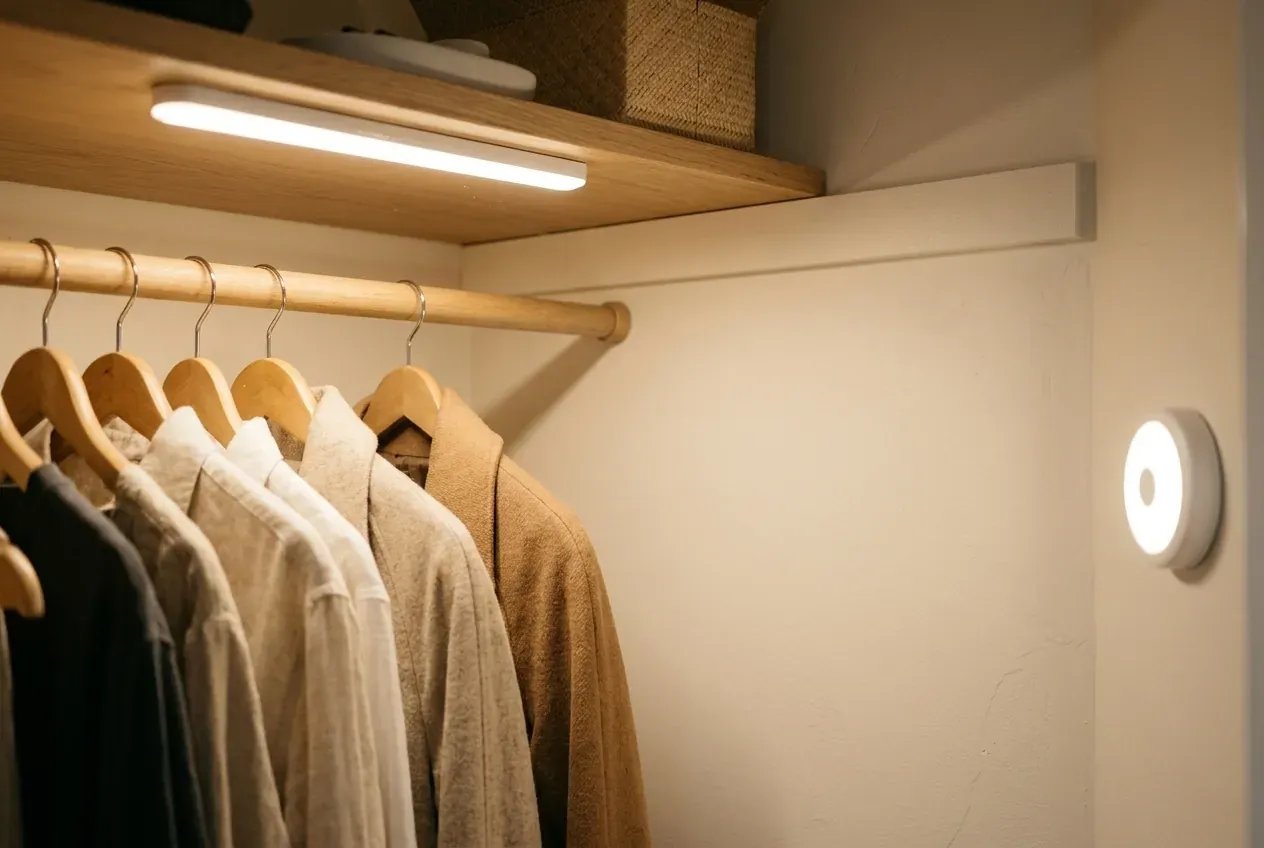 Close up: Mount the light 12 in (30 cm) forward of the closet back wall and 72 in (183 cm) high so it clears hanging clothes.
Mounting so you get the deposit back
- Use a magnetic base plate. The adhesive stays on the wall while the light comes off for charging, so you stress the adhesive only once.
- Clean first. Wipe the surface with isopropyl alcohol so grease and chalky residue do not weaken the bond. Let it dry.
- Do a patch test in a hidden corner before committing, since some paints peel.
- Plan the removal. At move-out, gently warming the adhesive with a hair dryer and peeling slowly, following the adhesive maker’s instructions, usually reduces the chance of tearing paint.
Batteries and settings
Set the motion mode and a short auto-shutoff delay (around 20 seconds is a common choice) so the battery lasts between charges. Point the sensor toward the door opening. Keep batteries and USB cables away from hanging clothes, and charge on a hard surface.
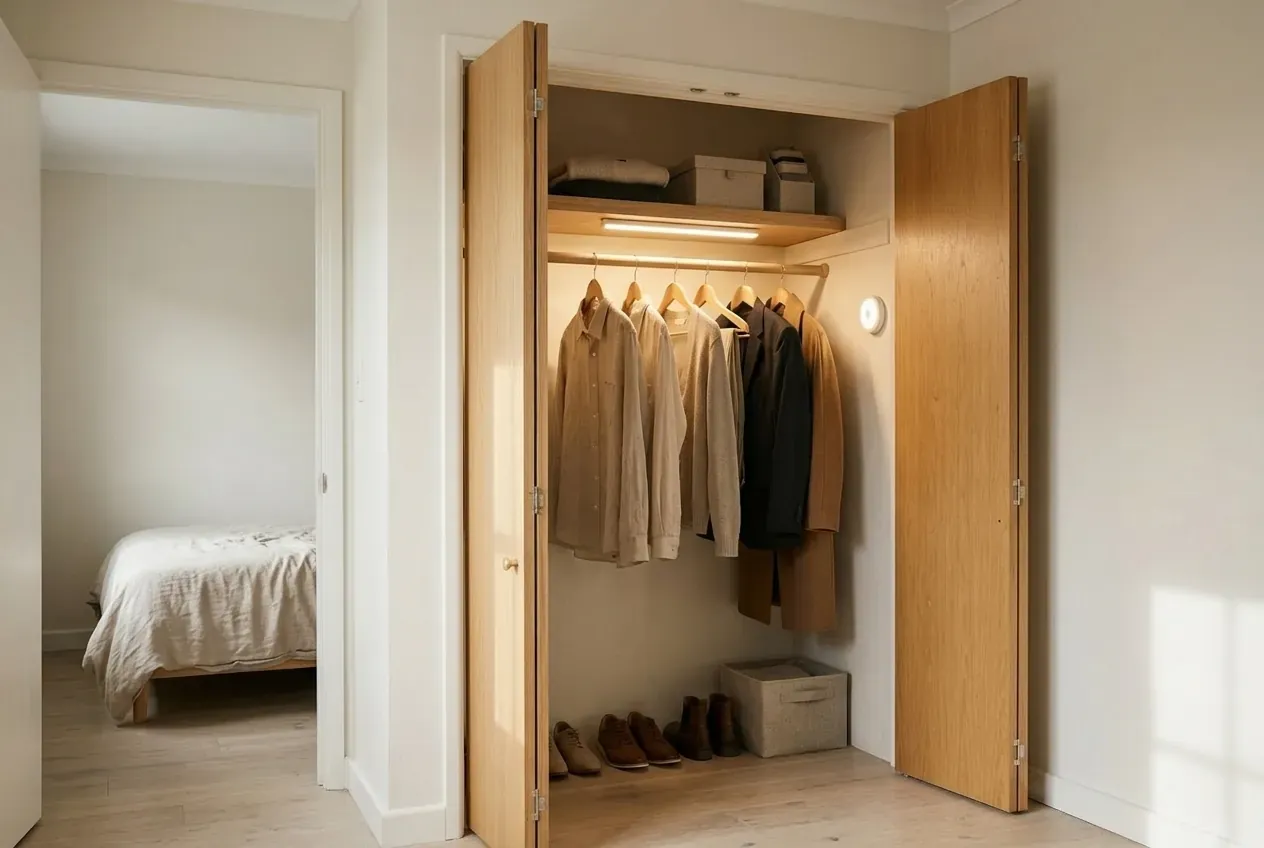 From above and to one side, the full footprint and the walkway read at a glance.
Light colour
Warm 2700K to 3000K light makes wood and linen look natural and flatters skin tones when you dress. Very cool daylight tones can make blacks and navies look closer than they are. A pale wall inside the closet helps bounce light around; see the wall paint guide and warm vs cool colors.
Common mistakes
- Mounting the light against the back wall.
- Skipping the surface cleaning.
- Choosing a very low-lumen puck for a whole rail.
- Aiming the motion sensor at the wall instead of the opening.
Before you buy
- Measure the header, shelf lip and side walls.
- Decide how many lumens you need and what colour temperature.
- Pick one bar for the rail and a puck or strip for the dark corner.
- Buy a light with a magnetic base plate and USB-C charging.
- Test the adhesive on a hidden spot first.
Curated Color Palette & Key Textures
- Alabaster Chalk #F5F2EB
- Oat Linen #D9CDB8
- Light Oak #C9A97C
- Charcoal Ink #2F3135
General references
Dimensions in these guides are typical planning ranges, not legal minimums, and they can differ by jurisdiction. Use the references below as starting points, then confirm local code and your lease before making changes.
FAQ
How do I light a closet with no wiring?
Use magnetic rechargeable USB-C LED light bars or battery-operated motion-sensor pucks mounted with removable adhesive command strips directly onto the door header or under shelves.
What lumens are enough for a closet?
A small 4-to-6 foot reach-in closet requires 300 to 500 lumens of light at a warm 2700K to 3000K color temperature with 90+ CRI so fabric colors appear accurate.
Can I put LED strip lights in a rental closet?
Yes, provided you choose battery-powered or rechargeable LED strips backed by low-tack renter-safe mounting tape that peels away without tearing drywall paper upon move-out.
Save this idea

Keep reading
Related rooms
Bunk Bed Dimensions: 5 Sizes, Clearances & Safety Gaps
A twin bunk is 77 x 41 in (196 x 104 cm) and about 62 in tall: all 5 standard sizes, the 5 in guardrail rule, deck spacing and the ceiling check.
Standard Bed Sizes: Queen 60 x 80 in (152 x 203 cm)
Standard bed sizes in inches and cm: a double (full) is 54 x 75 in, a queen 60 x 80, a king 76 x 80, a California king 72 x 84, plus the room each needs.
Rug Size for a King Bed: 8x10 Shows 22 in Each Side
Rug size for a king bed: an 8x10 ft rug shows 22 in (56 cm) each side and 43 in past the foot; a 9x12 shows 34 in. See the maths, a chart and a calculator.