What Colors Go With Red in a Small Room
What colors go with red in a small room: the green opposite, neutrals and warm pairings, and how much red a 10 x 12 ft room can hold before it shrinks.
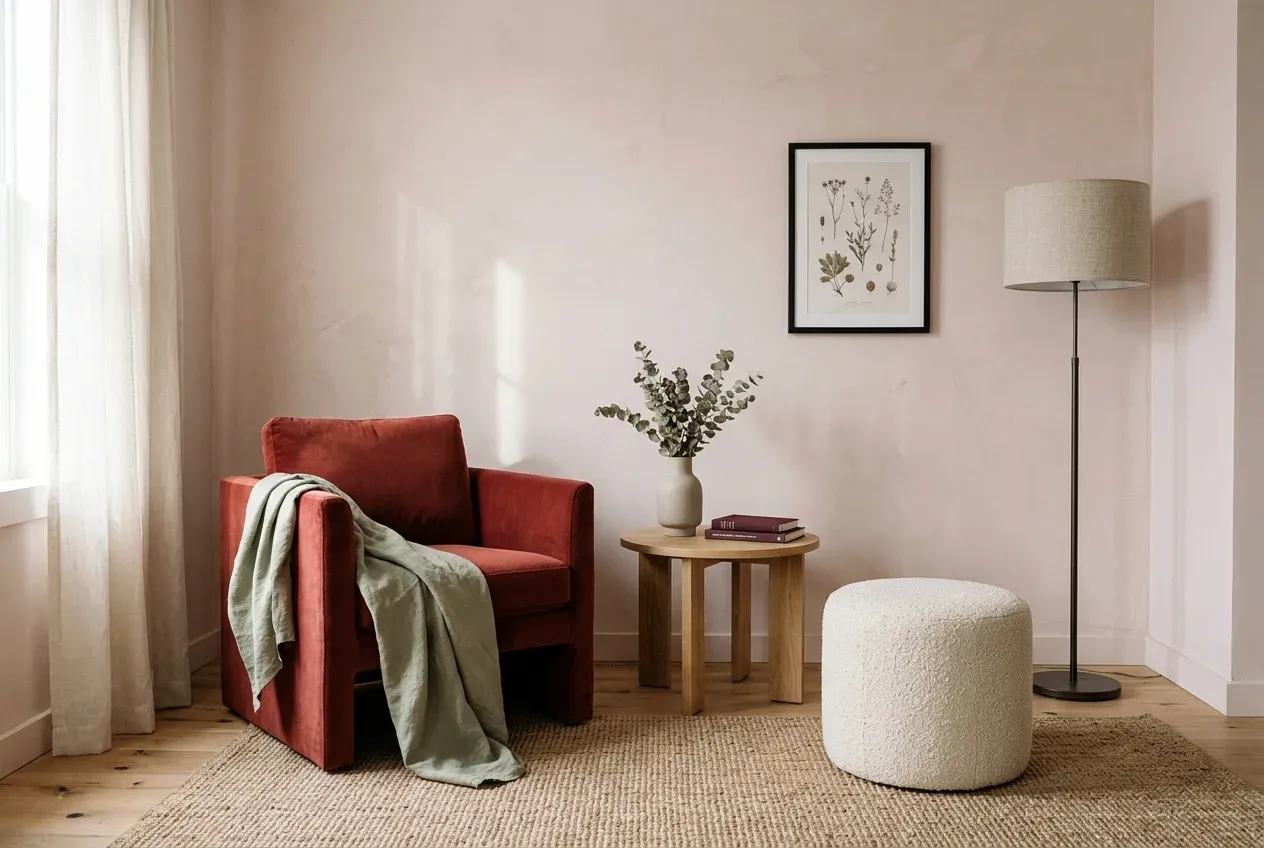
Room specifications
- Room ScaleSmall living room (about 10 x 12 ft) with one red accent wall or sofa
- Design StyleWarm Contemporary Color Study
- Budget TierBudget ($)
- Palette Swatches4 colors
1. Start With the Wheel
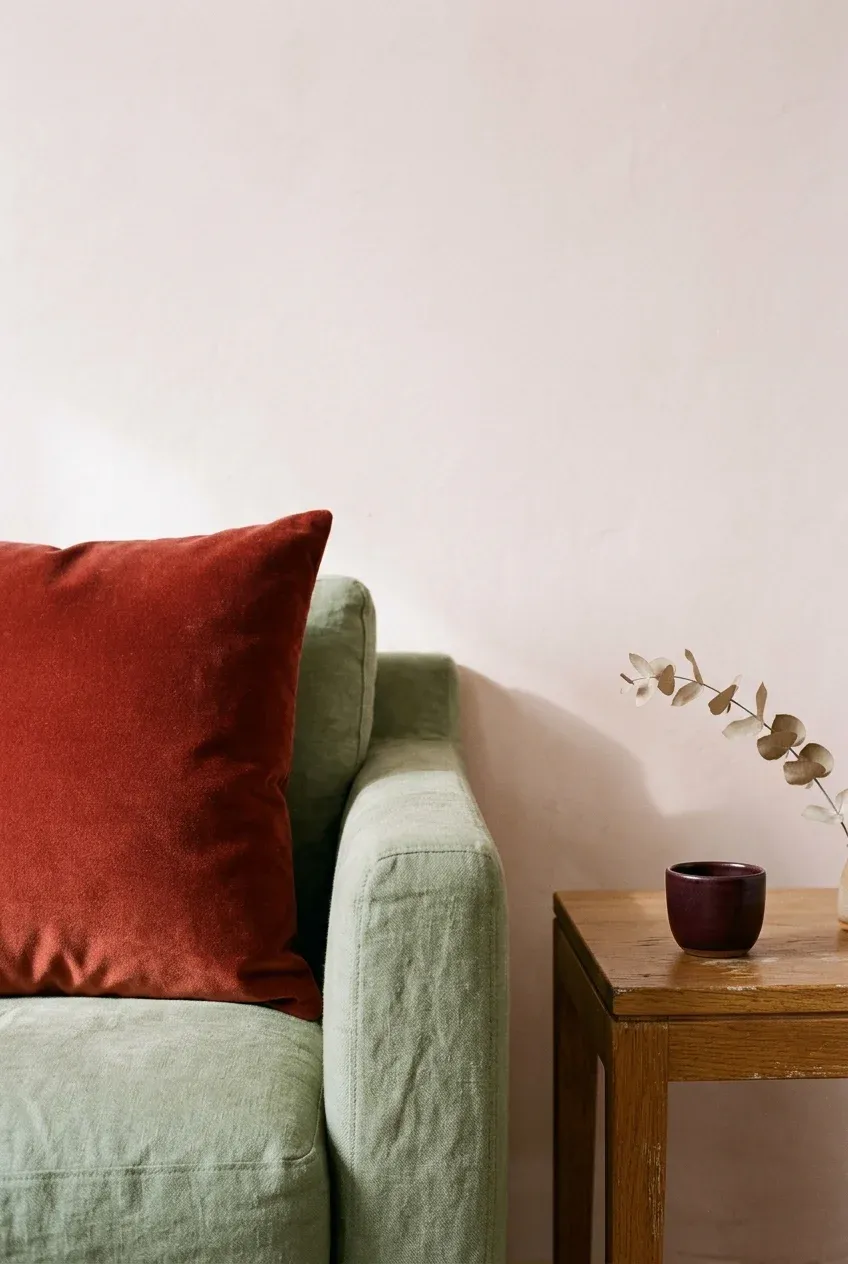
If you are wondering what colors go with red in a small room, start with muted sage green—red’s traditional opposite on the colour wheel—alongside warm cream, oatmeal, and soft charcoal. Pure primary red advances visually toward the eye, which can make a 10 x 12 ft (3.0 x 3.7 m) living room feel narrower if paired with high-contrast brights.
Choosing a desaturated brick red #A8383A or deep cabernet shade #4A1C24 immediately softens that visual push. When you pair it with a dusty sage counterpoint #A9B79A instead of emerald or kelly green, the complementary contrast feels restful rather than festive. For broader undertone theory, see our warm vs. cool room colors guide.
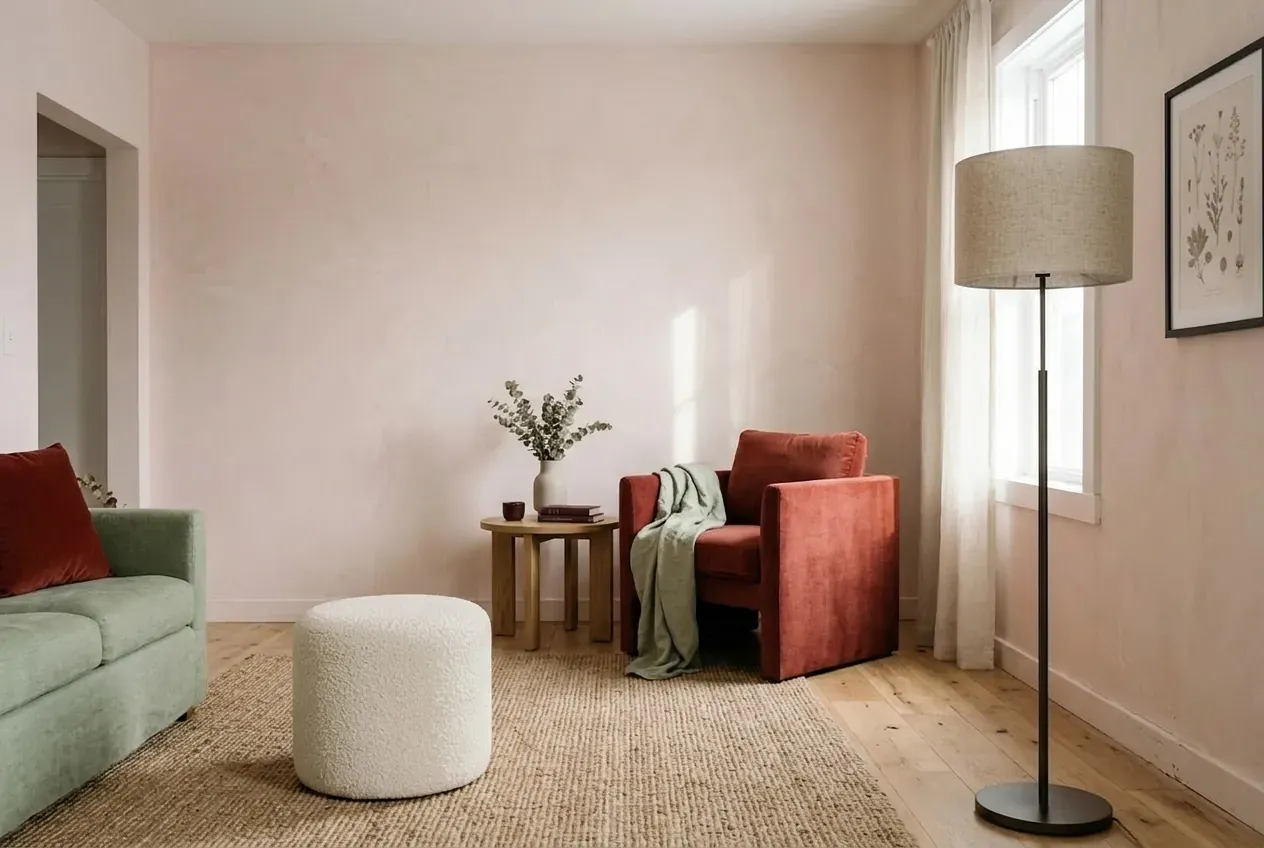 The same room seen from the opposite end, so you can judge the layout from the far side.
2. Neutrals That Calm Red
Neutrals do the heavy lifting in any small room carrying red. Warm off-whites, rose paper #F8EDEB, oatmeal linen, and pale oak floorboards absorb red’s intensity without turning muddy. Soft warm grey and matte charcoal also ground brick or rust tones cleanly.
The one neutral to skip is stark, blue-tinted gallery white. Placing a cold, bright white baseboard or wall directly beside a warm red sofa creates an abrupt, jarring edge that makes the red read louder and the room feel smaller. Keep your neutral base palette warm-undertoned so transitions stay gentle.
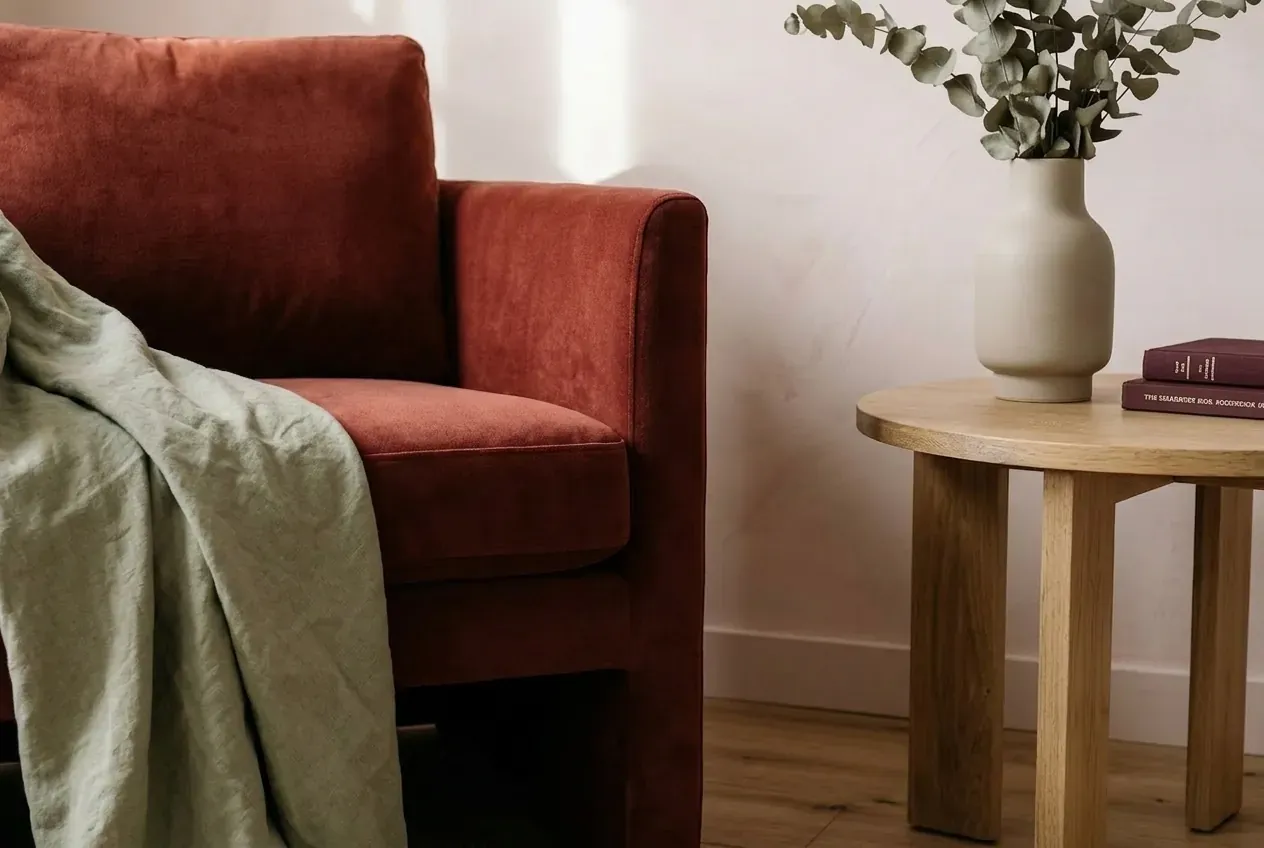 A closer look at the material finishes and the clearances that keep the layout usable.
3. Warm and Bold Pairings
| Pairing Partner | Effect in a 10 x 12 ft (3 x 3.7 m) Room | Best Application |
|---|---|---|
| Sage or Olive Green | Balances warmth; classic opposite contrast | Linen throw, rug border, or foliage |
| Warm Cream & Pale Oak | Opens wall sightlines and softens edges | Walls, curtains, 24 in (61 cm) side tables |
| Dusty Blush or Terracotta | Creates tonal harmony without sharp breaks | Accent pillows or ceramic vessels |
| Deep Navy | High-contrast anchor; can feel heavy if overused | One small rug stripe or framed print |
Avoid combining bright orange, saturated gold, and fire-engine red together in compact quarters—too many high-chroma warm hues compete for attention and crowd the eye. If you already own a warm-toned anchor piece, compare our orange couch living room guide for keeping terracotta tones balanced.
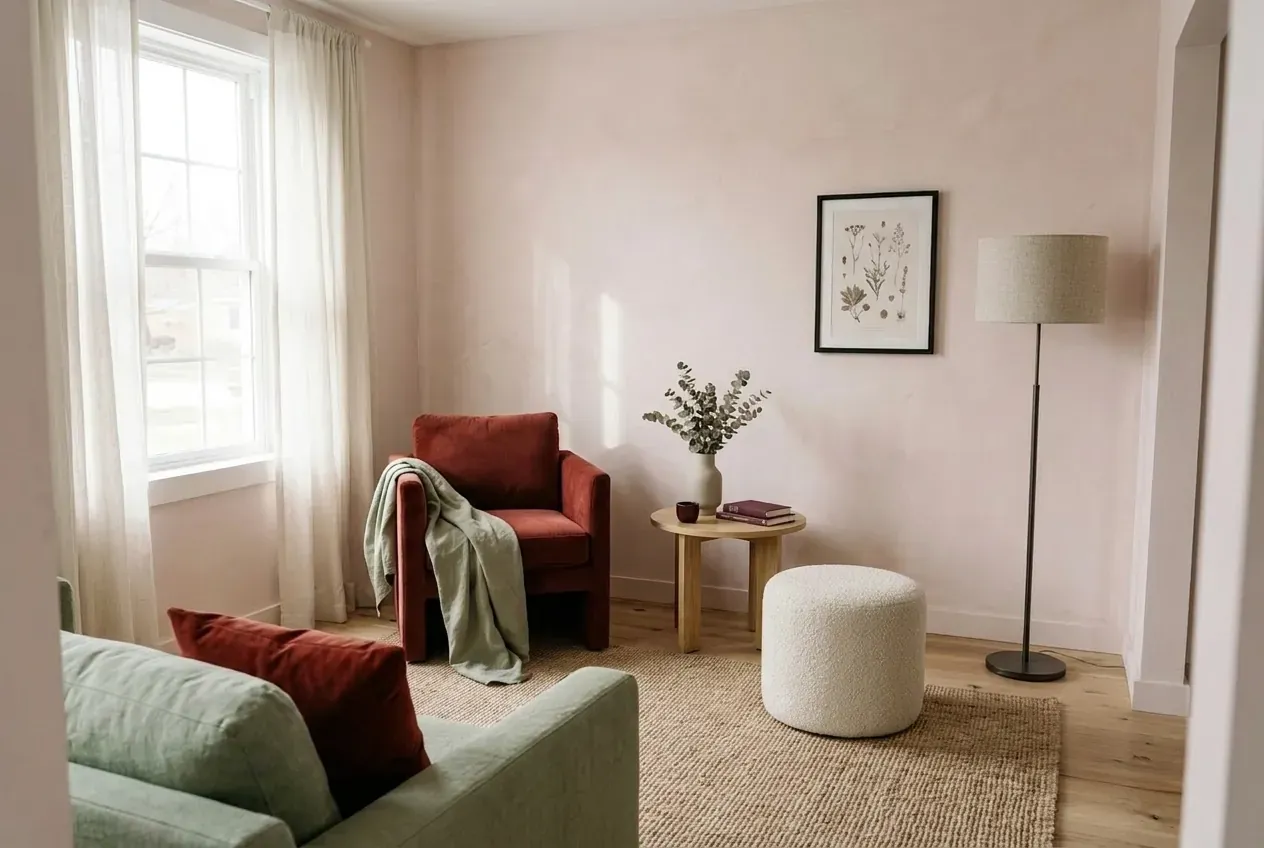 From above and to one side, the full footprint and the walkway read at a glance.
4. How Much Red to Use
A reliable small-space guideline is keeping red to roughly a tenth of the room’s visible surface area. In a 10 x 12 ft (3.0 x 3.7 m) living room, that equals one velvet armchair, one 72 in (183 cm) sofa, or one 4 x 6 ft (1.2 x 1.8 m) accent zone—never red on all four walls.
Concentrate red in a single focal spot rather than scattering matching red cushions, red curtains, and red lampshades into every corner. Finally, tape a fabric or paint swatch beside your window and check it at 10 a.m. daylight and 8 p.m. lamplight before committing, since yellow evening bulbs push brick red warmer while north light cools it toward plum.
Lighting & Texture Balance Around Red
Texture keeps red from feeling flat in a small room. A matte velvet or nubby linen brick-red chair absorbs harsh overhead glare, whereas glossy red lacquer bounces light and feels louder than its actual footprint. Keep metallic accents warm—brushed brass or aged bronze hardware echoes red’s warmth without competing. On walls, rose paper #F8EDEB reflects soft daylight across a 10 x 12 ft (3.0 x 3.7 m) room while letting a single cabernet shade #4A1C24 accent cushion or framed print anchor the seating corner calmly.
If you are nervous about committing to a brick red #A8383A armchair or sofa, test the colour ratio first with removable textiles: drape a cabernet wool throw over a neutral sofa, add two sage counterpoint #A9B79A linen pillows, and live with the pairing for one week across morning daylight and evening lamps. Notice how natural wood tones—especially warm white oak and walnut—act as a bridge between green and red so neither hue feels disconnected. Keeping framed prints in thin black or ebonised wood frames ties the room together cleanly without adding another competing accent colour.
By holding red to roughly a tenth of your visible surfaces and grounding it with warm cream walls and muted sage accents, a 10 x 12 ft (3.0 x 3.7 m) living room stays open and inviting.
Curated Color Palette & Key Textures
- Rose Paper #F8EDEB
- Sage Counterpoint #A9B79A
- Brick Red #A8383A
- Cabernet Shade #4A1C24
General references
Dimensions in these guides are typical planning ranges, not legal minimums, and they can differ by jurisdiction. Use the references below as starting points, then confirm local code and your lease before making changes.
FAQ
What is the opposite color of red?
Green sits opposite red on the traditional colour wheel. In a room, a muted sage or olive pairs with red more calmly than a bright green does.
What neutral colors go with red?
Warm white, cream, soft grey, oatmeal and charcoal all work. Avoid a stark cool white next to a warm red, which can make the red look harsh.
How much red is too much in a small room?
As a guide, keep it to about a tenth of the visible surface and place it in one spot, such as a chair or a single wall, so the room still reads open.
Save this idea

Keep reading
Related rooms
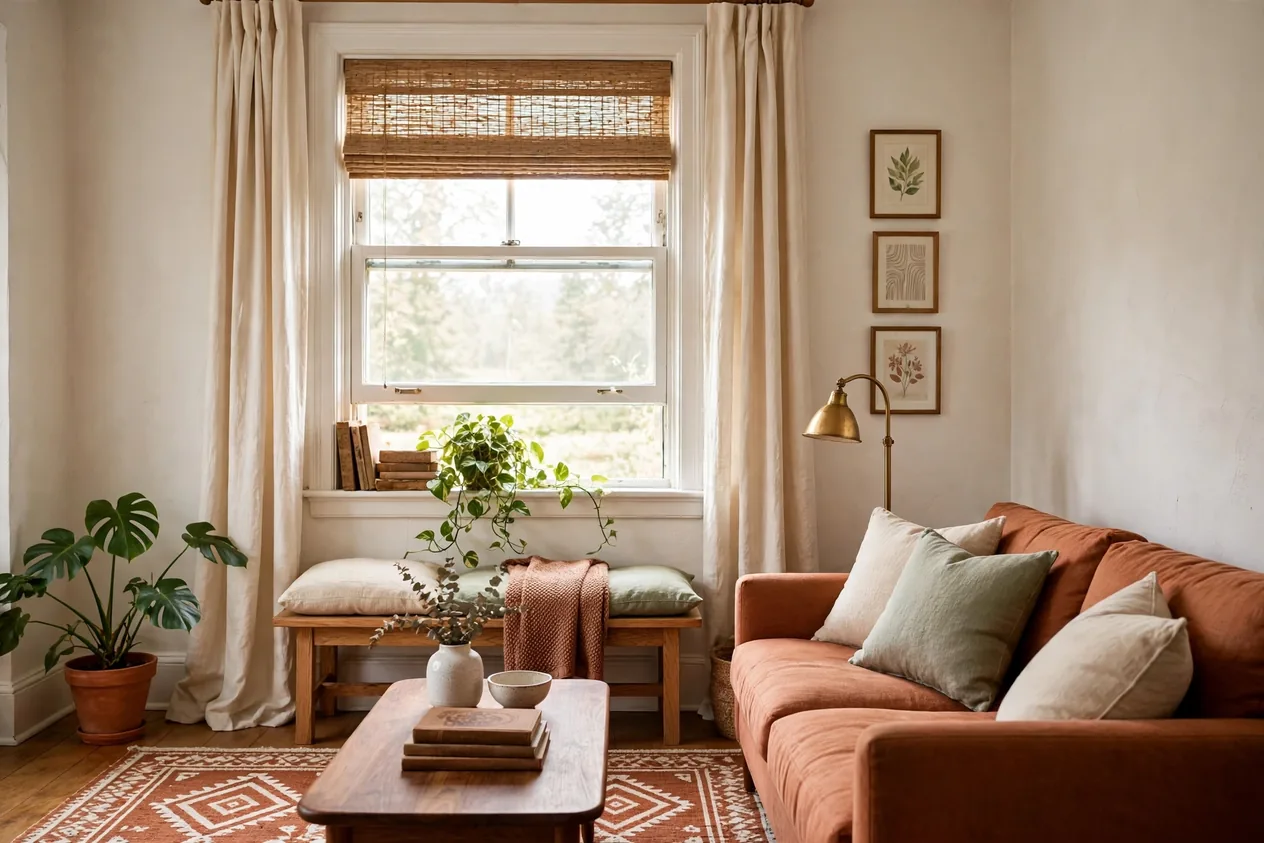
Standard Window Sizes: 24 x 36 to 48 x 72 in Chart
Standard window sizes in inches and cm: most run 24 to 48 in wide by 30 to 72 in high, and a bedroom window needs a 5.7 sq ft clear opening for egress.
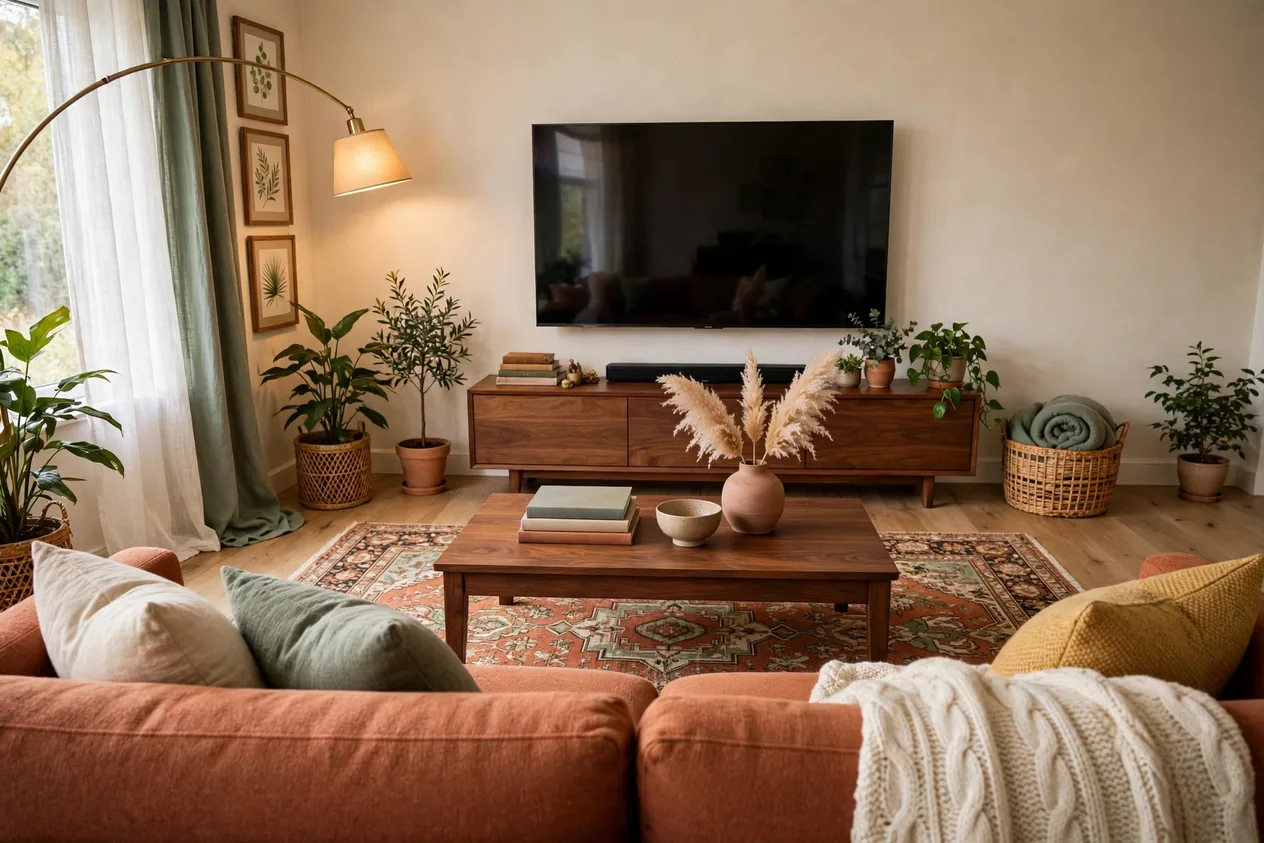
TV Dimensions by Screen Size: 65 in Is 56.7 x 31.9 in
TV dimensions by screen size in inches and cm: a 65 in TV is 56.7 x 31.9 in, a 55 in is 47.9 x 27.0 in, plus the viewing distance and stand width for each.
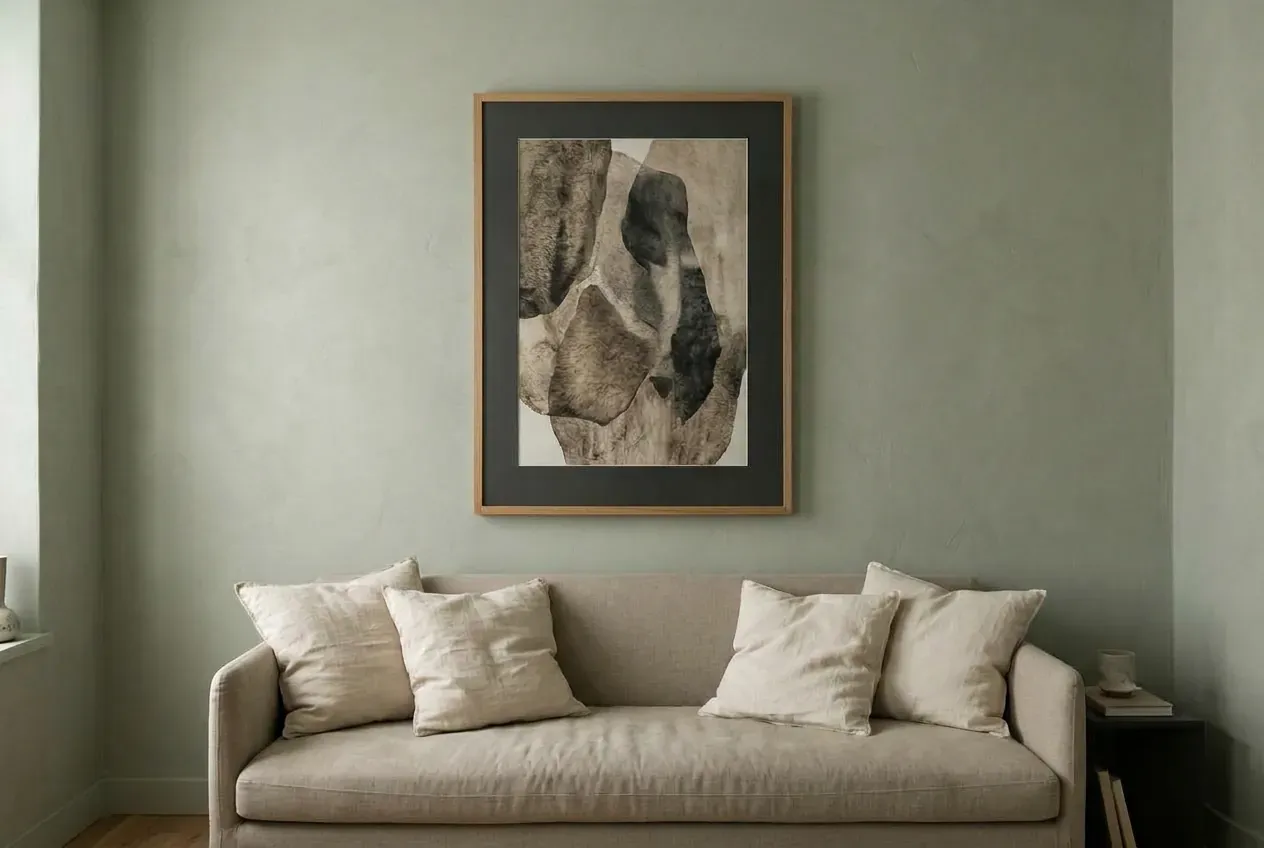
How High to Hang Pictures: 57 in (145 cm) Center
Hang pictures with the center 57 in (145 cm) up, the frame bottom 7 to 10 in (18 to 25 cm) above a sofa, and frames 2 to 3 in (5 to 8 cm) apart.