Modular Sofas for Small Spaces: Layout Guide
Modular sofas for small spaces: a modular sofa for a small space with reversible chaises, armless modules and 30 in clearance rules, under 300 sq ft.
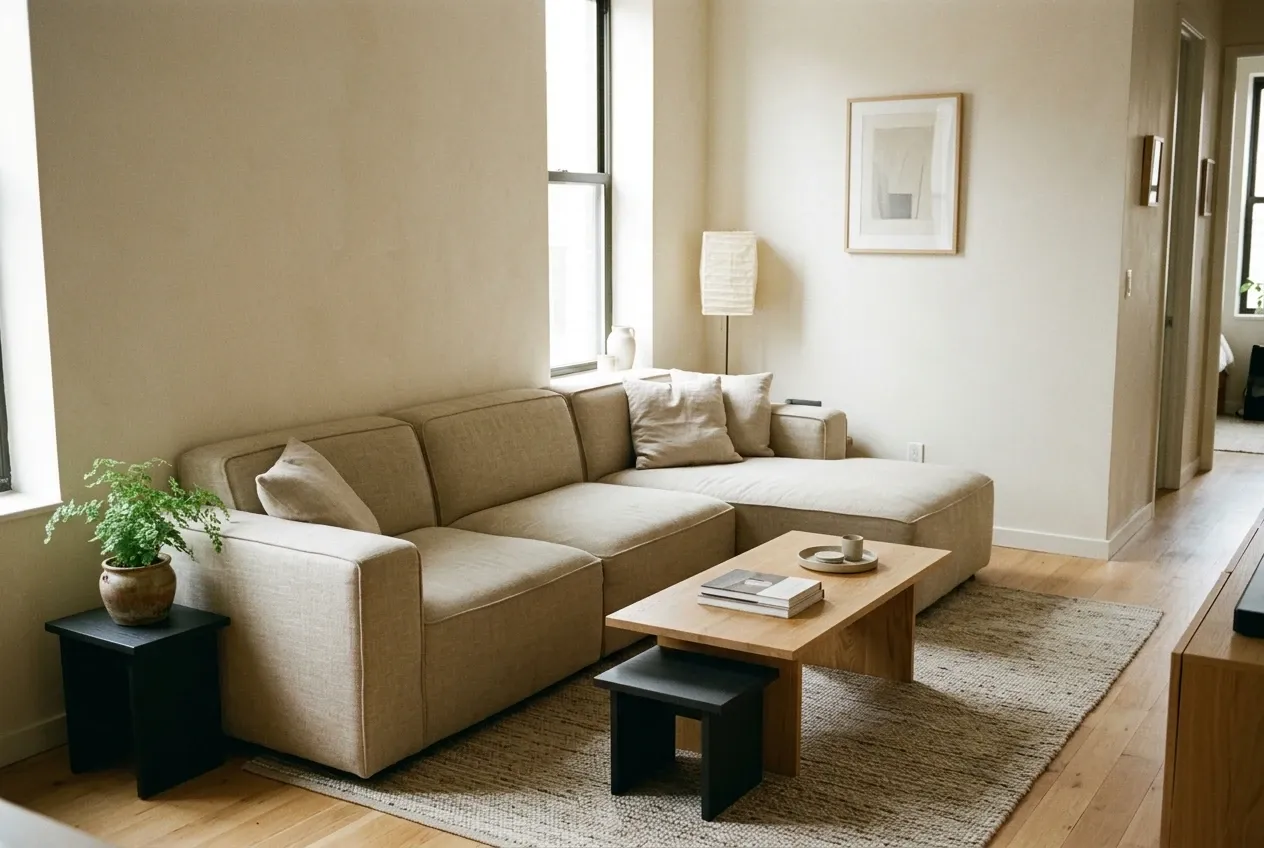
Room specifications
- Room ScaleSmall apartment living room (about 10 x 13 ft)
- Design StyleWarm Minimalist / Japandi
- Budget TierMid-Range ($$)
- Palette Swatches4 colors
Room clearance calculator
Enter the room in feet and a bed size. The leftover on the tighter axis is your walkway. Pass is 30 inches.
You have 40 inches of walkway clearance left. Pass. Minimum 30-inch clearance met.
Top-down mock to scale: the bed sits in a corner, green strips are walkway of 30 in (76 cm) or more, red strips are tighter.
Modular sofas for small spaces work when the module count is set by the walkway, not by the showroom. A modular sofa solves a problem most apartment sofas create: a 90 inch (229 cm) three-seater is a fixed object, and it cannot change when you redecorate or when the room does double duty. The catch is that modules arrive one at a time, and a room that needed three can end up outfitted with five.
This guide treats the modular sofa the way every other measurement on this site is treated: as a footprint problem with a clearance rule attached.
1. The 30 inch rule decides how many modules you own
Everything about a modular layout follows from the walkway you keep.
- 30 in (76 cm) behind the sofa: the minimum for a path between the sofa and whatever is behind it.
- 96 in (244 cm) assembled width: the ceiling for a small living room under 10 ft (305 cm) wide, because 96 plus 30 plus a 30 inch wall leaves a workable room.
- 30 in (76 cm) per armless module: the unit that makes modular sofas work in small rooms. Arms are the expensive part of width; without them three people fit into 90 inches (229 cm).
- 55 in (140 cm) chaise depth: the limit above which the chaise starts eating the walkway.
That gives a practical formula: divide the available wall width by 30, and subtract one module for every corner you want to turn.
| Modules | Assembled width | Best for |
|---|---|---|
| Two | 60 in (152 cm) | Rooms under 100 sq ft |
| Three | 90 in (229 cm) | A 10 x 13 ft living room |
| Four or an L-shape | 120 in (305 cm)+ | Only when a corner is dead space |
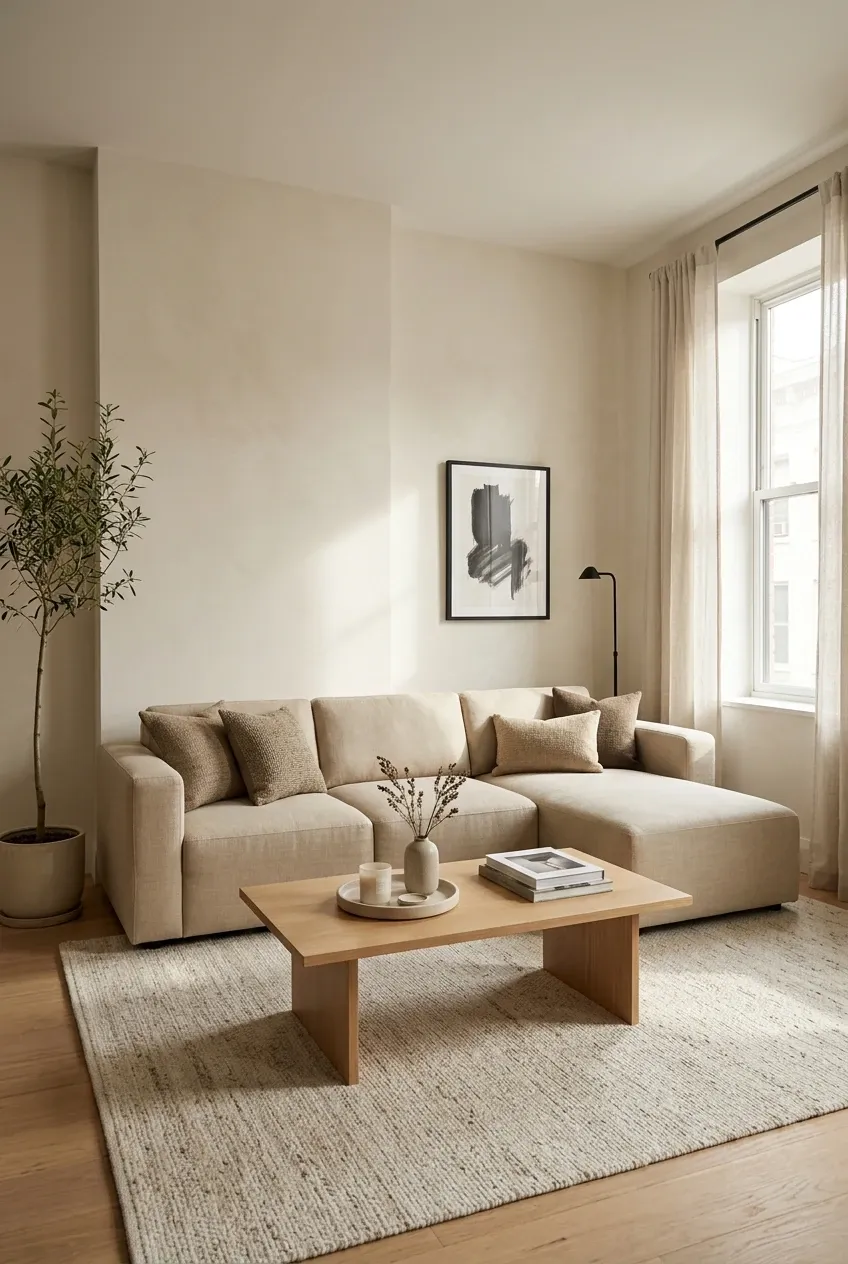
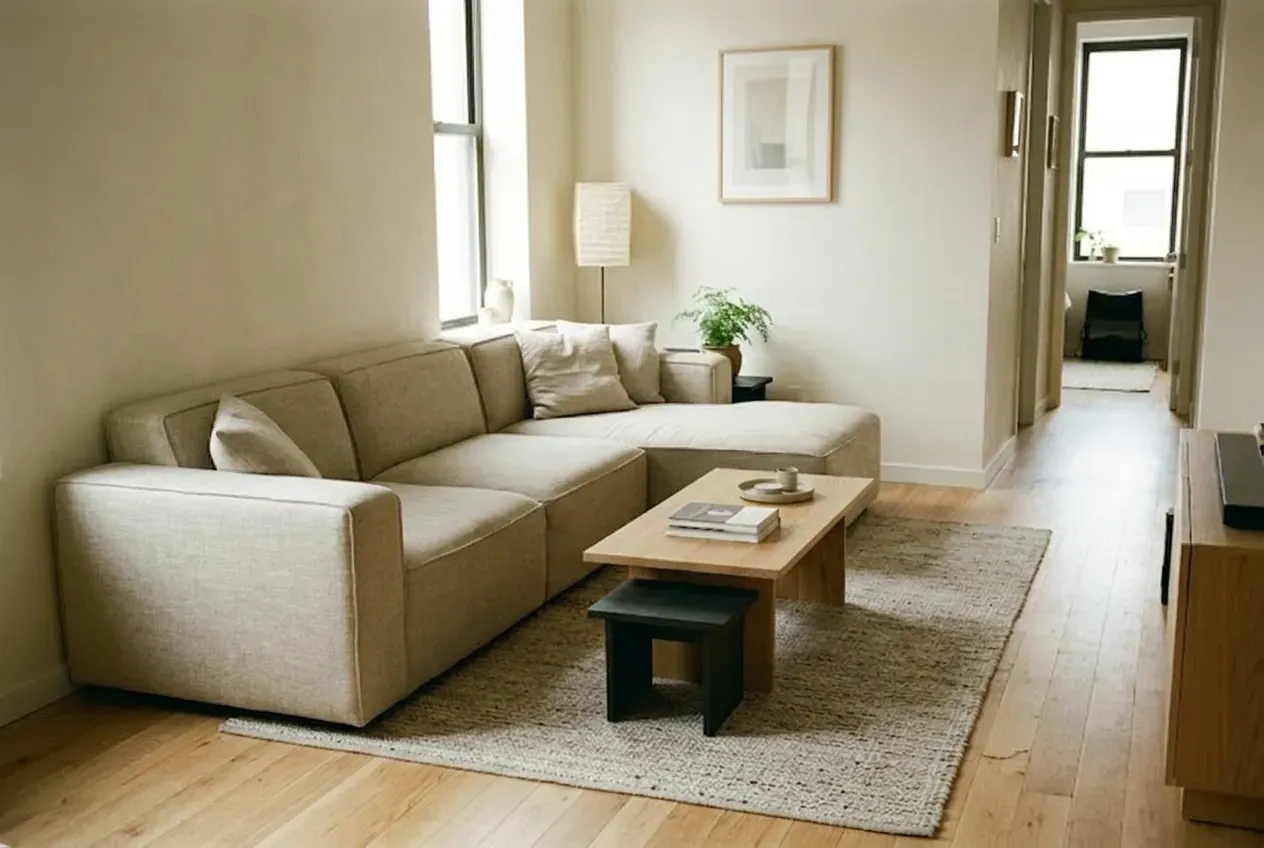 The same room seen from the opposite end, so you can judge the layout from the far side.
2. Count modules against the walkway, not the seat count
Most modular sofas are sold in five- and six-module configurations. In a small apartment you want two or three.
- Two modules (60 in / 152 cm): a loveseat that can still reconfigure into a corner or an ottoman. Best for rooms under 100 square feet.
- Three modules (90 in / 229 cm): a full three-seater. The maximum for a 10 by 13 foot (3.05 x 3.96 m) living room.
- Four modules or an L-shape: only when a corner is genuinely dead, and never when it crosses the main path.
The small sectional sofa layout rules cover the fixed-section equivalent in more depth, and the small loveseat sizing guide is the right comparison when you are choosing between a loveseat and a compact sectional.
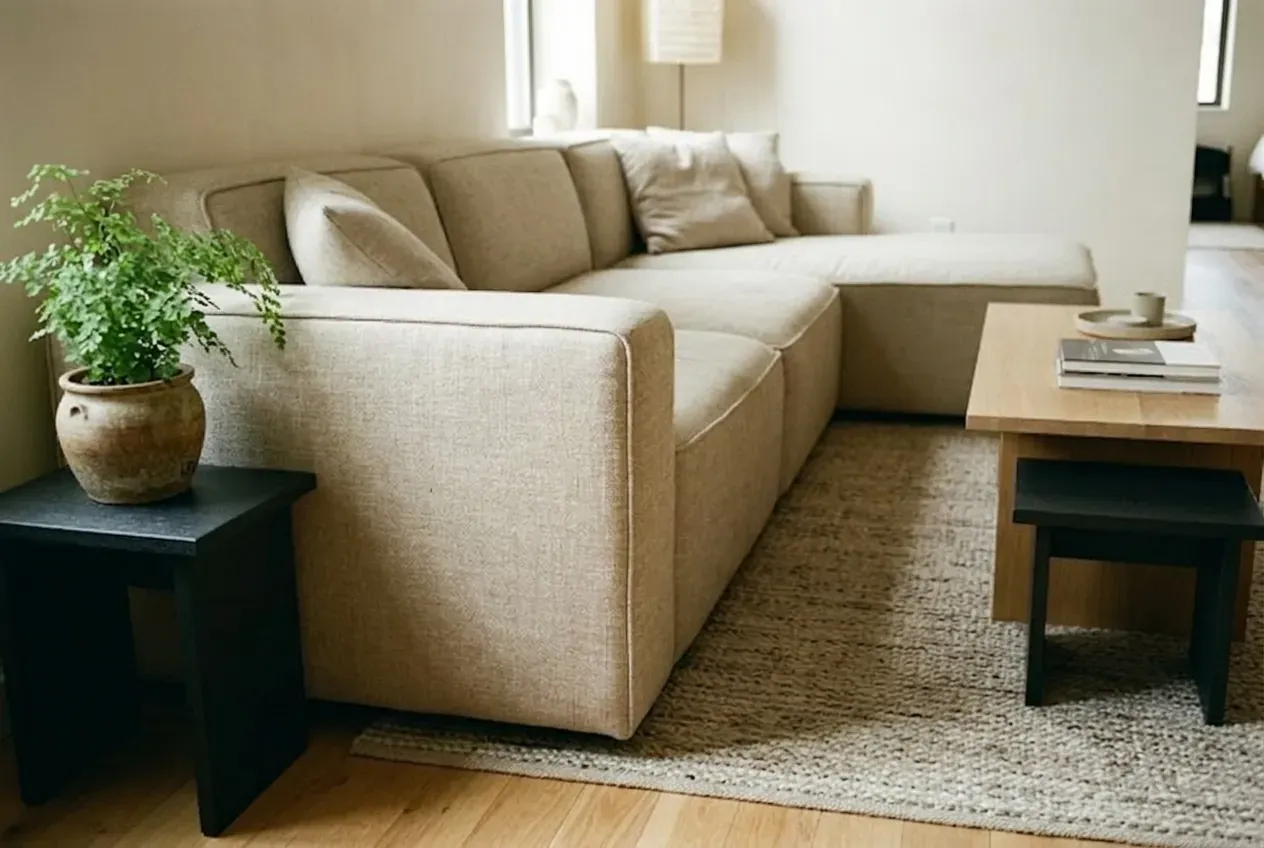 Close up: Keep 30 in (76 cm) between the assembled modules and the opposite wall, and cap the assembled width at 96 in (244 cm).
3. Check the delivery path before you commit
This is the step that separates a good modular purchase from a trip to the hardware store. Modules are delivered one at a time, and each box has to fit through your door.
- Measure the narrowest point: the door opening, the hallway corner, and the stairwell turn. A 34 inch (86 cm) box will not make a 32 inch (81 cm) turn.
- Measure the door swing: the largest single module, not the assembled sofa. If the largest module will not clear the door, the whole configuration fails.
- Note that armless modules are also the smallest boxes, which is another reason to skip the arms.
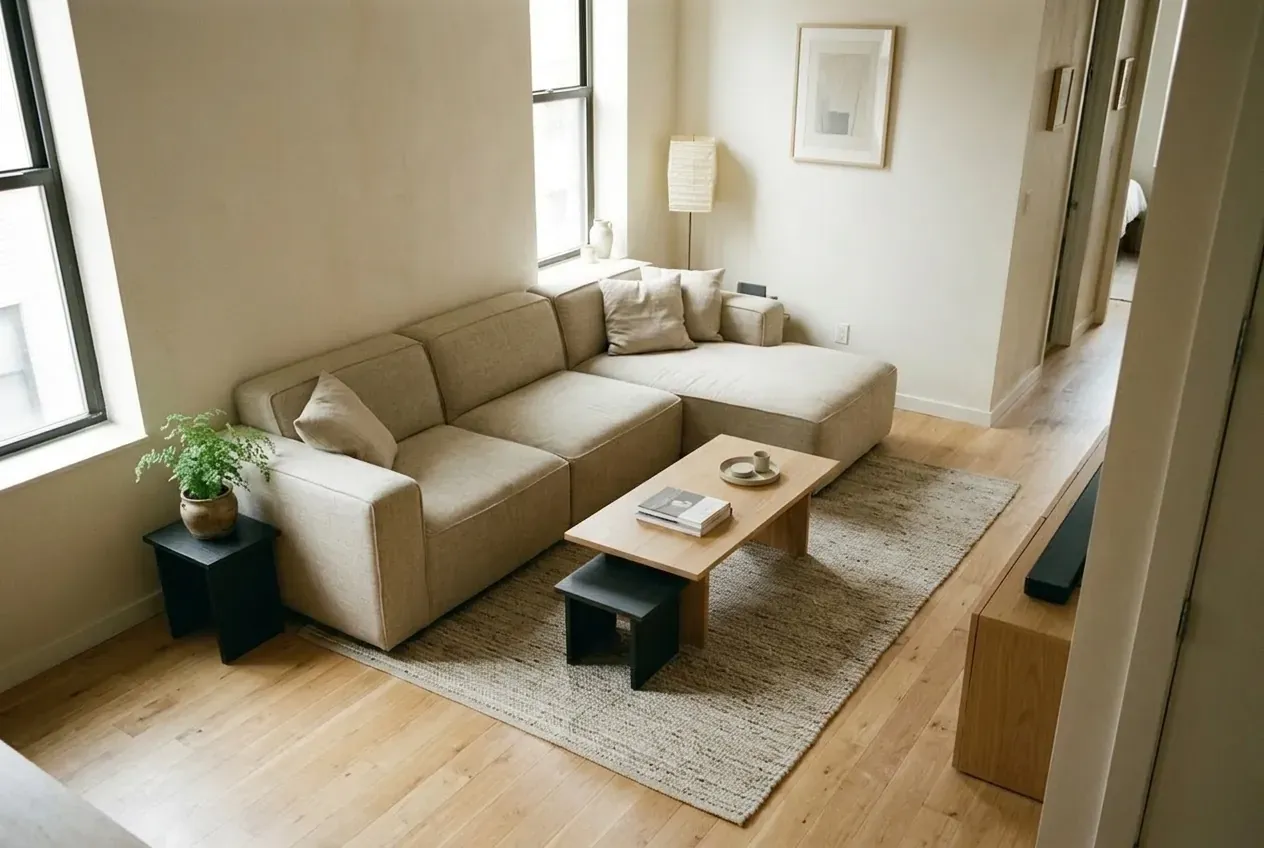 From above and to one side, the full footprint and the walkway read at a glance.
4. Use the reversibility you paid for
A modular sofa earns its price when the same modules serve two floor plans.
- The reversible chaise: one module that flips left or right, so the chaise can face the window in the living configuration and the wall in the working one. Under 55 inches (140 cm) deep, it costs nothing in walkway.
- The corner wedge: the module that turns a straight run into an L. It is the one piece worth adding last, and only if the corner is dead space rather than a path.
- The ottoman module: doubles as a table, a footrest, and extra seating, which is how a three-module sofa covers a four-person evening.
The best sofa sizes for 250 square foot apartments guide compares the modular build against conventional frames, and the small couches for small spaces post covers the lower-cost alternatives if a full modular system is more than the budget allows.
The modular sofa number to hold
Three modules, 30 inch arms-free sections, 96 inches assembled, 30 inches of walkway behind. Buy the configuration that satisfies those four numbers, and a modular sofa will fit an apartment that a fixed sofa could never have occupied.
Curated Color Palette & Key Textures
- Alabaster Chalk #F5F2EB
- Oat Linen #D9CDB8
- Light Oak #C9A97C
- Charcoal Ink #2F3135
General references
Dimensions in these guides are typical planning ranges, not legal minimums, and they can differ by jurisdiction. Use the references below as starting points, then confirm local code and your lease before making changes.
FAQ
Are modular sofas actually good for small spaces?
They are good when you buy fewer modules than the showroom configuration, and bad when you buy the full L and then discover it cannot be reassembled through the door. Check the module width against your door before ordering.
What is the smallest modular sofa that still seats three?
Three armless modules of 30 inches (76 cm) each assemble into 90 inches (229 cm) with no arms, which is narrower than a conventional three-seater of 84 to 96 inches.
Do modular sofas need to be pushed against a wall?
No, which is the point. Modules can float to define a zone in an open plan, as long as you keep 30 inches (76 cm) behind them for the walkway.
Is a reversible chaise worth it in a small apartment?
Yes if the chaise is under 55 inches (140 cm) deep. A reversible chaise lets you switch which side faces the room, which is worth more than any extra cushion in a space that has to work for two different floor plans.
Save this idea

Keep reading
Related rooms
Standard Window Sizes: 24 x 36 to 48 x 72 in Chart
Standard window sizes in inches and cm: most run 24 to 48 in wide by 30 to 72 in high, and a bedroom window needs a 5.7 sq ft clear opening for egress.
TV Dimensions by Screen Size: 65 in Is 56.7 x 31.9 in
TV dimensions by screen size in inches and cm: a 65 in TV is 56.7 x 31.9 in, a 55 in is 47.9 x 27.0 in, plus the viewing distance and stand width for each.
How High to Hang Pictures: 57 in (145 cm) Center
Hang pictures with the center 57 in (145 cm) up, the frame bottom 7 to 10 in (18 to 25 cm) above a sofa, and frames 2 to 3 in (5 to 8 cm) apart.